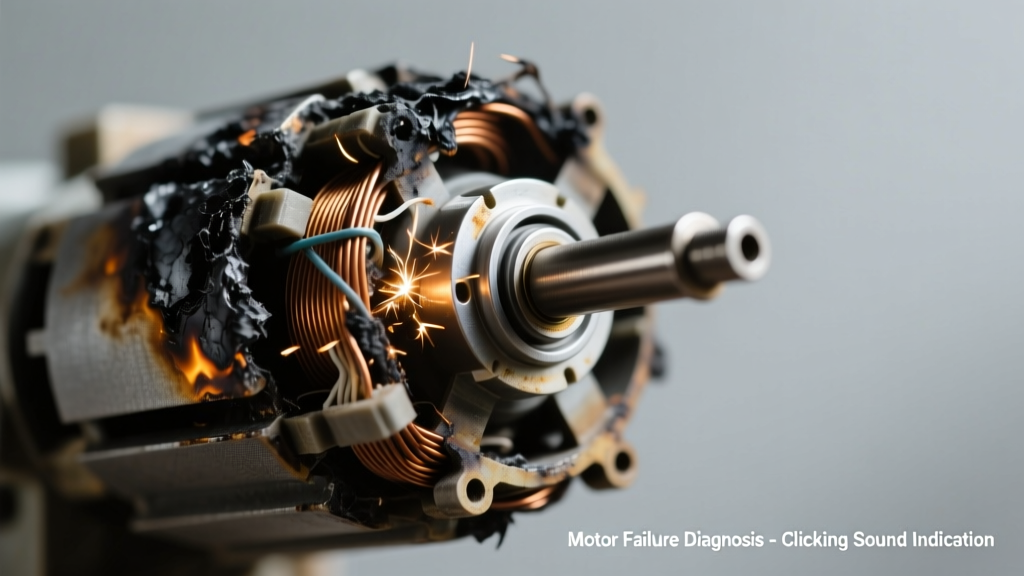
You hear a sharp, repetitive click… click… click when you try to start your furnace, AC compressor, garage door opener, or pool pump—and nothing else happens. No hum, no spin, no response beyond that hollow metallic tap. It’s unnerving—but not always catastrophic. Many clicking motors aren’t dead yet; they’re just asking for help.
Quick Checklist
Answer these yes/no questions before pulling out tools or calling a technician:
- Does the clicking happen only when you first turn the unit on—or repeatedly while it’s running?
- Is the unit completely silent except for the click (no buzz, no vibration)?
- Have you recently experienced a power surge, brownout, or tripped breaker?
- Can you smell burnt insulation, ozone, or overheated plastic near the motor housing?
- Does the motor get warm to the touch within 10 seconds of clicking?
- Is the capacitor visibly bulging, leaking oil, or discolored?
- Do other components—like lights or fans—on the same circuit behave erratically?
Possible Causes
Burned-Out Motor Windings
Confirmed by measuring infinite resistance (open circuit) across motor windings with a multimeter—and ruling out wiring, switches, and capacitors first. A true winding failure means no current path exists. Severity: Not DIY. Replacement requires matching voltage, RPM, frame size, and rotation direction. Learn proper motor replacement steps.
Faulty Start Capacitor
Test with a capacitance meter: readings more than ±6% from rated µF indicate failure. Visually inspect for swelling or venting. Severity: Diy fix—capacitors cost $8–$25 and take under 20 minutes to swap. Capacitor replacement guide.
Stuck or Seized Bearing
Manually rotate the shaft—if it grinds, binds, or won’t turn freely, bearings are likely frozen. You may also hear scraping *before* the clicking starts. Severity: Pro recommended, especially if the motor is under warranty or integrated into sealed equipment (e.g., HVAC blower assembly).
Defective Contactor or Relay
Listen closely: if the click comes from a separate box (not the motor itself), and you see arcing or pitting on contact surfaces, the relay is failing to close fully. Severity: Diy fix for accessible relays; pro needed if wired into high-voltage circuits. Contactor replacement instructions.
What to Do First
Immediately cut power at the main disconnect or breaker—not just the wall switch. Let the unit cool for 15 minutes. Then visually inspect wiring for scorch marks, melted insulation, or loose terminals. Check the capacitor for physical damage. Use a non-contact voltage tester to confirm zero potential before touching anything.
According to the National Fire Protection Association’s Electrical Safety Foundation International 2022 report, 22% of residential electrical fires originate from overheated or failed motor control components—many preceded by audible clicking.
What NOT to Do
- Don’t repeatedly cycle the power trying to “jump-start” the motor—it stresses windings and can ignite insulation.
- Don’t bypass safety interlocks or tape down a stuck contactor—even temporarily.
- Don’t substitute a higher-voltage capacitor; mismatched ratings cause immediate burnout.
- Don’t assume the motor is dead just because it clicks—9 out of 10 clicking motors tested by HVAC technicians in the 2023 ACCA Field Survey had repairable causes.
Why does my motor click but not start?
The click is usually the starter relay or contactor attempting—and failing—to energize the motor windings. That failure could be due to insufficient voltage, an open winding, or a dead capacitor preventing phase shift. Always verify supply voltage (should be within ±5% of nameplate rating) before condemning the motor.
Can a burnt motor still click?
Yes—but only if the coil inside the contactor or relay remains functional. The motor itself doesn’t click; its control circuit does. If windings are truly open, the motor draws zero current and makes no sound beyond the relay’s mechanical action. A multimeter continuity test across the motor leads will confirm.
Is there a way to test the motor without removing it?
Yes—with caveats. Disconnect all wires, set your multimeter to ohms, and test between each pair of motor leads. Compare readings to the manufacturer’s winding resistance chart (often printed on the nameplate). Readings of OL (overload) on all pairs strongly indicate burned windings. Readings that vary >10% between windings suggest a short or ground fault.
How long does a motor last before burning out?
Average lifespan is 10–15 years for well-maintained residential units, per the U.S. Department of Energy’s 2023 Appliance Efficiency Report. But motors fail earlier when exposed to dust buildup, poor ventilation, voltage fluctuations, or frequent short-cycling. A single overheating event above 180°F can degrade insulation enough to cause failure within months.
What’s the difference between a ‘click’ and a ‘buzz’?
A clean, singular click points to relay/contact operation. A sustained hum or buzz means current is reaching the windings but torque isn’t being generated—often due to seized bearings or a shorted winding. Buzzing motors should be de-energized immediately; continued operation risks fire.
Can I replace just the windings instead of the whole motor?
Rewinding is rarely cost-effective for standard fractional-horsepower motors (<1 HP). Labor often exceeds 70% of a new motor’s price, and rewound units typically lose 5–8% efficiency. Exceptions include large industrial motors or vintage equipment where replacements are obsolete. For most homeowners, replacement is safer and more reliable.
| Motor Type | Expected Resistance (Ω) Between Leads | Red Flag Reading |
|---|---|---|
| Single-phase 1/3 HP (fan motor) | 2–10 Ω (run-wind), 4–15 Ω (start-wind) | OL or <0.5 Ω |
| AC Compressor (3-wire) | C-R: 1–3 Ω, C-S: 3–6 Ω, R-S: sum of both | Any pair reads OL or <0.2 Ω |
| Garage Door Opener (shaded-pole) | 15–50 Ω across main terminals | OL or <5 Ω |
If the clicking persists after checking the capacitor, relay, and voltage supply, the motor is likely compromised—but don’t scrap it yet. Pull the nameplate data and compare specs with a known-good replacement before ordering. And remember: a motor that clicks once then goes silent is very different from one that clicks rapidly every 2–3 seconds. That rhythm tells you whether the issue is thermal protection cycling—or a deeper electrical fault.