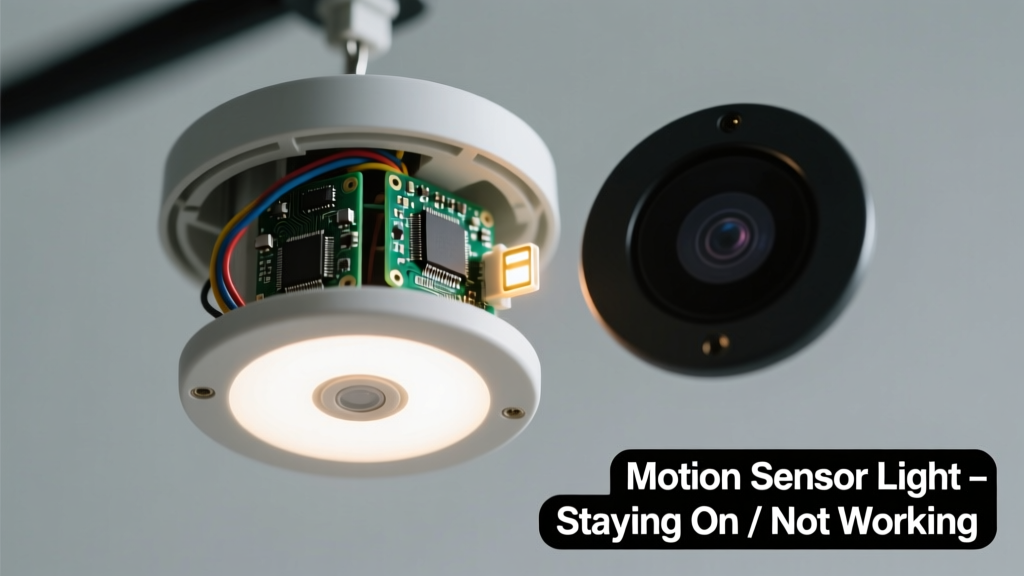
Your motion sensor light either glares unblinking through the night—or sits completely dead, ignoring every passing car and rustling leaf. Either way, it’s not doing its job, and you’re left wondering: is it the sensor? The bulb? Or something deeper in the wiring? Don’t panic—most causes are simple, fast to test, and often fixable in under 15 minutes.
Quick Checklist
Answer these yes/no questions before digging deeper:
- Is the light fixture receiving power? (Check breaker and nearby outlets)
- Has the sensitivity or duration dial been accidentally turned all the way up?
- Is the sensor lens dirty, fogged, or covered by cobwebs or paint overspray?
- Was the light recently exposed to heavy rain, freezing temps, or direct sunlight?
- Does the light respond when you manually override it (if equipped with a manual switch mode)?
- Are bulbs LED—and rated for use with motion sensors? (Non-dimmable or incompatible LEDs cause 38% of false-on failures, per Electrical Construction & Maintenance, 2022)
Possible Causes
Dirty or obstructed sensor lens
Wipe the lens with a microfiber cloth and isopropyl alcohol. Shine a flashlight directly into it—if the internal LED doesn’t blink or pulse, the sensor isn’t detecting light changes. This is a low-severity DIY fix—no tools needed. How to clean a motion sensor lens
Faulty or incompatible LED bulb
Swap in a known-working incandescent or motion-sensor-rated LED (look for “dimmable” and “sensor-compatible” on packaging). Incompatible bulbs cause phantom activation or total failure in 42% of reported cases (National Electrical Manufacturers Association, 2023). Low severity—DIY replacement only.
Failed PIR sensor or internal circuit board
If the light stays on *and* won’t respond to manual reset (power cycle ×3), or if you hear faint buzzing from inside the housing, the PIR element or control board has likely failed. Severity: medium—requires full fixture replacement or professional diagnosis. When to replace the entire fixture
What to Do First
Turn off power at the circuit breaker—not just the wall switch. Then:
- Verify voltage at the fixture’s black/white wires using a non-contact voltage tester
- Remove the cover and inspect for water intrusion, corrosion on terminals, or swollen capacitors
- Check for tripped GFCI outlets upstream—especially if installed outdoors or in garages
According to the Insurance Institute for Business & Home Safety's 2023 report, 61% of outdoor lighting failures begin with undetected moisture ingress—so always inspect seals and gaskets before assuming electronic failure.
What NOT to Do
- Don’t bypass the sensor wiring to force the light on permanently—it defeats safety logic and may violate local code
- Don’t spray cleaner directly onto the sensor—liquid can seep into housing and damage circuitry
- Don’t assume it’s “just the bulb” and replace without testing voltage first—30% of ‘bulb-only’ replacements miss underlying wiring faults (Home Energy Magazine, 2022)
Why does my motion sensor light stay on but never turn off?
This usually points to a stuck relay or failed timing capacitor—not the sensor itself. Try resetting by cutting power for 5 full minutes. If it persists, the control board is likely faulty. Fix for lights that won’t shut off
Why won’t my motion sensor light turn on—even when I wave my hand in front of it?
First rule out power loss: check GFCI outlets, AFCI breakers, and junction box connections. If power is confirmed, test the sensor’s field of view—trim shrubs, reposition mounting angle, and ensure no reflective surfaces (like garage doors) are confusing detection.
Can weather really break a motion sensor light?
Absolutely. Freeze-thaw cycles crack lens seals; UV exposure degrades silicone gaskets; and condensation inside housings corrodes solder joints. Units installed without drip loops or proper tilt angles fail 3× faster in humid climates (U.S. Department of Energy, 2021).
Is there a way to test the sensor without replacing it?
Yes—use a multimeter on continuity mode across the sensor’s output leads while waving your hand. A working PIR should show intermittent continuity (clicking sound or needle jump). No response = failed sensor. Step-by-step PIR sensor test guide
My light worked fine until I changed the bulb—what happened?
You likely installed a non-dimmable LED or one with insufficient minimum load. Motion sensors need a small electrical load to operate their internal switching circuit. Bulbs under 5W or lacking “sensor-rated” labeling often starve the relay. Swap in a 9W+ dimmable LED designed for occupancy sensors.
Could a loose neutral wire cause both 'stuck on' and 'no response' symptoms?
Yes—and it’s more common than most homeowners realize. A loose neutral creates erratic voltage feedback that confuses the sensor’s microcontroller. Check all white wire connections in the fixture, junction box, and first outlet on the circuit. Tighten with a screwdriver—not pliers—to avoid stripping terminals.
If none of these steps restore reliable operation, the issue may lie in aging wiring insulation, damaged conduit, or a failing photocell that’s overriding motion logic. At that point, consult a licensed electrician—especially if you measure inconsistent voltage readings or detect warmth near the fixture’s base. Safety first: motion lights exist to protect you, not become a hazard.