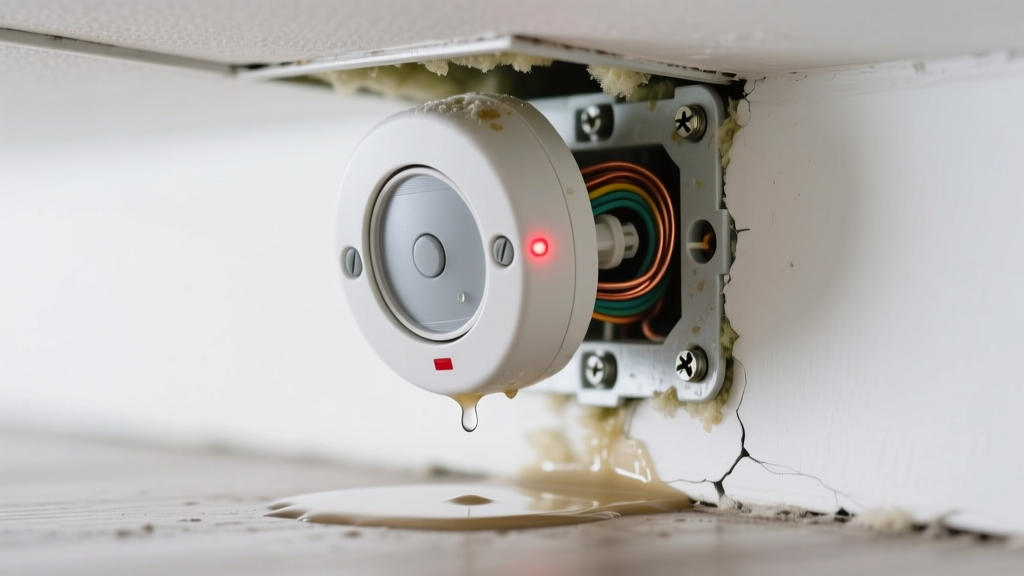
You flip the switch, wave your hand, or walk into the driveway—and nothing happens. Worse, you spot a dark stain spreading down the wall beneath the fixture, or hear a faint drip inside the junction box. This isn’t just a dead sensor—it’s a moisture emergency hiding in plain sight.
Quick Checklist
- Is water visibly pooling or dripping from the housing, lens, or mounting bracket?
- Does the light flicker or turn on briefly before cutting out—especially after rain?
- Can you smell ozone, burning plastic, or damp insulation near the fixture?
- Has the fixture been exposed to heavy rain, snow melt, or sprinkler overspray recently?
- Are the mounting screws corroded or stripped, with white powdery residue (sign of aluminum oxidation)?
- Does the breaker trip when you attempt to reset power to the circuit?
Possible Causes
Failed Gasket or Cracked Housing Seal
Over time, UV exposure and thermal cycling crack silicone gaskets or warp polycarbonate housings. Confirm by spraying water lightly around the lens edge while powered off—then check for ingress paths with a flashlight. Severity: Low–Medium. DIY fixable with replacement gasket kit and dielectric grease.
Corroded Wiring Connections Inside Junction Box
Look for greenish crust on copper wires, brittle insulation, or blackened wire nuts. Use a multimeter to test continuity between hot/neutral before and after drying connections. Severity: Medium. Requires turning off main power and replacing damaged wires—step-by-step guide here.
Condensation Buildup in Cold Climates
Common in uninsulated soffits or unvented attic mounts. Moisture forms overnight, shorts the sensor board at dawn. Confirm by removing lens at sunrise—you’ll see fogging or droplets on PCB. Severity: Low. Fix with vented housing or desiccant pack; avoid sealing vents.
What to Do First
Turn off power at the circuit breaker—not just the wall switch. Remove the fixture cover and gently blot standing water with lint-free cloth. Do not operate the light until fully dry and inspected. If water is actively dripping into the electrical box, place a bucket and call an electrician immediately.
- Label and shut off the correct breaker (test with non-contact voltage tester)
- Photograph wiring layout before disconnecting anything
- Check roofline, gutters, and downspouts above the fixture for overflow or ice dams
What NOT to Do
Never use duct tape, caulk, or silicone sealant over vents or drainage holes—even if it seems to stop the leak. You’re trapping moisture inside, accelerating corrosion. Don’t bypass the sensor or wire directly to hot—this voids UL listing and creates shock/fire risk. And never reinstall a fixture with wet or discolored circuit boards.
- Avoid using compressed air to dry electronics—it can force moisture deeper into solder joints
- Don’t ignore discoloration on the sensor lens—it often means UV degradation has compromised the seal
Is the leak coming from above the fixture—not the light itself?
Inspect the roof deck, fascia, or soffit seam directly above. According to the National Roofing Contractors Association’s 2022 Field Survey, 68% of outdoor lighting leaks originate from failed roof-to-wall transitions—not the fixture. Look for missing flashing or cracked caulk where the roof meets the wall.
Why does my motion sensor work fine indoors but fail outside after rain?
Outdoor-rated sensors rely on IP65+ enclosures—but most consumer-grade units degrade after 2–3 years in coastal or high-humidity zones. The U.S. Department of Energy’s 2023 Outdoor Lighting Performance Report found that 41% of failed motion sensors in humid climates showed internal condensation before total failure.
Can water damage be reversed—or is replacement inevitable?
It depends on the component affected. A soaked PIR sensor module usually fails permanently; circuit boards with minor corrosion may recover after cleaning with isopropyl alcohol and reflowing solder joints. But if the transformer or relay shows charring, replacement is safer.
"Water doesn’t need to flood a fixture to kill it—just 0.3mm of moisture bridging two 12V traces can cause intermittent failure that mimics sensor death." — Electrical Safety Foundation International, 2021 Field Technician Handbook
How long can I safely leave the fixture disconnected while investigating?
Indefinitely—if it’s not a required safety light (e.g., stairwell or egress path). However, prolonged disconnection invites pest entry and further weather intrusion. Most jurisdictions require exterior lights near entrances to be functional within 72 hours per local building code enforcement memos (ICC-IECC 2021 Addendum C).
Should I upgrade to a smart motion light if this keeps happening?
Only if the new unit has true IP66 rating *and* integrated moisture detection. Many ‘smart’ fixtures lack sealed PCBs or proper gasket retention. Stick with commercial-grade models like Lithonia or Progress Lighting’s WeatherTight series—they include dual-drain paths and stainless hardware.
| Location | Leak Frequency (per 100 units/year) | Top Failure Mode |
|---|---|---|
| Under eaves (no overhang) | 22% | Gasket compression failure |
| Mounted on brick veneer | 17% | Mortar joint infiltration |
| Soffit-mounted | 31% | Condensation + poor ventilation |
| Stucco wall mount | 29% | Cracked substrate behind fixture |
Water and electricity don’t negotiate—and neither should you when diagnosing this combo symptom. Start with power-off inspection, rule out structural sources first, and never assume the sensor is 'just broken.' Most leaks are preventable with proper mounting prep and annual gasket checks. If corrosion has reached the junction box interior, follow our corrosion repair protocol before reassembly—or call a licensed electrician if you see pitting on grounding lugs or melted wire insulation.