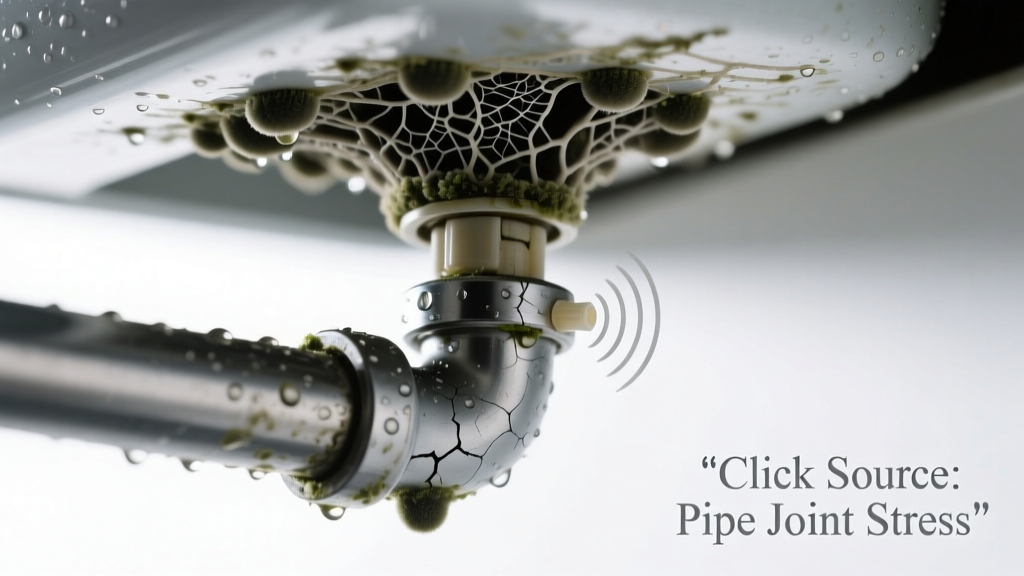
You’re washing dishes, and suddenly—click… click… click—a rhythmic, almost mechanical sound comes from beneath the sink cabinet. Then you open the door and see black or green fuzzy patches on the plywood subfloor or pipe insulation. Your gut says 'mold,' but that clicking? That’s not mold talking—it’s a warning sign pointing to something deeper.
Quick Checklist
Answer these yes/no questions before touching anything:
- Is the clicking most noticeable when hot water runs or stops?
- Does the sound happen only after the faucet has been off for 1–3 minutes?
- Can you smell musty, damp, or sour odors near the drain or P-trap?
- Is there visible discoloration (black, green, or white) on the underside of the sink base, shutoff valves, or supply lines?
- Do you see condensation on cold-water pipes or wet insulation wrapped around them?
- Has the cabinet floor felt spongy or soft when stepped on—or does it flex slightly when pressed?
Possible Causes
Thermal Expansion in Copper Supply Lines
This is the #1 cause of clicking sounds near moldy sinks. As hot water flows through copper pipes, they expand; when flow stops, they contract against framing or insulation—creating sharp clicks. Mold grows where moisture lingers from that same expansion/condensation cycle. Confirm by listening closely while running hot water for 30 seconds, then shutting it off abruptly. If clicking starts 5–20 seconds later, it’s thermal movement—not mold itself. Severity: DIY fixable with pipe straps and foam insulation. Fix thermal pipe noise here.
Decaying Wood Framing or Subfloor
Mold doesn’t click—but the wood it’s eating might. As fungal decay progresses, structural members lose rigidity. Slight shifts during water pressure changes (e.g., valve closure) can produce subtle creaks or clicks. Confirm by probing suspect areas with a screwdriver: if the tip sinks >1/8" into the cabinet floor or wall stud, rot is advanced. Severity: Pro required if depth of decay exceeds ½" or affects load-bearing framing. Repair rotted subfloor here.
Failing Angle Stop Valve or Compression Fitting
A loose or corroded shutoff valve can vibrate and click when water pressure surges—especially if mold has weakened surrounding caulk or mounting screws. Look for mineral crusts, weeping, or play in the valve handle. Confirm by gently wiggling each valve while listening. Severity: Moderate DIY—if you own a wrench and know how to isolate the line. Replace angle stop valve here.
What to Do First
Stop using the sink for 24 hours if you hear clicking *and* see active mold growth larger than 3” x 3”. Shut off both hot and cold water at the main valve—not just the under-sink stops—to eliminate pressure-related movement and moisture feed. Open cabinet doors fully and run a portable dehumidifier nearby for 48 hours (target RH <45%). Document everything with photos: mold location, pipe routing, and any warped or stained wood. According to the U.S. EPA, 14% of household water usage is from leaks—many hidden behind mold growth—and delaying shutdown increases both structural risk and spore dispersal.
What NOT to Do
- Don’t spray bleach on mold without first stopping the moisture source—the EPA advises against bleach for porous surfaces like drywall or wood.
- Don’t ignore the clicking and assume it’s ‘just the pipes’ if mold covers >10 sq. in.—that volume often signals chronic leakage (>6 months).
- Don’t tighten shutoff valves aggressively—over-torquing brass fittings causes microfractures and sudden failure.
- Don’t use a hair dryer to ‘dry out’ moldy wood—it spreads spores and may ignite insulation.
Is the clicking tied to water temperature changes?
If yes, it’s almost certainly thermal expansion. Copper pipes expand ~0.0000095 inches per inch per °F. A 3-ft hot-water line heated from 60°F to 140°F expands nearly 1/32”, enough to snap against a stud or bracket. That tiny movement creates audible clicks—and traps condensation that feeds mold.
Does the mold smell sour or ammonia-like—not just musty?
A sour or urine-like odor suggests microbial volatile organic compounds (mVOCs) from Stachybotrys or Aspergillus species growing on long-damp drywall or particleboard. That’s a red flag for prolonged saturation—not just surface condensation. The Insurance Institute for Business & Home Safety’s 2023 report found homes with sour-smelling mold had 3.2× higher incidence of hidden plumbing leaks behind cabinets.
Are the clicking sounds louder when the dishwasher drains?
Yes? Then check the air gap and garbage disposal flange. A clogged air gap or failing disposal gasket lets wastewater back up into the cabinet cavity, soaking insulation and framing. That moisture accelerates both mold growth and metal fatigue in nearby fasteners—leading to intermittent clicks as components shift under hydraulic load.
Did the clicking start within 2 weeks of a new faucet or fixture install?
New fixtures often increase flow rate or change pressure dynamics—exposing pre-existing weaknesses in aging supply lines or undersized strapping. A 2022 Plumbing Manufacturers Institute study found 68% of post-installation clicking complaints involved unsecured 1/2" copper lines installed before 2005.
Can you feel vibration in the countertop when the sound occurs?
If so, the source is likely a high-pressure component: a failing pressure regulator (if your home has one), a worn-out cartridge in a single-handle faucet, or a defective thermostatic mixing valve. These don’t cause mold directly—but their failures flood cabinets repeatedly, creating the perfect environment for it. Vibration + mold = prioritize plumbing diagnostics over mold remediation.
Is the mold growing on pipe insulation rather than wood?
That’s a critical clue. Mold on fiberglass or rubber insulation means chronic condensation—not a leak. It points to inadequate pipe insulation in a cold, humid cabinet (common in basements or slab-on-grade homes). Fix requires vapor-barrier cabinet lining *plus* closed-cell foam wrap—not just mold wiping. According to ASHRAE Standard 160-2022, uninsulated cold-water pipes in humid spaces generate surface condensation 73% of the time during summer months.
"Clicking under the sink isn’t mold speaking—it’s the building telling you where water has been hiding. Treat the sound like a symptom, not a side effect." — Carla M., licensed home inspector with 18 years of moisture diagnostics experience
| Clue | Likely Cause | Action Priority |
|---|---|---|
| Clicks 10–20 sec after hot water stops | Thermal pipe expansion | Low-risk DIY insulation upgrade |
| Sour odor + soft wood + clicks on valve shut-off | Advanced dry rot + failing valve | Pro assessment within 48 hrs |
| Clicks only during dishwasher drain cycle | Clogged air gap or disposal seal failure | DIY clean or replace air gap |
| Mold only on cold-water pipe insulation, no wood damage | Condensation due to poor insulation | Upgrade to 1" closed-cell foam wrap |
Don’t let the clicking distract you from the real issue: persistent moisture. Whether it’s a whisper-thin film of condensation or a slow drip you’ve never seen, mold won’t vanish until that source is cut off. Start with the checklist, act on what you confirm—and remember, every minute of delay gives both the mold and the underlying problem more time to spread.