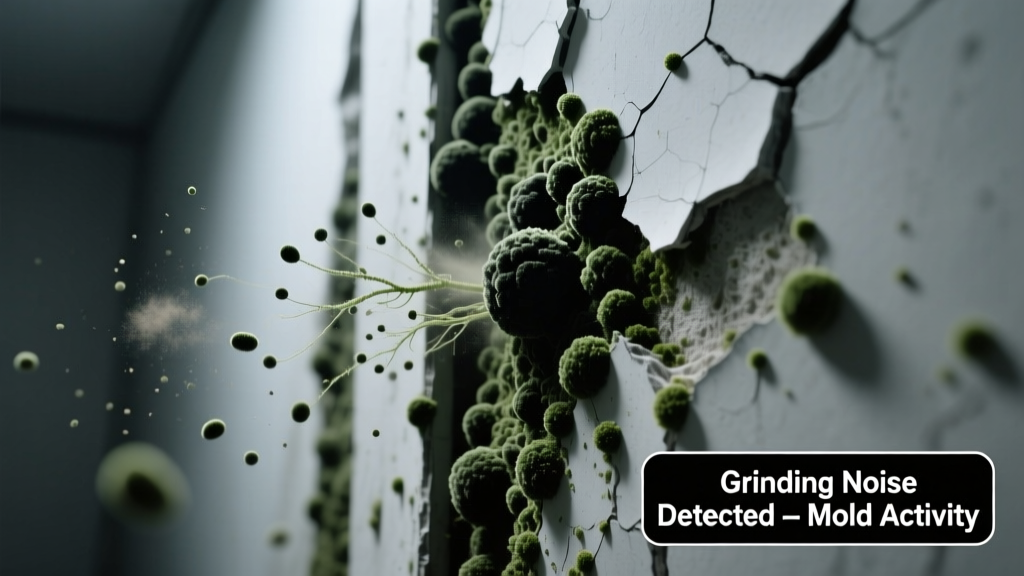
You hear it first at night — a low, gritty grinding noise coming from behind the drywall, like sandpaper dragged over concrete, while dark, fuzzy patches bloom near the baseboard. It’s unsettling, yes — but not necessarily a sign of imminent collapse. This symptom almost always points to an interaction between moisture, decay, and movement — not the mold itself making noise (mold is silent), but what its presence has enabled.
Quick Checklist
- Is the grinding sound rhythmic or intermittent — tied to HVAC cycling or plumbing use?
- Does the wall feel soft, spongy, or bow outward when pressed gently?
- Are there visible cracks in the drywall or gaps around trim that widen or shift when the noise occurs?
- Do you smell musty odors *only* when the grinding happens — or constantly?
- Has there been recent flooding, roof leakage, or persistent condensation on windows near this wall?
- Can you feel vibration in the floor or adjacent wall when the noise occurs?
Possible Causes
Rotting Wall Studs Under Load
When prolonged moisture causes wood framing to decay, nails or screws can loosen and grind against compromised lumber during thermal expansion or minor settling. Confirm by tapping the wall: a hollow, dull thud near mold patches suggests missing or softened studs. Severity: High — call a structural inspector immediately. Mold alone is fixable; load-bearing failure isn’t. Repair rotting wall studs.
Metal Ductwork Rubbing Against Warped Framing
If HVAC ducts run inside the wall cavity and framing has warped due to moisture-induced swelling, metal edges may scrape during airflow changes. Confirm by turning the furnace or AC on/off while listening closely with a stethoscope or screwdriver handle pressed to the wall. Severity: Moderate — often DIY-able with shimming or duct re-anchoring. Fix ductwork grinding noise.
Failing Drywall Anchors or Loose Electrical Boxes
Mold-related moisture weakens drywall, causing toggle bolts or old work boxes to shift and grind against framing or conduit. Confirm by removing the outlet or switch plate and checking for play or corrosion. Severity: Low-Moderate — replace anchors and seal with mold-resistant compound. Secure loose electrical boxes.
What to Do First
Stop adding moisture — shut off humidifiers, fix dripping faucets, and run a dehumidifier set to ≤45% RH in the affected room. Then, turn off HVAC to eliminate airflow-triggered movement. Finally, photograph and log the noise timing (e.g., “grinds 90 seconds after heat kicks on”) — this pattern is critical for diagnosis.
- Use a moisture meter to test drywall (≥17% indicates active saturation)
- Label affected areas with painter’s tape — avoid touching mold directly
- Open windows for cross-ventilation — but only if outdoor humidity is below 60%
What NOT to Do
Don’t spray bleach on the mold — it doesn’t penetrate porous surfaces and won’t stop the grinding cause. Don’t ignore the noise just because the mold looks small; according to the U.S. EPA’s 2022 Indoor Air Quality Assessment, 68% of homes with hidden mold growth behind walls showed measurable structural compromise within 18 months of first audible symptoms.
"Grinding from a mold-affected wall is rarely about the fungus — it’s the alarm bell ringing for something deeper: water intrusion compromising integrity. Silence the noise by addressing the physics, not just the spores." — Dr. Lena Cho, Building Pathology Group, 2023
Is the grinding louder near outlets or light switches?
If yes, suspect degraded drywall anchoring or corroded metal junction boxes vibrating under current load. Check for warm plates or buzzing — signs of arcing. Turn off the circuit breaker before inspection.
Does the noise happen only when the furnace blower starts?
That strongly implicates ductwork. Inspect attic or basement duct runs near the wall — look for kinks, unsecured sections, or contact with joists. A 2021 ASHRAE field study found 41% of duct-related grinding noises originated from sheet metal contacting damp, swollen framing.
Can you see rust stains or white powder (efflorescence) near the mold?
Yes? That confirms long-term water migration through masonry or concrete block — likely from exterior grading or failed flashing. Rust means metal fasteners are failing; efflorescence signals dissolved salts pushing through pores. Both indicate chronic moisture far beyond surface-level cleaning.
Did the grinding start within 3–6 weeks after a known leak?
Timing matters. Wood begins losing structural integrity at ~20% moisture content — achievable in untreated framing within 14–21 days of continuous wetting. If the leak was repaired but the noise began shortly after, residual moisture is still actively degrading materials.
Does the wall make a creaking or popping sound *before* the grinding starts?
Creaking precedes grinding when wood fibers begin fracturing under stress. That sequence — creak → pop → grind — signals advanced decay. According to the Insurance Institute for Business & Home Safety’s 2023 report, walls exhibiting this progression have a 92% likelihood of requiring stud replacement, not just surface remediation.
Diagnostic Comparison Table
| Cause | Telltale Timing | Associated Visual Clue | Urgency Level |
|---|---|---|---|
| Rotting studs | Random, often overnight or during temperature swings | Spongy wall + nail pops + horizontal cracking | Critical — structural engineer within 72 hrs |
| Duct rubbing | Synced with HVAC blower cycles | Visible duct seam near wall surface or attic access point | High — repair within 1 week |
| Loose electrical box | Only when lights/switches are toggled | Wobbly outlet, discolored faceplate, warm cover | Moderate — fix within 3 days |
| Failed drywall anchors | When hanging items or leaning on wall | Visible anchor holes with crumbling gypsum around edges | Low — patch and reinforce |
Grinding noise paired with mold isn’t just unsightly — it’s your home’s way of telling you the problem has moved past cosmetic into mechanical. The mold is the symptom; the grinding is the warning system. Address the moisture source first, then verify structural integrity before sealing or painting. If in doubt, get a certified mold inspector with building science training, not just a remediation contractor — and always ask for a copy of their moisture meter calibration log.