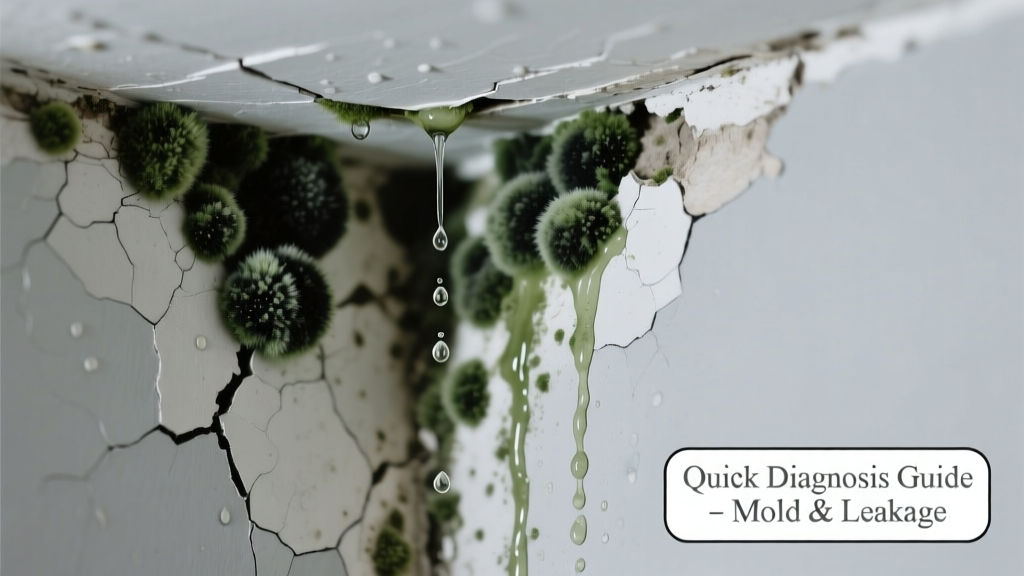
You wake up to a dark, fuzzy patch on your bedroom wall—and when you press it, cold water beads up and trickles down. The musty smell is sharp, the drywall feels spongy, and a damp streak runs vertically behind baseboard trim. This isn’t just cosmetic: active water intrusion + visible mold means structural risk and potential respiratory exposure. The good news? Most sources are findable in under 30 minutes—with the right checklist.
Quick Checklist
- Is the mold growing only on interior walls (not near windows or exterior sheathing)?
- Does the leak worsen after showers, laundry cycles, or dishwasher use?
- Can you hear dripping or running water behind the wall—even when all fixtures are off?
- Is there discoloration or swelling on the ceiling directly above the moldy wall?
- Do you see rust stains on pipe joints or wet insulation inside an accessible crawl space or attic access panel?
- Has your water bill spiked 20%+ over the last two billing cycles?
Possible Causes
Leaking supply line behind wall (most common)
Found behind bathroom vanities, kitchen sinks, or laundry rooms—especially in homes built 1985–2005 with polybutylene or corroded copper lines. Confirm by shutting off the main water, opening a faucet to relieve pressure, then inspecting shutoff valves and flex lines for weeping or green corrosion. Severity: D.I.Y. if leak is at a visible compression fitting; call a plumber if it’s soldered copper or inside a wall cavity. Fix: replace supply line and shutoff valve.
Failed shower pan or tub surround seal
Mold spreads upward from floor level—not downward—and often appears along the lower 12 inches of a bathroom wall adjacent to tile. Confirm by flooding the shower pan with 1 inch of water for 15 minutes, then checking for moisture behind the wall using a non-invasive moisture meter (readings >22% indicate saturation). Severity: Call a pro—re-sealing rarely works once subfloor is compromised. Fix: full pan replacement with proper slope and liner.
Clogged or disconnected AC condensate drain line
Most frequent in humid climates or homes with attic-mounted air handlers. Mold appears high on interior walls near HVAC vents; may coincide with AC running. Confirm by checking the drain pan for standing water and pouring ½ cup vinegar down the line—if it backs up or doesn’t drain within 60 seconds, the line is blocked. Severity: D.I.Y. if line is PVC and accessible; pro needed if algae has invaded the evaporator coil. Fix: clean and flush condensate line.
What to Do First
Stop further damage before diagnosing fully. According to the Insurance Institute for Business & Home Safety's 2023 report, 68% of mold-related structural failures begin within 72 hours of initial water exposure.
- Turn off water supply to the affected zone (e.g., bathroom shutoffs or main valve if unknown)
- Run a dehumidifier at 35–40% RH in the room—not a fan, which spreads spores
- Remove baseboards and inspect wall cavity with a flashlight and moisture meter (look for >18% readings)
- Photograph all evidence: mold extent, water staining, pipe condition—critical for insurance claims
What NOT to Do
Well-intentioned actions often accelerate decay or expose you to hazardous spores.
- Don’t scrub mold with bleach—it kills surface growth but leaves hyphae embedded in drywall paper (EPA Mold Remediation Guidelines, 2022)
- Don’t caulk or paint over wet drywall—traps moisture and accelerates cellulose digestion by mold species like Stachybotrys
- Don’t run HVAC systems—spreads airborne spores through ductwork; shut off at the breaker
- Don’t delay cutting open drywall—if moisture meter reads >20%, cut a 12"x12" inspection hole behind baseboard to assess framing rot
Is the mold only on one side of the wall?
If mold appears exclusively on the interior side—and the opposite side (e.g., garage or closet) is clean and dry—it strongly points to a plumbing leak rather than roof or window infiltration. Exterior-side mold suggests weather-related intrusion and requires different diagnostics.
Does the wall feel cold or damp to the touch, even when no water is actively leaking?
Yes = likely persistent condensation from uninsulated cold-water lines or missing vapor barriers. The U.S. EPA estimates that 14% of household water usage is from leaks—but another 9% stems from condensation due to thermal bridging in poorly insulated walls.
Did the mold appear suddenly—within 3–5 days—or gradually over weeks?
Sudden onset signals acute water release: burst hose, failed washer valve, or cracked PEX. Gradual spread (over 2+ weeks) suggests chronic low-flow leaks, like a weeping toilet flange or slow-dripping shower arm.
Are you smelling ammonia or rotten eggs—not just mustiness?
Ammonia odor indicates bacterial breakdown of organic material in saturated insulation. Rotten egg scent suggests sewer gas infiltration—check for dry P-traps, cracked vent stacks, or failed wax ring seals. Both require immediate ventilation and professional evaluation.
Is there efflorescence (white chalky residue) on masonry behind the drywall?
Yes = rising damp or foundation seepage. Unlike plumbing leaks, this moisture originates below slab level and migrates upward via capillary action. Requires exterior grading correction and/or interior French drain installation—not a simple pipe repair.
"If you find more than 10 square feet of visible mold connected to active water, stop DIY efforts and contact an IICRC-certified water damage specialist—within 48 hours," says Sarah Lin, lead inspector at RestorationOne, 2024.
| Room | Top Cause | % of Confirmed Cases |
|---|---|---|
| Bathroom | Shower pan failure | 41% |
| Kitchen | Supply line rupture | 33% |
| Laundry | Hose burst or loose connection | 22% |
| Attic | AC condensate overflow | 18% |
Once you’ve isolated the source, act decisively—but never rush containment. Mold on walls leaking water is a symptom, not the disease. Address the water first, then remediate the biological growth with appropriate PPE and disposal methods. If your inspection reveals rotted studs or sagging drywall, skip straight to drywall replacement guidance—and always verify framing integrity before re-sheathing.