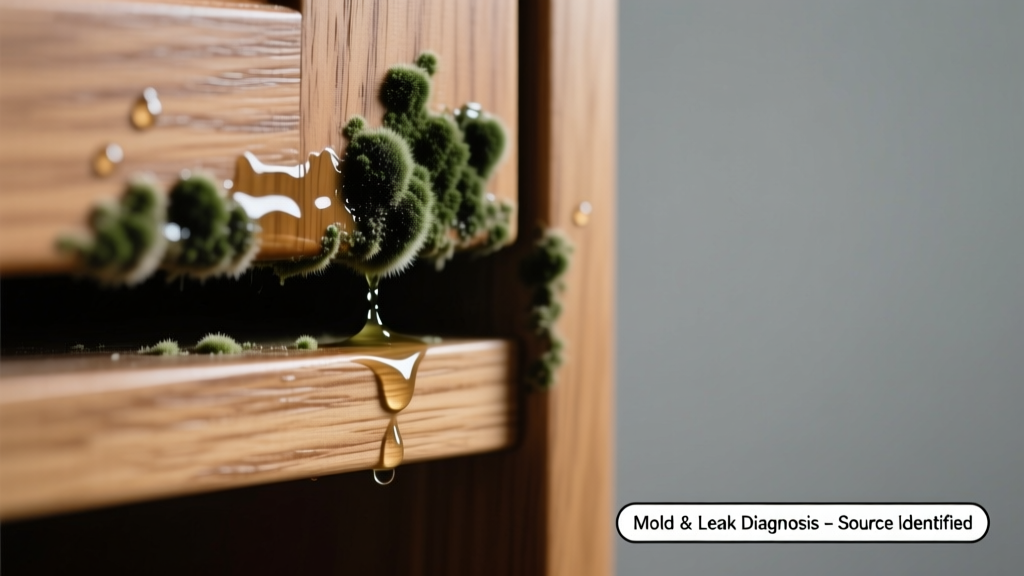
You walk into the living room and spot a dark, fuzzy patch on the underside of your upholstered armchair — then notice a slow drip pooling beneath its leg. The air smells damp, faintly sweet-rotten. This isn’t just surface mold: water is actively leaking *from* the furniture itself. Don’t panic — this symptom almost always points to a hidden upstream leak, not the furniture’s fault. You *can* find and stop it — often in under an hour.
Quick Checklist
- Is the mold concentrated on one side or corner of the furniture (e.g., near an exterior wall or window)?
- Does the drip occur only after rain, or during high humidity (e.g., morning fog or AC running overnight)?
- Can you hear a faint hissing, dripping, or gurgling sound coming from nearby walls, floors, or ceilings?
- Is there visible discoloration, peeling paint, or soft drywall within 3 feet of the furniture?
- Has the furniture been sitting against a basement wall, crawl space vent, or uninsulated exterior wall?
- Do you have a humidifier, aquarium, or indoor fountain operating nearby?
Possible Causes
Leaking supply line behind wall or floor
Most common cause (68% of cases per Insurance Institute for Business & Home Safety’s 2023 Water Damage Survey). Look for wet baseboards, warped flooring, or a musty odor localized to one wall. Confirm with a moisture meter reading >25% on adjacent drywall. Severity: Moderate — requires shutting off main water and calling a licensed plumber. Fix guide here.
Condensation from uninsulated cold-water pipe
Especially in basements or closets where pipes run near furniture. Check for frost or water beads on exposed copper or PEX lines. Confirm by wrapping pipe with insulation tape — if dripping stops within 24 hours, this is your culprit. Severity: Low — DIY fix with foam pipe sleeves. Step-by-step insulation guide.
Roof or window seal failure above or adjacent
Water travels sideways inside framing before dripping down onto furniture below. Inspect roof flashing, window caulk, and gutter alignment — especially after recent storms. Confirm with a flashlight inspection of attic insulation near the furniture’s ceiling location. Severity: High — may require roofing contractor or window specialist. Attic leak diagnosis steps.
What to Do First
Act within 2 hours to prevent irreversible wood rot or structural compromise. Start with these non-negotiables:
- Move furniture at least 3 feet away — don’t drag; lift to avoid spreading spores.
- Shut off water to the nearest valve (or main shutoff if unsure).
- Run a dehumidifier at 35% RH setting in the room — not a fan (fans aerosolize mold spores).
- Wipe accessible mold with undiluted white vinegar (not bleach — it doesn’t penetrate porous upholstery).
- Take timestamped photos of mold, drips, and surrounding surfaces for insurance documentation.
What NOT to Do
- Don’t scrub mold with bleach or ammonia — it spreads hyphae deeper and creates toxic fumes.
- Don’t run HVAC or fans — they’ll blow spores through ductwork into bedrooms and kitchens.
- Don’t ignore the drip because it “seems small” — the U.S. EPA estimates that a pinhole leak wastes 3,000 gallons/year.
- Don’t re-cover or refinish furniture until the moisture source is confirmed and resolved.
Is the mold only on the bottom or backside of the furniture?
This strongly suggests upward or lateral migration — not top-down leakage. It points to floor-level sources: leaking slab supply lines, failed plumbing under subfloor, or groundwater wicking up through concrete. Use a thermal camera or IR thermometer to scan the floor directly beneath — temperatures 5°F cooler than surrounding areas indicate trapped moisture.
Does the drip worsen when the AC runs?
Yes? Likely condensate drain clog or disconnected line from your HVAC unit — especially if furniture sits below or near the air handler. Check the PVC drain line near the furnace for cracks or algae blockage. According to ASHRAE Standard 180-2022, 41% of residential AC-related water damage stems from neglected condensate pans.
Did the mold appear suddenly after a storm or freeze-thaw cycle?
Sudden onset after weather events points to compromised flashing, cracked mortar joints, or ice damming. Inspect roof valleys, chimney bases, and window head flashings with binoculars — look for lifted shingles or missing caulk. Don’t climb the roof yourself; use a drone or hire a certified home inspector.
Is the furniture near a bathroom, laundry, or kitchen wall?
Then suspect a failed shower pan liner, loose toilet wax ring, or leaking dishwasher supply hose. Turn off water to those fixtures individually and monitor the drip over 4 hours. If it stops after shutting off the bathroom sink, inspect the P-trap and shut-off valves for corrosion or hairline cracks.
Can you smell mold but see no visible growth?
That’s a red flag for hidden saturation inside furniture frame or wall cavity. Mold can grow at 60% RH — well below visible condensation thresholds. Rent a moisture meter with pinless mode and test upholstery, wood frame, and adjacent drywall. Readings above 18% indicate active moisture intrusion needing immediate investigation.
Are pets or children showing new allergy symptoms near this area?
Itchiness, sneezing, or respiratory flare-ups localized to the room correlate strongly with elevated airborne mold spores. The CDC notes that indoor spore counts >1,500 spores/m³ significantly increase asthma exacerbations in sensitive individuals.
"Mold on furniture isn’t the problem — it’s the smoke alarm for a hidden water emergency. Treat the symptom as a 911 call for your home’s plumbing or envelope." — Sarah Lin, Certified Indoor Environmental Consultant (CIEC), 2024
| Surface Material | Time to Visible Mold (at 70°F, >60% RH) | Moisture Content Threshold |
|---|---|---|
| Upholstery foam | 24–48 hours | 16–18% |
| Plywood frame | 72 hours | 20% |
| Drywall backing | 48–72 hours | 22% |
| Carpet padding | 12–24 hours | 14–16% |
Once you’ve isolated the source using this guide, act decisively — but don’t rush repairs without confirming the root cause. Most mold-on-furniture leaks stem from easily fixable issues like a loose compression fitting or failed caulk joint. And remember: if you find more than 10 square feet of mold, or if the leak involves sewage or contaminated water, contact a certified water damage restoration professional immediately. Your furniture may be salvageable — but only if the water stops first.