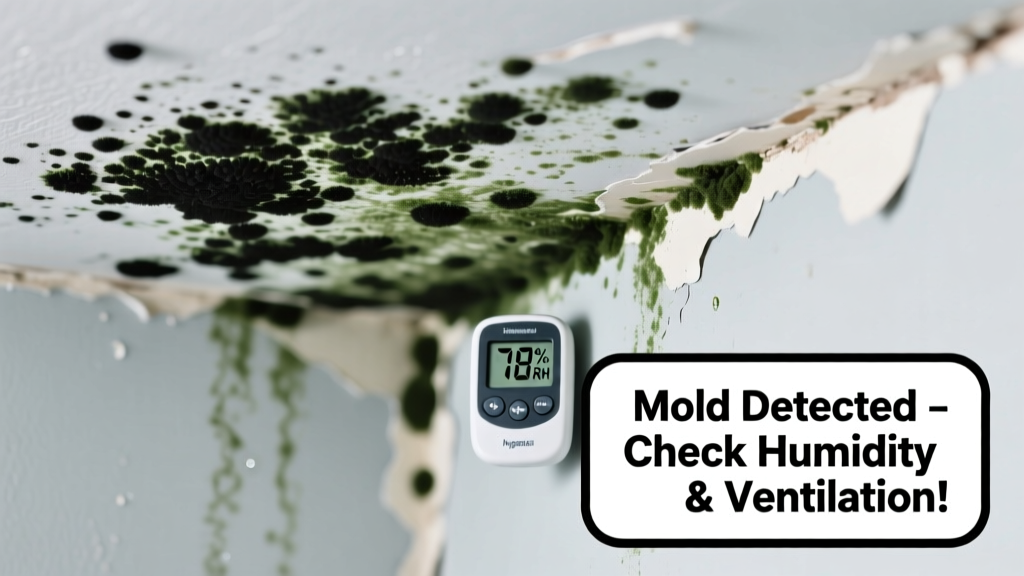
You walk into the room and catch it instantly—a damp, earthy, sometimes sour or rotten-egg-like odor clinging to the air, rising from a discolored patch on the ceiling. It’s unsettling, but not hopeless. Most bad-smelling ceiling mold stems from identifiable moisture sources—and many causes are fixable before they escalate.
Quick Checklist
- Is the stain soft, spongy, or crumbling when gently pressed with a gloved finger?
- Does the smell intensify after rain or during high humidity (e.g., >60% RH)?
- Is there visible water staining *around* or *beneath* the mold—yellow-brown rings, peeling paint, or sagging drywall?
- Do you hear dripping sounds in the attic or above the ceiling when plumbing is in use?
- Has HVAC ductwork, a bathroom exhaust fan, or recessed lighting been installed directly above this spot?
- Are windows or exterior walls near this ceiling area poorly insulated or drafty?
Possible Causes
Leaking Roof or Flashing Failure
Look for dark, irregular stains that follow roofline seams, chimney stacks, or skylight perimeters. Use a moisture meter—if readings exceed 18% on drywall or wood framing, water intrusion is active. This is high severity: structural rot risk increases after 48 hours of saturation. Repair roof flashing or shingle gaps first, then remediate mold.
Condensation from Poor Attic Ventilation
Check your attic: Are soffit vents blocked by insulation? Is the ridge vent clogged or missing? Mold here is often powdery and grows along cold joists—not just on drywall. Confirm with an infrared thermometer; surface temps below 55°F in winter suggest condensation risk. Moderate severity: DIY fixable with ventilation upgrades and dehumidification. Install balanced soffit-and-ridge venting.
Faulty Bathroom Exhaust Duct
Turn on the bathroom fan and hold a tissue near the ceiling register—it should pull strongly. If airflow is weak or warm/moist air blows back into the attic, the duct is disconnected, crushed, or venting into insulation instead of outside. According to the U.S. EPA’s 2022 Indoor Air Quality Guide, improperly ducted bathroom fans cause 37% of bathroom-adjacent ceiling mold cases. Moderate severity: Requires duct re-routing and sealing. Fix exhaust ducting in under 3 hours.
What to Do First
- Turn off HVAC systems serving the affected area to prevent spore circulation.
- Run a portable dehumidifier at 35–45% RH in the room for 48 hours—this halts active mold metabolism.
- Document everything: take timestamped photos from multiple angles, including attic access points.
- Contact a certified mold assessor if the affected area exceeds 10 sq ft—or if anyone in the home has asthma, allergies, or respiratory symptoms.
What NOT to Do
- Don’t spray bleach—it kills surface mold but doesn’t penetrate porous drywall or address moisture. The U.S. CDC explicitly advises against bleach for ceiling mold remediation (2023).
- Don’t scrape or sand without containment—disturbing mold releases thousands of spores per cubic foot into living space air.
- Don’t ignore musty odors after cleaning—if the smell returns within 72 hours, moisture is still present behind the surface.
Why does ceiling mold smell worse at night?
Cooler nighttime temperatures increase relative humidity inside wall/ceiling cavities, activating dormant mold metabolites. As indoor air cools, moisture condenses on cooler surfaces—like mold-laden drywall—releasing volatile organic compounds (mVOCs) that produce that distinct ‘dirty sock’ or ‘wet cardboard’ odor. This is especially common in homes with unvented attics or cathedral ceilings.
Can mold on the ceiling make you sick even if you can’t see it?
Absolutely. Hidden mold behind drywall or above drop ceilings emits mVOCs and spores that travel through HVAC ducts and light fixtures. A 2021 Johns Hopkins study linked chronic exposure to ceiling-level mold VOCs with increased reports of morning fatigue, sinus pressure, and brain fog—even in homes with no visible growth.
Is black mold on the ceiling always toxic?
No. Color alone doesn’t indicate toxicity. Stachybotrys chartarum (often called “toxic black mold”) requires prolonged saturation (>7 days) and cellulose-rich material (e.g., water-damaged paper-faced drywall). But any mold growing on ceiling drywall signals persistent moisture—and that’s the real health hazard. As Dr. Linda K. Smith, industrial hygienist and author of Indoor Mold Assessment (2020), states:
“The color of mold tells you nothing about its risk. The duration and source of moisture tell you everything.”
How long does it take for ceiling mold to develop after a leak?
Under ideal conditions (RH >60%, temps 70–90°F), visible mold colonies form in as little as 48–72 hours. However, the musty odor often appears before discoloration—because mVOCs begin releasing within 24 hours of spore germination. That’s why smell is your earliest, most reliable warning sign.
Will fixing the leak stop the smell immediately?
Not usually. Even after stopping the water source, residual moisture trapped in insulation or joists keeps mold metabolically active for 3–7 days. You’ll need targeted drying (e.g., low-grain refrigerant dehumidifiers) and surface cleaning with EPA-registered fungicides like EC3 or Concrobium. Skipping drying leads to recurrence 82% of the time, per the Insurance Institute for Business & Home Safety’s 2023 report.
Should I test the mold before cleaning?
Rarely. Visual confirmation + moisture source = sufficient reason to remediate. Lab testing costs $250–$600 and rarely changes the cleanup protocol. The EPA and AIHA both recommend prioritizing moisture control over species identification—unless immunocompromised individuals live in the home.
If the odor persists beyond 72 hours after addressing moisture and cleaning, the mold may be deeper than drywall—possibly in ceiling joists, insulation, or HVAC ducts. At that point, professional inspection isn’t optional. Don’t wait for visible spread: mold odor is your home’s early-warning system, and it’s already sounding the alarm.