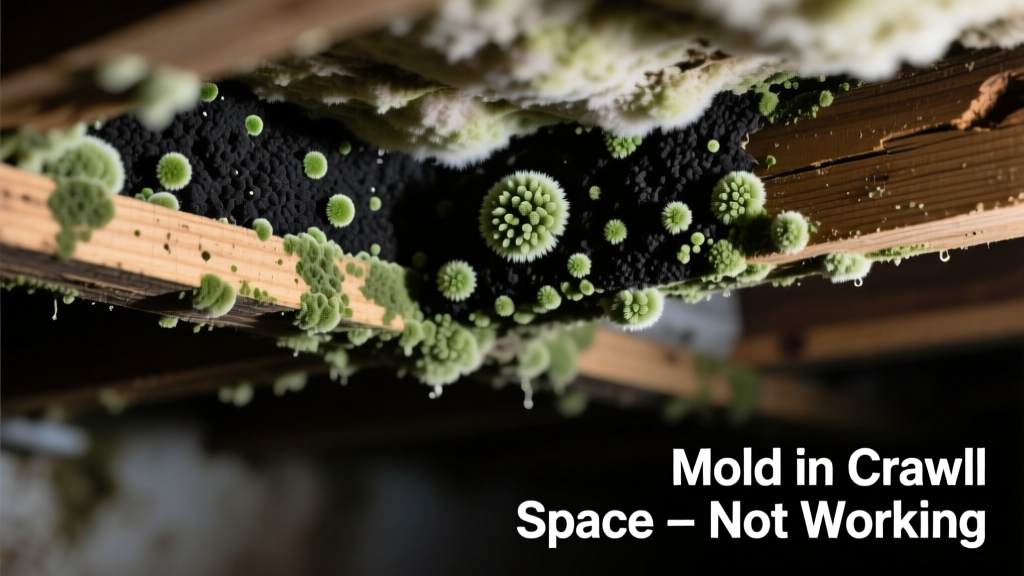
You walk into the crawl space, smell that unmistakable musty, damp-earth odor, see black or green splotches on joists or insulation — and yet your mold treatment (spray, fogger, or dehumidifier) seems to have zero effect. No reduction in spores, no drying, no improvement after days or even weeks. Don’t panic: this is a diagnosable failure — not a lost cause.
Quick Checklist
- Is the crawl space actively wet? (standing water, soaked insulation, dripping pipes)
- Has relative humidity stayed above 65% for >48 hours after treatment?
- Was visible mold wiped or scrubbed *before* applying any biocide or encapsulant?
- Are HVAC ducts or supply vents running *into* the crawl space?
- Is there an unsealed access hatch or foundation vent allowing humid outdoor air in?
- Did you use a non-EPA-registered mold-killing product (e.g., vinegar, tea tree oil, or generic 'mildewcide')?
- Has the source of moisture (leaky pipe, failed vapor barrier, poor grading) been identified and repaired?
Possible Causes
Active Moisture Source Still Present
How to confirm: Use a moisture meter on subfloor sheathing (readings >19% indicate active wetness); check for condensation on cold water lines or foundation walls; inspect for plumbing leaks or exterior drainage failures. If humidity stays >70% despite dehumidifier runtime, moisture is entering faster than it’s removed.
Severity: High — DIY fix only if leak is minor (e.g., loose compression fitting). Major sources (failing sump pump, cracked foundation, gutter overflow) require a crawl space water leak repair pro.
Inadequate or Incorrect Mold Treatment
How to confirm: Review product label — EPA Registration Number must be present (e.g., 'EPA Reg. No. 12345-6'). If you used bleach on porous wood or drywall, it likely only killed surface spores while leaving hyphae intact. Microscopic inspection or ATP swab test (available via home mold test kits like EnviroLogix 2023 kit) shows live biomass remains.
Severity: Medium — Fixable with proper EPA-registered fungicide and mechanical removal. See our how to kill mold in crawl space guide for step-by-step protocol.
Poor Ventilation & Airflow Trapping Spores
How to confirm: Place a smoke pencil or incense stick near floor level — if smoke pools or moves sluggishly instead of rising and exiting, airflow is stagnant. IR camera scans often reveal cold spots where condensation forms unseen.
Severity: Low-Medium — Often resolved with strategic exhaust fan installation and sealing of unintended air intakes. A certified crawl space encapsulation contractor can assess airflow design.
What to Do First
Stop all remediation efforts immediately. Running fans or foggers into a wet, unsealed environment spreads spores and delays drying. Instead:
- Turn off any HVAC ducts serving the crawl space (check for open registers or disconnected flex ducts).
- Measure ambient RH with a calibrated hygrometer — if ≥70%, run a heavy-duty dehumidifier (≥90-pint capacity) on continuous drain mode.
- Visually trace every inch of foundation wall, rim joist, and plumbing for active leaks — mark with flag tape.
- Photograph all mold growth *and* surrounding conditions (wet insulation, rusted pipes, missing vapor barrier) for contractor review.
What NOT to Do
- Don’t sand or wire-brush mold without containment — this aerosolizes spores at dangerous concentrations.
- Don’t apply sealants (like Kilz or epoxy coatings) over wet or actively growing mold — they trap moisture and accelerate wood decay.
- Don’t assume “no visible mold = problem solved” — hidden growth behind insulation or under plywood is common and confirmed only by moisture mapping.
- Don’t ignore seasonal patterns: According to the Insurance Institute for Business & Home Safety's 2023 report, 68% of crawl space mold recurrences stem from untreated spring rain infiltration or summer humidity spikes.
Is the mold returning within 2 weeks of cleaning?
This strongly indicates either incomplete removal (hyphae left in wood grain) or persistent moisture. Surface wipe tests show regrowth starts in micro-fractures where biocides didn’t penetrate. Always verify with a moisture meter before declaring success.
Does the musty smell persist even after visible mold is gone?
Yes — because mold metabolites (MVOCs) linger in damp cellulose materials long after spores die. The U.S. EPA estimates that 14% of household water usage is from leaks — many undetected in crawl spaces — which continuously feed microbial activity. Smell alone means moisture is still present.
Are you seeing white, fuzzy growth that looks like salt or dust?
That’s likely efflorescence (mineral deposits), not mold — but it signals chronic moisture intrusion. Efflorescence forms when groundwater wicks through masonry and evaporates at the surface. It’s a red flag for hydrostatic pressure issues requiring drainage correction.
Did mold appear only after installing new insulation or closing vents?
Yes — this points to trapped humidity. Closed crawl spaces need mechanical dehumidification *and* sealed vapor barriers. The 2022 ASHRAE Handbook confirms that unconditioned, closed crawl spaces without vapor retarders at ≤0.1 perm rating develop mold 4.3× faster than properly detailed ones.
Is mold concentrated around HVAC duct boots or electrical panels?
This suggests condensation from cold ducts meeting warm, humid crawl space air — a classic thermal bridging issue. Insulating ducts with R-6 or higher fiberglass wrap and sealing seams with mastic stops this. Never use duct tape — it fails in high-humidity environments.
Can you hear dripping or feel dampness in floorboards above?
If yes, structural damage may already be underway. Wood with sustained moisture content >20% loses up to 30% of its bending strength in just 6 months (Forest Products Laboratory, USDA 2021). That’s a structural red flag — get a licensed inspector to assess joist integrity before proceeding with cosmetic fixes.
"Mold doesn’t grow in dry places — it grows where water lives. Your job isn’t to kill mold; it’s to evict the water that pays its rent." — Dr. Linda Griggs, Indoor Air Quality Specialist, Building Science Corporation, 2022
| Cause | Key Indicator | DIY Feasible? | Time to Fix |
|---|---|---|---|
| Undetected plumbing leak | Localized wetness + rust stains on copper pipes | Only for pinhole leaks with SharkBite fittings | 2–4 hours |
| Failed vapor barrier | Torn poly, puddles under barrier, seam gaps >2 inches | Yes — with 10-mil reinforced poly & seam tape | 1 day |
| Exterior grading directing water inward | Soil sloping toward foundation + mulch piled against siding | Yes — regrade to 6-inch drop in first 10 feet | 1–2 days |
| Unvented dryer exhausting into crawl space | White crystalline residue on joists + constant warm, humid air | Yes — reroute duct to exterior per IRC M1502.2 | 3–5 hours |
Fixing mold that “isn’t working” isn’t about stronger chemicals — it’s about reversing the physics that let it thrive. Start with moisture mapping, not mold counting. Once the water is gone, the mold has no future. And if you’re unsure whether it’s safe to proceed alone, a qualified crawl space mold contractor can provide targeted diagnostics — often at no cost for initial assessment.