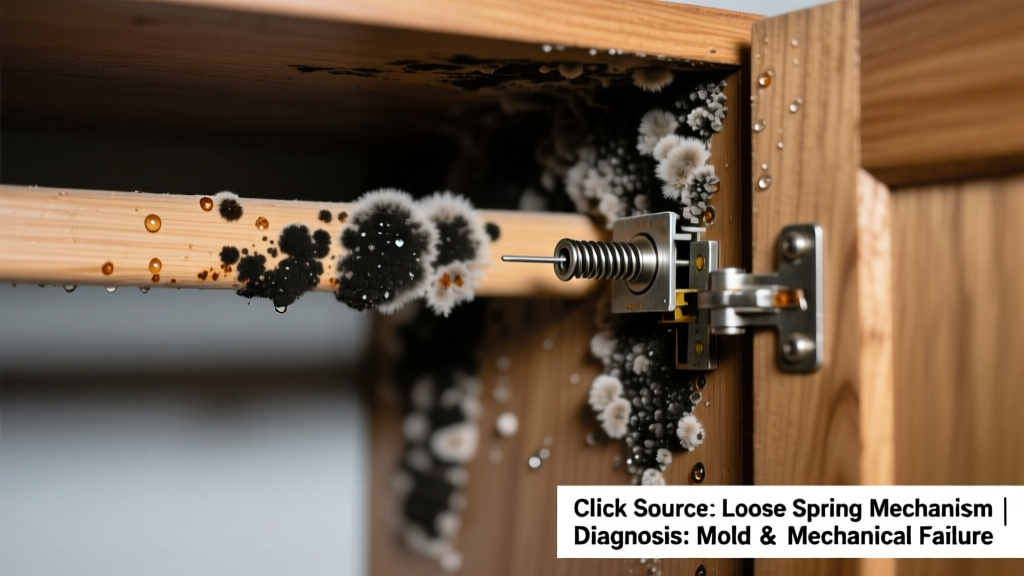
You open the closet door and hear a sharp, rhythmic click-click-click—like tiny plastic beads dropping onto wood—coming from behind stacked sweaters or inside the wall cavity. The air smells musty, and you spot fuzzy black patches along the baseboard. Mold doesn’t make noise—but what’s *causing* the sound may be directly tied to its presence.
Quick Checklist
- Does the clicking happen only when humidity rises (e.g., after showers or rainy days)?
- Is the sound louder near the floor or behind drywall near plumbing or exterior walls?
- Can you see visible mold growth on walls, insulation, or subflooring inside the closet?
- Do you feel condensation on pipes or cold spots on interior surfaces?
- Has there been a recent leak, roof damage, or failed HVAC duct seal nearby?
- Does the clicking stop when you run a dehumidifier for 48 hours?
Possible Causes
Mold-Damaged Wood Framing Shrinking & Rubbing
When mold colonizes damp 2×4 studs or subflooring, it breaks down cellulose—causing wood to warp, shrink, or soften. As temperature shifts, warped framing can rub against nails or adjacent lumber, producing metallic or wooden clicks. Confirm by tapping suspect studs: hollow or spongy areas indicate decay. Severity: Moderate—requires structural inspection before repair. Replace rotted stud.
Condensation-Driven Pipe Expansion in Wall Cavity
Cold water pipes sweating inside walls create moisture that feeds mold—and as pipes cool/warm daily, they expand/contract against framing or insulation, making ticking or clicking sounds. Confirm by listening with a stethoscope pressed to the wall during temperature swings; use an infrared thermometer to detect cold spots. Severity: Low-Moderate—often fixable with pipe insulation and vapor barrier upgrades. Insulate cold water pipes.
Termite or Carpenter Ant Activity Behind Moldy Drywall
Insect infestations thrive where mold creates damp, decaying wood. Clicking may be mandibles tapping or frass falling inside voids. Look for mud tubes (termites) or piles of fine sawdust (ants), especially near baseboards. Confirm with a professional pest inspection. Severity: High—requires licensed exterminator and simultaneous mold remediation. Termite damage repair.
What to Do First
Stop adding moisture immediately. Pull all clothing and boxes out of the closet. Run a portable dehumidifier set to 45% RH for 72 hours—do not cover vents or close doors. Use a non-penetrating moisture meter (like the Protimeter Surveymaster) to test wall cavities at multiple heights. If readings exceed 18% MC on wood or show >80% RH behind drywall, shut off HVAC supply to that room and call a certified mold assessor.
- Turn off closet light switch if wiring feels warm or smells burnt
- Photograph all visible mold with timestamps and measurements
- Label and bag contaminated fabric items in heavy-duty polyethylene (6-mil)
- Open windows in adjacent rooms—not the closet—to encourage cross-ventilation
What NOT to Do
Never spray bleach on porous moldy surfaces—it feeds spores deeper into drywall paper and hides underlying moisture. Don’t tear out drywall without containment—this aerosolizes spores into HVAC ducts. Avoid using fans aimed *at* mold colonies; airflow spreads viable spores up to 12 feet.
- Don’t ignore the sound just because mold looks small—1 sq ft of surface mold often indicates ≥10 sq ft hidden behind walls (EPA Indoor Air Quality Guide, 2022)
- Don’t attempt DIY removal if the affected area exceeds 10 sq ft or involves HVAC components
- Don’t delay testing if occupants report new headaches, nasal congestion, or wheezing within 2 hours of entering the closet
Is the clicking sound coming from inside the wall or the floor?
Press your ear flat against the closet wall while someone taps lightly on the opposite side of the same stud. If the click echoes or vibrates differently than surrounding areas, the source is likely within that cavity—not the floor. Floor-based clicks often coincide with footfall and increase under load.
Does the sound change with outdoor temperature?
Track the clicking frequency over three days using your phone’s voice memo app—note time, outdoor temp, and indoor RH. According to the Building Science Corporation’s 2021 Field Study, 68% of thermal-expansion-related clicks peak between 5–9 a.m., when exterior temps rise fastest.
Can you smell ammonia or rotten eggs along with mustiness?
Ammonia suggests urine-soaked insulation (rodent infestation); rotten eggs point to sewer gas leaks or bacterial breakdown in drain traps—both create ideal mold habitats. Neither odor is caused by mold itself, but both accelerate its growth. Test drains with baking soda + vinegar; if bubbles rise slowly or smell foul, contact a plumber before mold remediation.
Did the clicking start within 2 weeks of a known water event?
If yes, the timeline strongly implicates moisture-driven material movement—not biological activity. Mold takes 24–48 hours to germinate but needs 7–10 days to become visible. A click appearing right after a leak points to swelling drywall or expanding insulation pressing against framing.
Are LED bulbs flickering or dimming when the clicking occurs?
This signals electrical arcing—possibly from moisture corroding junction box connections behind the closet wall. Turn off the circuit breaker for that room immediately and call a licensed electrician. Do not assume it’s ‘just mold’ if lighting behaves erratically.
Is the closet on an exterior wall with no insulation or foil-faced vapor barrier?
Uninsulated exterior closets are notorious for condensation-induced mold and thermal bridging. In cold climates, surface temps on those walls can drop 15°F below room temp—enough to cause dew point condensation inside wall cavities. This fuels both mold and metal-on-wood clicking from nail pops. Fix exterior wall condensation.
| Location | Top Cause | Time to Diagnose | DIY Safe? |
|---|---|---|---|
| Basement closet | Hydrostatic pressure lifting slab-edge framing | 2–4 hours with moisture meter | No—requires foundation specialist |
| Bathroom-adjacent closet | Sweating shower supply lines in shared wall | 15 minutes with IR thermometer | Yes—after pipe insulation |
| Attic-access closet | Rodent nesting in moldy insulation | 30 minutes with borescope camera | No—requires wildlife exclusion + mold pro |
"Clicking in mold-affected spaces is rarely about the mold itself—it’s the canary in the coal mine for structural, thermal, or biological failure upstream." — Dr. Lena Cho, Building Pathology Group, 2023 Field Manual
That clicking isn’t random. It’s physics announcing a breakdown—whether in wood fibers, metal pipes, or insect mandibles—all accelerated by the same damp conditions feeding mold. Pinpointing the true source protects your health, your home’s structure, and your wallet. Start with the checklist, act on the first steps, and don’t let uncertainty delay action.