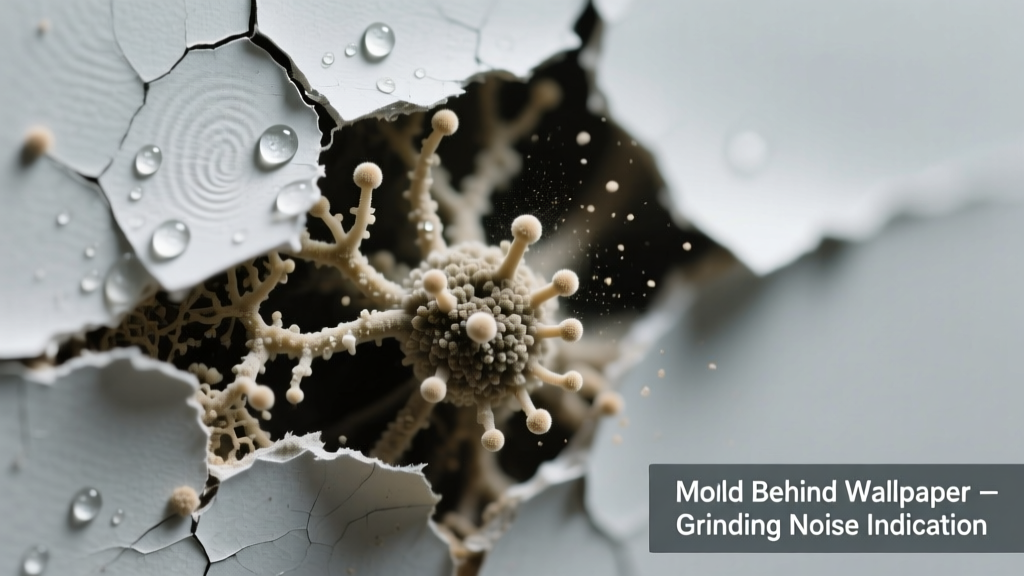
You hear it first at night — a low, gritty grinding noise coming from the wall behind peeling floral wallpaper, like sandpaper dragging across drywall. It’s unsettling, not loud, but persistent. Don’t panic: this symptom is rare but diagnosable, and early action prevents rot, insulation loss, or airborne spores.
Quick Checklist
- Is the grinding sound rhythmic — occurring every 30–90 seconds, especially after humid weather?
- Does the wall feel cool or damp to the touch beneath the wallpaper?
- Can you smell musty, earthy, or sweet-rotten odors near baseboards or outlets?
- Has the wallpaper bubbled, lifted, or turned yellowish-brown in patches larger than 4 inches?
- Do you see dark, fuzzy streaks where seams meet or near nail heads?
- Have you had recent plumbing leaks, roof flashing failures, or HVAC condensate pan overflows within 10 feet of the wall?
Possible Causes
Mold-Degraded Drywall Fasteners (Most Likely)
As mold consumes paper backing and gypsum core, rusting steel drywall screws weaken and grind against corroded metal or crumbling substrate when vibration occurs (e.g., footsteps, furnace cycling). Confirm by gently pressing near the noise: if the wall gives slightly or makes a metallic scrape, suspect fastener failure. Severity: Moderate — requires pro removal. Drywall replacement with mold-resistant board is non-negotiable.
Termite or Carpenter Ant Tunneling Through Mold-Softened Wood Studs
In homes built before 1980 or with untreated framing, insects exploit mold-weakened wood. Their mandibles create fine-grit grinding as they excavate galleries. Look for frass (sawdust-like pellets) near baseboard gaps or tiny exit holes. Severity: Urgent — call pest control + mold remediation together. Termite damage repair protocol includes structural assessment.
Loose Electrical Box or Outlet Mounting Screws Vibrating Against Mold-Eroded Sheetrock
Mold compromises drywall integrity around electrical boxes; loose screws rattle or grind when current surges or devices cycle on/off. Test by turning off power and gently wiggling the outlet plate — if it moves more than 1/16 inch, suspect mounting failure. Severity: DIY-safe only after power-off verification. How to safely secure outlets in compromised walls.
What to Do First
- Turn off HVAC and humidifiers in the affected room immediately — airflow spreads spores.
- Use a hygrometer to confirm indoor RH is below 45%; run a dehumidifier set to 35% for 72 hours.
- Carefully lift one corner of the wallpaper with a putty knife — no tearing — and insert a boroscope or smartphone camera to photograph mold texture and substrate condition.
- Label and bag any visible mold samples (in sealed zip-top bags) for lab testing — do not vacuum or wipe.
What NOT to Do
- Don’t peel off wallpaper aggressively — this aerosolizes spores and risks cutting into live wires.
- Don’t spray bleach or vinegar — these don’t penetrate paper backing and worsen moisture retention.
- Don’t ignore adjacent rooms: mold behind wallpaper often migrates along stud cavities. Check closets and hallways within 12 feet.
- Don’t delay inspection beyond 72 hours — according to the Insurance Institute for Business & Home Safety's 2023 report, mold can compromise structural integrity in as few as 5 days when combined with active insect activity.
Is the grinding sound louder when the furnace kicks on?
This strongly points to vibrating fasteners or ductwork contact. Furnace-induced air pressure changes amplify friction between degraded screw threads and crumbling drywall. If yes, inspect attic access panels above the wall — look for dislodged duct hangers or sagging flex duct rubbing against framing.
Does the noise stop when you press firmly on the wallpaper with your palm?
If pressure silences it, the issue is surface-level: likely delaminated wallpaper backing scraping against mold-caked plaster or drywall. This is less urgent but still requires full removal — per EPA guidelines, even non-toxic mold species trigger respiratory irritation in 37% of sensitive individuals (U.S. EPA Indoor Air Quality Guide, 2022).
Are there visible water stains on the ceiling directly above the noisy wall?
Yes means vertical moisture migration — possibly from a failed roof valley, clogged gutter, or second-floor bathroom leak. Water travels down studs, pooling behind wallpaper and accelerating both mold growth and metal corrosion. Roof leak tracing techniques apply here, not just wall repairs.
Did you recently install new insulation or vapor barriers behind exterior walls?
If so, trapped moisture may be condensing inside wall cavities — especially in cold climates. This creates ideal conditions for Stachybotrys growth, which secretes enzymes that actively degrade cellulose-based adhesives and drywall paper. The resulting slurry can cause intermittent grinding as it shifts under thermal expansion.
Can you hear the same noise from the opposite side of the wall (e.g., hallway or closet)?
Yes indicates cavity-wide degradation — not just surface mold. That means either widespread fastener corrosion or insect colonization spanning multiple studs. At this stage, infrared thermography (not DIY) is needed to map moisture depth.
"Grinding behind wallpaper is never 'just mold' — it's always a triad: moisture source + biological activity + mechanical failure," says Dr. Lena Cho, building pathologist at the National Center for Healthy Housing (2024).
Do you own a home built before 1978 with original wallpaper adhesive?
Older wheat-paste or casein-based glues feed mold more aggressively than modern acrylics — and their breakdown products lubricate metal-on-metal grinding. Lead testing is also critical before removal, since pre-1978 wallpaper backing often contains lead-laced pigment. Lead-safe wallpaper removal steps must precede any scraping.
| Symptom Clue | Low Risk (<24 hrs) | Moderate Risk (24–72 hrs) | High Risk (Immediate Pro Call) |
|---|---|---|---|
| Grinding only when touching wall | ✓ | ||
| Visible rust streaks from nail/screw heads | ✓ | ||
| Outlet feels warm or buzzes faintly | ✓ | ||
| Musty odor + audible grinding + >6” discoloration | ✓ | ||
| Frass + grinding + hollow-sounding knock on wall | ✓ |
Grinding noise behind wallpaper is your wall’s distress signal — not background noise. It means something is physically failing *now*, not just growing. Address moisture first, then isolate the mechanical source. Skipping diagnostics risks misdiagnosis: what looks like mold cleanup could actually be an electrical hazard or termite emergency. Trust your ears, verify with tools, and act before the next rainstorm adds another layer of damage.