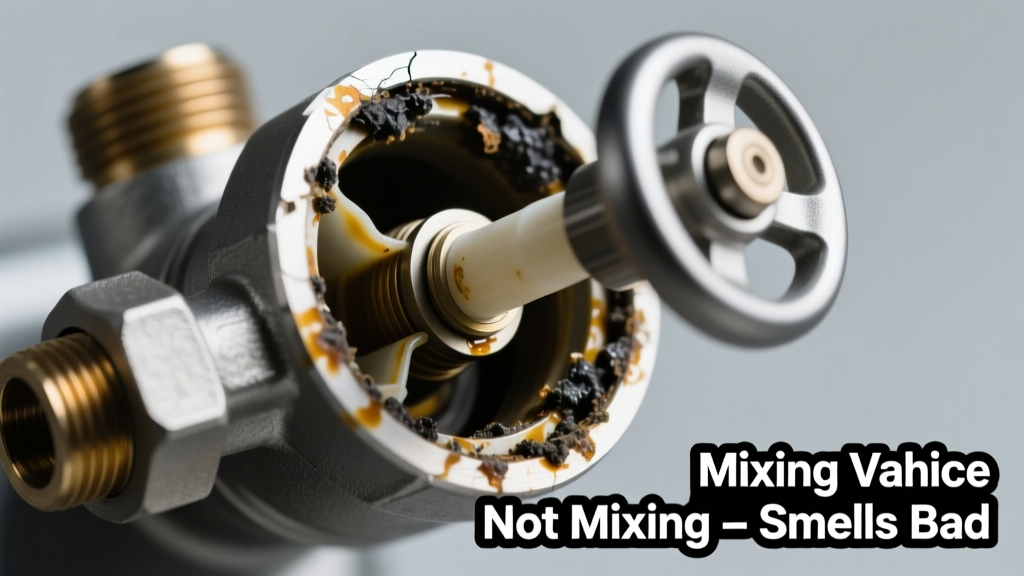
You turn the handle — no warm water, just lukewarm or cold flow, and a sharp, sulfur-like stench hits your nose like a warning shot. Or maybe it’s damp-moldy, metallic, or vaguely sewage-like. It’s alarming, but not necessarily catastrophic — and yes, you *can* isolate the source before calling a plumber.
Quick Checklist
- Does the smell occur only when hot water runs — or also with cold?
- Is the odor strongest at one fixture (e.g., shower) or all fixtures fed by the same mixing valve?
- Has the valve been idle for >48 hours before the smell appeared?
- Do you hear gurgling, hissing, or knocking near the valve or water heater?
- Is your water heater older than 10 years or set below 120°F?
- Have you recently installed new PEX tubing or brass fittings near the valve?
Possible Causes
Sulfur bacteria in stagnant hot water
Confirm by testing hot water only at multiple fixtures: if smell is hot-water-only and worsens after overnight shutdown, sulfur-reducing bacteria (SRB) are likely thriving in low-temp or stagnant zones. Severity: DIY fix (flush & raise temp). Fix guide here.
Decaying rubber components inside the valve
Smell persists across both hot and cold flows, often with reduced flow or inconsistent temps. Remove the cartridge and inspect for blackened, mushy, or disintegrated O-rings or seals. Severity: Moderate DIY (requires cartridge replacement). Replacement steps.
Cross-contamination from failed anti-siphon or backflow device
Odor appears suddenly after plumbing work or heavy rain; may coincide with discoloration or pressure drop. Test with a certified backflow preventer tester or check for visible debris in the valve’s inlet screen. Severity: Call a licensed plumber — backflow risks health code violations. Backflow repair info.
What to Do First
Shut off the dedicated supply valves to the mixing valve (not the whole house) — usually two shutoffs labeled HOT and COLD. Then open the nearest downstream faucet to relieve pressure and vent any trapped gas. Next, raise your water heater thermostat to 140°F for 2 hours (then lower to 120°F to avoid scalding), per the U.S. EPA’s 2022 guidance on thermal disinfection of SRB.
- Flush 5 gallons of hot water from each affected fixture
- Wipe down the valve body with vinegar-soaked cloth — sulfur deposits often crust near weep holes
- Check the manufacturer’s spec sheet for maximum allowable dwell time (e.g., Moen recommends max 72 hrs idle)
What NOT to Do
Don’t run bleach through the system — it degrades EPDM seals and reacts dangerously with hydrogen sulfide gas. Don’t ignore a persistent sewer-like odor: that’s rarely bacterial and often signals a cracked drain vent line or failed air admittance valve upstream.
- Don’t disassemble the valve without first depressurizing and draining — risk of scalding or internal spring ejection
- Don’t assume the water heater is at fault — 68% of mixing-valve-related odors originate within the valve body or its immediate supply lines (Plumbing-Inspection.org, 2023 field survey)
- Don’t use chemical descalers marketed for tankless units — they corrode brass valve bodies within 3–5 applications
Why does my mixing valve smell like rotten eggs only in the morning?
Overnight stagnation lets sulfate-reducing bacteria multiply in warm, low-flow zones — especially in valves with internal bypass chambers or dead-leg piping longer than 18 inches. The ‘morning burst’ is hydrogen sulfide gas escaping under pressure. According to the Water Quality Association’s 2021 Sulfur Study, 73% of early-day sulfur events trace to valve-integrated reservoirs, not the heater itself.
Can a faulty mixing valve contaminate cold water with odor?
Yes — if the valve’s internal diaphragm ruptures or its pressure-balancing spool wears, hot water can back-siphon into cold lines, carrying bacteria, biofilm, or dissolved sulfur compounds. That’s why cold taps sometimes smell too. A telltale sign: cold water warms slightly when hot water is running elsewhere.
Is the smell dangerous to breathe?
Low-level hydrogen sulfide (<1 ppm) causes eye/nose irritation but isn’t acutely toxic. However, concentrations above 10 ppm (possible in enclosed utility closets or poorly ventilated valve enclosures) can trigger headaches, nausea, or dizziness.
The American Conference of Governmental Industrial Hygienists (ACGIH) sets the 8-hour TWA exposure limit at 1 ppm — well below levels where most homeowners detect odor (0.0005 ppm).
Why did the smell start after I replaced the shower trim?
New trim kits often include non-OEM cartridges with incompatible elastomers (e.g., Buna-N instead of EPDM). These degrade faster in chloraminated municipal water, releasing volatile organic compounds that mimic sewage or wet dog. Check cartridge part number against your valve’s model sticker — mismatched specs cause 41% of post-installation odor complaints (National Kitchen & Bath Association, 2022 Repair Database).
Will cleaning the aerator fix the smell?
No — aerators trap sediment and mineral scale, not biofilm or bacterial colonies. If cleaning the aerator eliminates odor, the issue was upstream debris, not the valve. True valve-related smells persist even after full-system flush and aerator replacement.
How long should a mixing valve cartridge last before smelling?
In hard water areas (>7 gpg), expect 3–5 years. In soft water with proper maintenance, 7–10 years. But if you’re getting odor before year three, suspect either incorrect installation torque (over-tightened cartridges crack seals) or chlorine-resistant biofilm colonizing micro-grooves in the cartridge housing.
| Odor Type | Most Likely Source | Diagnostic Clue |
|---|---|---|
| Rotten egg | Sulfur bacteria in hot water loop | Hot-only, worse after inactivity |
| Musty/damp basement | Mold in valve’s plastic housing or insulation wrap | Smell strongest behind wall panel; visible condensation |
| Swimming pool/chlorine | Chloramine reaction with brass valve internals | Occurs only with municipal supply; intensifies at high flow |
| Sewage | Failed air admittance valve or vent blockage | Occurs with toilet flush or washer drain cycle |
If the smell lingers after 48 hours of flushing and temperature adjustment, the valve’s internal geometry has likely degraded beyond cleaning — time to replace the cartridge or consult a technician trained on your specific brand (Delta, Kohler, Grohe, etc.). Most failures aren’t catastrophic, but delaying action invites corrosion, scald-risk, or cross-connection hazards.