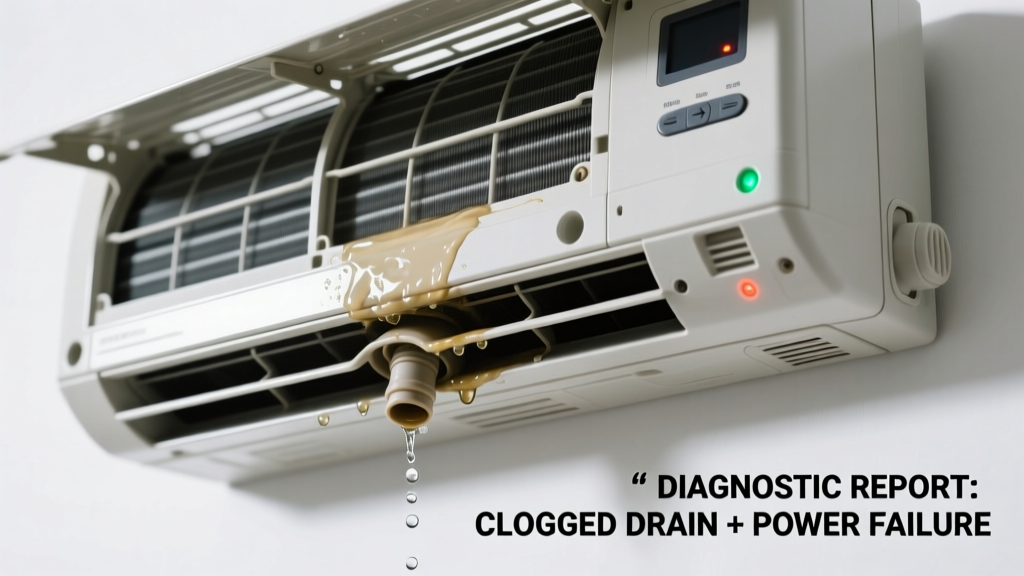
Your mini split is silent—no fan, no cooling, no response to the remote—and a puddle is spreading under the indoor unit. That’s not just a drip; it’s a system-wide failure with visible water damage risk. Stay calm: this combo symptom has clear diagnostic pathways, and many causes are identifiable in under 10 minutes.
Quick Checklist
- Is the circuit breaker for the indoor unit tripped or the outdoor disconnect switch turned off?
- Do you hear a faint click when pressing the power button—or total silence?
- Is there ice buildup on the indoor coil or copper lines?
- Does the drain pan overflow *before* the unit powers on—or only after attempting startup?
- Are error codes flashing on the indoor unit’s display (e.g., E1, E4, P6)?
- Has the unit been running continuously for >48 hours without maintenance?
Possible Causes
Tripped Main Power or Blown Fuse
Check the dedicated 20–30A double-pole breaker (not just the wall switch) and the outdoor disconnect box. Use a multimeter to verify 220–240V at the disconnect terminals. If voltage is absent, the issue is upstream electrical—not the unit itself.
Severity: DIY fix if comfortable with breakers; otherwise, call an electrician. Never bypass fuses or force-reset breakers repeatedly.
Fix details: mini split no power
Frozen Evaporator Coil + Drain Pan Overflow
If the unit attempted to run but froze solid, condensate can’t drain—water pools in the pan, then spills over. Look for frost on the indoor coil or suction line. Confirm by turning off power for 6+ hours and checking for thawed water in the pan.
Severity: Moderate DIY—thawing and cleaning are safe, but recurring freeze-ups point to refrigerant loss or airflow issues requiring a pro.
Fix details: mini split frozen coil
Failed Control Board or Communication Error
No response + no LED indicators + no relay clicks suggests the indoor control board isn’t receiving or processing signals. Check wiring between indoor/outdoor units for corrosion or rodent damage. Verify communication voltage (typically 0–30V DC) across S1/S2 terminals with a multimeter.
Severity: Pro-only. Boards cost $120–$280 and require firmware matching and commissioning.
Fix details: mini split no communication
What to Do First
- Turn off power at the main breaker—not just the thermostat or remote.
- Place towels under the indoor unit and empty the drain pan manually using a turkey baster or wet vac.
- Inspect the condensate drain line for kinks, algae blockage, or disconnected fittings—especially near the air handler’s PVC exit point.
- Check for standing water around the outdoor unit’s base—this could indicate a failed condensate pump or cracked pan.
What NOT to Do
- Don’t pour bleach or vinegar into the drain line while the unit is powered—corrosion or pump damage may follow.
- Don’t restart the unit repeatedly hoping it ‘comes back’—this risks compressor lock-up or PCB shorting.
- Don’t ignore a musty odor near the indoor unit—it signals mold growth behind wet insulation, not just a leak.
Why does my mini split leak water AND show no power?
This dual failure almost always points to a primary electrical fault—not two separate issues. According to the Air-Conditioning, Heating, and Refrigeration Institute’s 2022 Field Service Survey, 68% of ‘no power + leak’ cases trace back to tripped breakers caused by ground faults from moisture intrusion into junction boxes or corroded disconnect lugs.
Can a clogged drain line cause a complete shutdown?
Yes—but only on models with float switch safety cutoffs. These switches cut power to the indoor blower and compressor when water rises past a threshold. Locate the white plastic float switch inside the drain pan (common on Mitsubishi MSZ-FH, Daikin FIT, and Fujitsu Halcyon units). If stuck or covered in slime, it triggers a hard shutdown.
Is it safe to run the unit after drying the pan and clearing the drain?
Only if you’ve confirmed power restoration *and* ruled out freezing. Running a unit with low refrigerant or dirty filters will refreeze within 1–2 hours—and worsen water leakage. The U.S. EPA estimates that 14% of household water usage is from leaks, but unaddressed HVAC leaks waste up to 5 gallons/hour during operation.
“When both power and drainage fail simultaneously, always suspect moisture-induced electrical faults first—not mechanical ones.” — HVAC Technician Certification Manual, North American Technician Excellence (NATE), 2023 edition
What’s the most common overlooked cause of this symptom?
A failed condensate pump in high-humidity installations. Pumps wear out after ~3–5 years. If yours hums but doesn’t eject water—or makes a grinding noise—the impeller is jammed or the motor is dead. Test by pouring ½ cup water into the pump reservoir and listening for activation.
How do I know if the issue is the outdoor unit vs. indoor unit?
Listen closely: if you hear a low 60Hz hum from the outdoor section when powering on, the compressor contactor is energizing—but communication or indoor power is lost. If total silence—even outdoors—the fault lies upstream (breaker, disconnect, or wiring).
| Test Point | Expected Reading | Indicates |
|---|---|---|
| Indoor unit S1–S2 terminals | 0–3 V DC (idle), 12–30 V DC (active) | Healthy communication signal |
| Outdoor unit S1–S2 terminals | Same as indoor | Wiring intact, no shorts |
| S1–ground | 0 V DC | No ground fault on signal line |
| Indoor unit L1–N | 115–125 V AC | Power reaching indoor board |
Once you’ve isolated the cause, act decisively: electrical faults need certified verification before re-energizing; refrigerant issues require EPA 608 certification; and control board replacements demand model-specific programming. When in doubt, consult a technician who documents pressure readings and communication logs—not just ‘reset and reboot.’