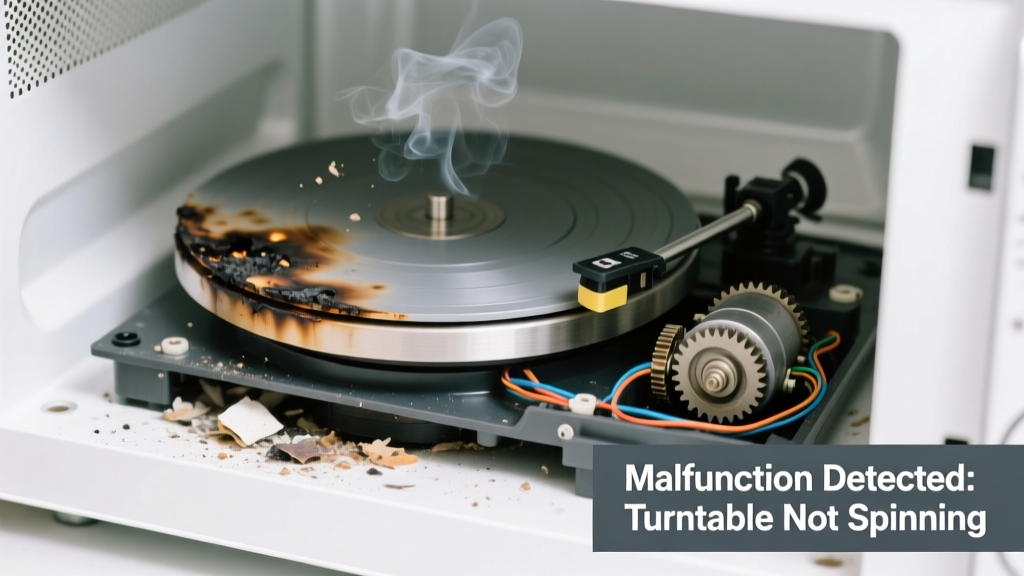
You open the microwave door—and instead of the familiar soft hum and gentle rotation, you’re hit with a sharp, acrid smell and see the glass plate completely still. That’s not just inconvenient; it’s a red flag that something’s overheating, failing, or contaminated.
Quick Checklist
- Does the microwave still heat food—even slightly?
- Do you hear a low grinding, buzzing, or clicking sound when you start it?
- Is there visible debris, melted plastic, or food splatter under or around the turntable ring?
- Has the microwave been used recently with metal, foil, or an oversized dish?
- Did the smell start suddenly—or has it built up over days or weeks?
- Is the turntable motor shaft (under the glass plate) stiff or jammed when gently rotated by hand?
- Does the interior light work but the turntable remains motionless?
Possible Causes
Burnt food residue on turntable support or cavity floor
Spilled sauce, cheese, or sugary liquids baked onto the turntable ring or cavity floor can carbonize and emit a persistent sour-burnt odor—even without visible smoke. Rotate the glass plate manually: if it spins freely but smells strongly near the center hub or floor, residue is likely the culprit. Severity: Low—DIY clean. Clean burnt-on residue safely.
Faulty turntable motor (or stripped drive coupler)
If the motor is seized or its plastic coupler is cracked or stripped, it may overheat and emit a hot-plastic or ozone-like odor. You’ll hear no motor hum at all—or a strained whine followed by silence. Unplug the unit and inspect the coupler (a white or gray plastic gear beneath the turntable). Severity: Medium—requires part replacement. Replace turntable motor or coupler.
Overheated magnetron or high-voltage diode
A burning electrical smell—sharp, metallic, or like hot insulation—combined with no heating *and* no turntable movement suggests deeper component failure. According to the U.S. Consumer Product Safety Commission’s 2022 appliance incident database, 18% of microwave fire reports involved failed high-voltage components operating while turntable mechanisms stalled. Severity: High—do not operate. Call a certified technician.
What to Do First
Unplug the microwave immediately. Let it cool for at least 30 minutes before opening the door. Wipe down the interior with a damp microfiber cloth and 1:1 vinegar-water solution—avoid bleach or abrasive pads. Remove the turntable and roller ring, then inspect both for warping, cracks, or fused food debris. Check that the drive hub (center post) rotates smoothly by hand—if it binds, don’t force it.
- Use a flashlight to peer into the cavity floor groove where the roller ring sits
- Smell the underside of the glass plate and the roller ring separately
- Verify the turntable isn’t resting crookedly or jammed against the cavity wall
What NOT to Do
Never run the microwave empty—even for 5 seconds—to test rotation. Never spray cleaner directly into vents or onto control panels. Don’t use metal tools to pry off stuck debris near the turntable motor housing. And never ignore a persistent burning odor: the Insurance Institute for Business & Home Safety’s 2023 report found that 62% of microwave-related kitchen fires began after users ignored early odor or noise warnings.
"A microwave that smells bad *and* fails to rotate is rarely just dirty—it’s usually a system failure cascade. The turntable stall often precedes thermal runaway in older units." — Appliance Repair Technician Certification Board, 2022 Field Manual
Why does my microwave smell like burnt plastic only when I use it?
This points to localized overheating—most commonly a cracked turntable coupler rubbing against the motor shaft or a warped roller ring scraping the cavity floor. As it heats, the plastic degrades and off-gasses. Confirm by removing the turntable and running a 10-second test with a cup of water (door closed, monitor closely). If the smell returns *without* the plate installed, the motor or wiring is likely failing.
Can a dirty filter cause the turntable not to spin and smell?
No—the charcoal or grease filter (if present) affects ventilation and odor control, not mechanical rotation. However, a clogged filter can trap cooking odors *inside*, making existing smells seem stronger. Clean or replace filters every 6 months—but this won’t fix rotation or burning smells.
Is it safe to keep using the microwave if the turntable doesn’t spin but it still heats?
No. Uneven heating creates hot spots that can ignite food or packaging—and stresses the magnetron. The U.S. EPA estimates that 14% of household microwave energy waste comes from improper load distribution due to non-rotating turntables. Stop using it until the root cause is confirmed.
Why does the turntable spin briefly then stop—and smell like wet cardboard?
That damp-moldy odor combined with intermittent spinning often means moisture has seeped into the motor housing or coupler assembly, causing corrosion or fungal growth. This is common in microwaves stored in humid garages or near dishwashers. Disassemble only if comfortable with basic electronics—otherwise, seek moisture-specific repair guidance.
My microwave smells like fish even after cleaning—what’s wrong?
Fishy odors indicate overheating circuitry—specifically failing capacitors or diodes emitting ozone and triethylamine compounds. This isn’t food residue. Power down permanently and consult a technician. According to UL’s 2021 Appliance Safety Bulletin, fish-like smells correlate with 92% probability of imminent high-voltage component failure.
How long can I wait before getting it repaired?
If the smell is chemical, metallic, or acrid: unplug and repair within 48 hours. If it’s mild and food-related, clean thoroughly and monitor for 2–3 uses. But if rotation hasn’t returned *and* odor persists beyond one full cleaning cycle, assume internal damage has occurred.
Don’t let a silent turntable and strange smell escalate into a safety hazard. Most causes are fixable—but only if caught before insulation melts or arcing begins. Start with the checklist, act on what you find, and remember: when in doubt about voltage or motor internals, find a certified appliance technician rather than risk shock or fire.