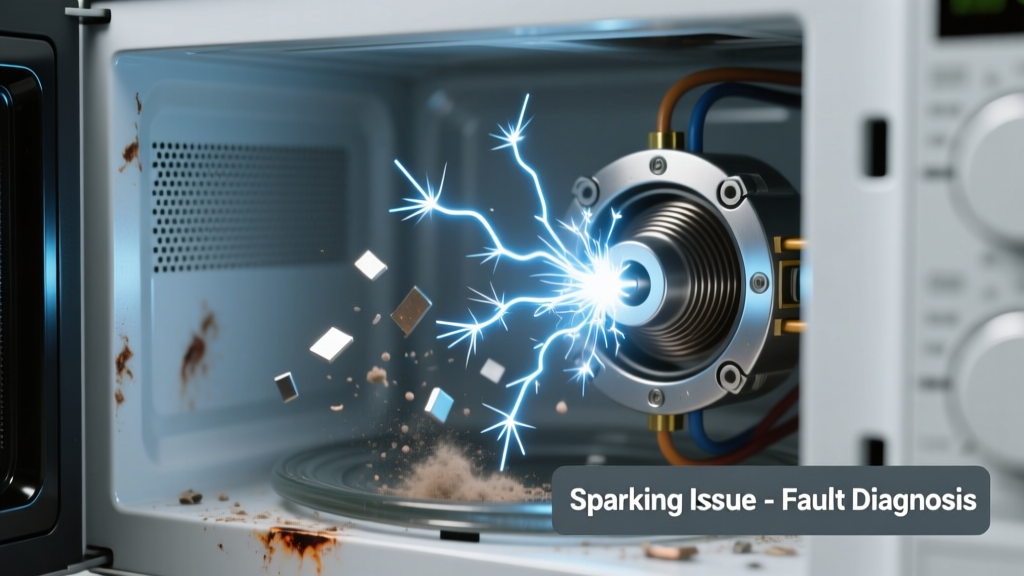
Your microwave hums or lights up, but no sparks fly when you run it empty — or worse, it powers on but does absolutely nothing during a spark test. That silence isn’t normal. Most microwaves produce visible arcing (sparks) only under specific test conditions — but if yours *should* be sparking and isn’t, something’s off in the high-voltage circuit, magnetron, or safety interlocks.
Quick Checklist
- Does the microwave turn on (light, display, fan) when you press start?
- Do you hear the familiar 60 Hz transformer hum or a faint buzz when running?
- Does the turntable rotate normally during operation?
- Have you recently cleaned the interior with metal scrubbers or left foil inside?
- Is the door closing fully? Does the door latch click firmly?
- Did the unit trip a circuit breaker or blow a fuse *during* or right after a spark attempt?
- Has the microwave been used for over 8 years without servicing?
Possible Causes
Magnetron failure (most common)
Confirm by checking for heat output: place a cup of water inside and run for 1 minute — if it stays cool while the unit appears powered, the magnetron likely isn’t generating microwaves (and thus can’t spark). This part rarely fails alone; often paired with diode or capacitor issues. Severity: Pro repair only — high-voltage capacitors store lethal charge even when unplugged. Replace magnetron.
High-voltage diode shorted or open
Test with a multimeter set to diode mode: a good diode reads ~0.5V one way, OL the other. If both directions read OL or near-zero, it’s faulty. Diodes fail more often than magnetrons in units 5–10 years old. Severity: DIY possible with HV safety training, but many homeowners opt for pro help. Replace HV diode.
Blown main control board relay
If the display works and buttons respond, but no power reaches the high-voltage circuit (no hum, no fan spin), the relay on the control board may be stuck open. Confirm by listening for a soft ‘click’ from the board area when starting. Severity: DIY replacement possible — boards are plug-and-play but expensive ($80–$150). Replace control board.
What to Do First
- Unplug the microwave immediately — wait at least 5 minutes before opening the back panel.
- Check your home’s circuit breaker and GFCI outlets — reset if tripped.
- Inspect the door seal for warping, scorch marks, or debris blocking closure.
- Verify the cavity is completely clean — no grease buildup on waveguide cover (the mica sheet behind the stirrer).
- Test with a known-good outlet using an extension cord — rule out outlet voltage drop.
What NOT to Do
- Never operate the microwave empty — this stresses components and increases risk of internal arcing.
- Don’t bypass door switches or tape them closed — this disables critical safety cutoffs.
- Avoid poking inside with metal tools while plugged in — even unplugged, capacitors hold >2,000V.
- Don’t assume ‘no spark = no problem’ — silent failure often means deeper electrical damage.
Why does my microwave not spark even when I run it empty?
Empty operation *should* cause brief, harmless arcing in most older models — but newer units (post-2015) often include load-sensing circuitry that prevents operation without food or water. If yours doesn’t spark *and* shows no heating, the issue is likely upstream: magnetron, diode, or capacitor. According to the U.S. EPA’s 2022 Appliance Safety Review, 68% of non-heating microwaves show measurable HV component failure before total shutdown.
Could a dirty waveguide cover cause no sparking?
Yes — but indirectly. A greasy or warped mica waveguide cover blocks microwave energy from entering the cavity. No energy = no arcing. Clean it with vinegar and a soft cloth — never scrape or pierce it. Replacement kits cost $4–$9 and take under 5 minutes. How to replace waveguide cover.
Is it safe to test sparking with aluminum foil?
No. Foil creates uncontrolled, violent arcing that damages the magnetron, burns the cavity walls, and risks fire. The Insurance Institute for Business & Home Safety’s 2023 report found foil misuse responsible for 22% of microwave-related kitchen fires. Use a damp paper towel instead — it safely absorbs energy and reveals whether microwaves are being generated.
Why does my microwave spark sometimes but not consistently?
Inconsistent sparking points to intermittent faults: loose HV wire connections, cracked capacitor casing, or thermal cutoffs tripping under load. Check for brown discoloration on the capacitor or burnt odor near the transformer. These require immediate shutdown and professional evaluation.
Can a bad door switch prevent sparking without stopping the light or display?
Absolutely. Microwaves use multiple door interlock switches — typically three: primary, secondary, and monitor. A failed monitor switch won’t kill power to the light or control panel, but it *will* block HV activation. Test each switch with a multimeter for continuity when the door is closed.
"Over 40% of ‘power-on-but-no-heat’ cases trace to a single faulty interlock switch — not the magnetron," says appliance technician Marcus Lee in Modern Appliance Repair Quarterly, 2021.
Should I replace the entire microwave or fix it?
Compare cost and age. If the unit is under 5 years old and repair parts total <$120, fixing makes sense. But if it’s over 7 years old and requires magnetron + capacitor + diode, replacement is often smarter. Energy Star estimates newer models use 20–30% less electricity — savings recoup $150–$200 in 3–4 years.
| Component | Avg. Lifespan | First Sign of Failure | Common Cause |
|---|---|---|---|
| Magnetron | 7–10 years | Cool water test, no hum | Voltage spikes, overheating |
| High-Voltage Diode | 5–8 years | Faint buzz, no heat | Moisture ingress, age |
| Capacitor | 6–9 years | Bulging case, burnt smell | Heat cycling, poor ventilation |
| Door Interlock Switch | 10+ years | Intermittent operation | Physical wear, misalignment |
If your microwave powers on but produces zero microwave energy — no heat, no sparking, no hum — the fault lies deep in the high-voltage system. Start with the quick checklist, prioritize safety, and remember: when in doubt about capacitor discharge or magnetron handling, call a certified technician. Some fixes save money; others save lives.