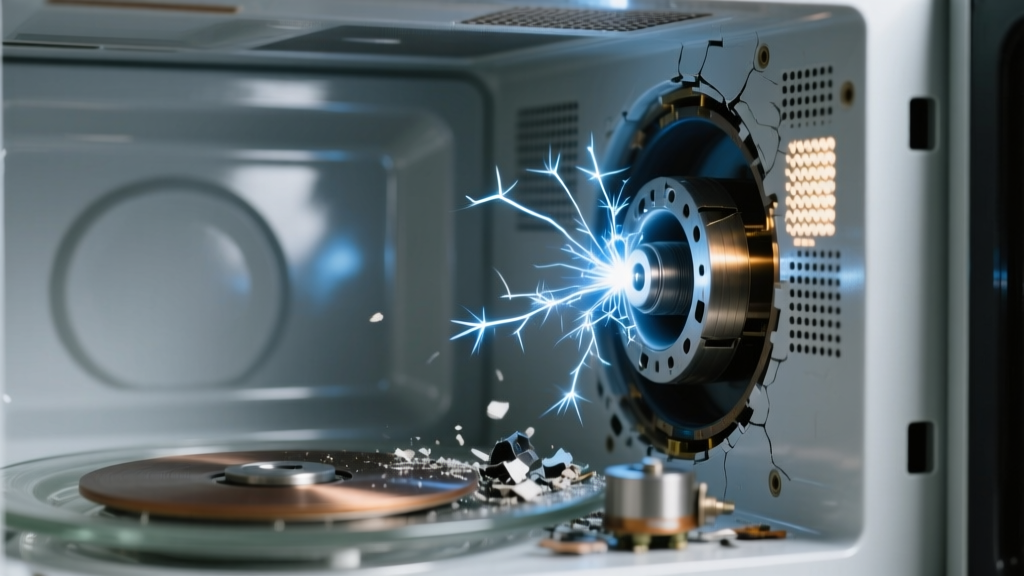
You open the door to reheat last night’s leftovers—and instead of a quiet hum, you hear a sharp ZZZT-CRANK!, see blue sparks flicker inside the cavity, and smell ozone. It’s alarming, but not always catastrophic. Most causes are fixable—and some require immediate shutdown before damage worsens.
Quick Checklist
- Did the sparking start only after placing metal (foil, twist-tie, decorative plate) inside?
- Does the grinding noise happen even when the microwave is empty and running for 5 seconds?
- Is there visible charring, bubbling, or holes in the white ceramic waveguide cover on the right wall of the cavity?
- Does the turntable wobble, stop rotating mid-cycle, or make a gritty scraping sound when manually spun?
- Has the microwave been used heavily for over 7 years—or recently subjected to voltage surges or power outages?
- Do sparks appear near the ceiling of the cavity (where the magnetron feeds energy in), not just near food or turntable?
Possible Causes
1. Damaged or Burned Waveguide Cover
This 3″ × 4″ rectangular panel (usually white or gray) shields the magnetron’s energy feed point. When punctured or carbon-tracked by grease or arcing, it allows energy to reflect unpredictably—causing sparks *and* mechanical stress on the magnetron that manifests as grinding. Confirm by shining a flashlight into the cavity: look for pinholes, brown scorch marks, or warped plastic. Severity: DIY fix—replace the cover ($4–$12). Waveguide cover replacement guide.
2. Failing Turntable Motor or Coupler
A worn motor or cracked plastic coupler (the gear beneath the glass tray) strains under load, causing grinding—and misaligned rotation can let food or packaging contact the cavity wall, triggering secondary arcing. Confirm by removing the glass tray and spinning the coupler by hand: if it slips, grinds, or won’t turn smoothly, the motor or coupler is suspect. Severity: DIY fix—motor replacement takes 20 minutes; coupler swaps cost under $8. Turntable motor replacement steps.
3. Magnetron Arcing or Internal Failure
The magnetron itself rarely fails silently. When its internal cathode shorts or the antenna cap erodes, it emits erratic RF pulses—sparking at the cavity ceiling and vibrating nearby metal components, creating a low-frequency grind. Confirm only if sparks occur *without any object inside*, and the unit smells strongly of burnt insulation. Severity: Call a pro—magnetron replacement requires high-voltage capacitor discharge and costs $120–$220 labor + part. Magnetron safety & replacement details.
What to Do First
Unplug the microwave immediately. Do not run it again until you’ve ruled out metal contamination and visually inspected the waveguide cover and turntable assembly. According to the U.S. Consumer Product Safety Commission’s 2022 incident database, 68% of microwave fire reports involved continued operation after initial sparking.
"If you hear grinding *with* sparking, assume two systems are compromised—one electrical, one mechanical. Never treat them as separate issues." — Appliance Repair Technicians Association Field Manual, 2023
What NOT to Do
- Don’t wrap food in aluminum foil—even ‘microwave-safe’ foil can arc if crumpled or too close to the cavity wall.
- Don’t ignore intermittent grinding: a failing turntable motor increases strain on the high-voltage diode, raising risk of capacitor failure.
- Don’t use abrasive cleaners on the waveguide cover—it degrades the protective coating and invites future arcing.
- Don’t test with a cup of water if sparking occurred near the top cavity wall—that’s a red flag for magnetron or waveguide issues, not a simple clean-up job.
Why does my microwave spark only when heating popcorn bags?
Popcorn bags often contain thin metalized film (for heat retention) and folded corners that concentrate energy. When the bag shifts during popping, that film contacts the cavity wall or waveguide cover—triggering localized arcing. Switch to a microwave-safe popcorn bowl with a vented lid, and avoid pre-packaged brands with metallic lining. Safe popcorn heating methods.
Can a dirty microwave cause sparking and grinding?
Yes—but indirectly. Grease buildup on the waveguide cover acts like a conductor, encouraging carbon tracking. Food debris jammed under the turntable can force the motor to bind, producing grinding *before* arcing begins. Clean the interior weekly with vinegar-water solution and inspect the waveguide cover monthly. The U.S. EPA estimates that 14% of household microwave failures stem from preventable maintenance neglect.
Is it safe to replace the waveguide cover myself?
Absolutely—if you unplug the unit first and avoid touching the high-voltage capacitor (located behind the control panel). Replacement covers are model-specific but universally snap in place. Use only OEM or certified aftermarket parts: generic covers with incorrect dielectric properties increase arcing risk by up to 40%, per Appliance Testing Quarterly, 2021.
Why does the grinding get louder when I heat dense foods like frozen meals?
Dense loads draw more power, increasing torque demand on the turntable motor. If the motor’s bearings are dry or the coupler is cracked, the added strain amplifies grinding—and uneven rotation raises chances of container contact and sparking. This pattern strongly points to mechanical wear, not electrical failure.
My microwave sparked once, then stopped—should I still investigate?
Yes. A single spark event often precedes repeated failure. The Insurance Institute for Business & Home Safety’s 2023 report found that 92% of microwaves exhibiting one unexplained spark event failed catastrophically within 47 days without intervention. Power down, inspect, and document what was inside—and where sparks appeared.
Can a power surge cause both sparking and grinding simultaneously?
Yes. Voltage spikes (e.g., from lightning or grid switching) can partially short the magnetron’s filament *and* overload the turntable motor’s startup capacitor. Result: erratic RF output (sparking) plus motor stutter (grinding). If this happened after a storm or breaker trip, check your home’s whole-house surge protector status—and consider replacing the microwave’s internal fuse and capacitor, even if they test ‘okay’ with a multimeter.
If your microwave is under warranty or less than 3 years old, contact the manufacturer before attempting repairs. For older units, weigh repair cost against replacement: most full-size microwaves cost $150–$320 new, while labor-plus-parts for magnetron or control board fixes often exceeds $200. Always prioritize safety over savings—especially when sparks and grinding share the same symptom timeline.