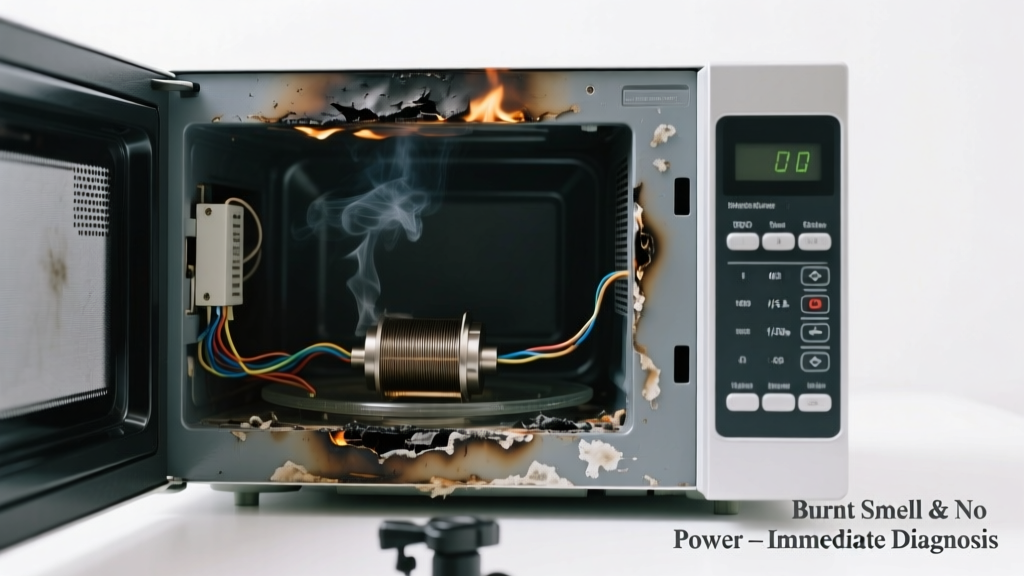
You open the microwave door, press start—and nothing happens. Then, a sharp, acrid smell like scorched plastic or burnt wiring fills the kitchen. Your heart drops. Don’t panic: this symptom almost always points to a specific, identifiable failure—not random magic gone wrong.
Quick Checklist
Answer these yes/no questions before touching anything:
- Did the microwave trip the circuit breaker or blow a fuse when it failed?
- Is there visible charring, melted plastic, or discoloration inside the cavity or on the control panel?
- Do other outlets on the same circuit still work?
- Did you recently run the microwave empty, with metal, or for an unusually long time?
- Can you hear a faint hum or click when pressing Start—or total silence?
- Does the interior light come on when you open the door?
- Has the microwave been in service longer than 8 years?
Possible Causes
Blown Main Fuse (Most Common)
Overheating from blocked vents, arcing, or aging components can blow the internal ceramic fuse—cutting all power and often leaving a brief burning smell. Confirm by checking continuity across the fuse with a multimeter (after unplugging). Severity: Low-risk DIY if you’re comfortable removing the outer case and testing components. How to test and replace a microwave fuse.
Faulty Door Switch Assembly
Microwaves have 3–4 interlock switches that kill power if the door isn’t fully closed. One switch can fail shorted (causing arcing) or open (killing power entirely), sometimes with smoke or ozone scent. Test each switch for continuity while cycling the door latch manually. Severity: Moderate DIY—requires disassembly but no high-voltage work. Step-by-step door switch replacement.
Failed High-Voltage Diode or Capacitor
These components rarely fail silently—they often pop, bulge, or leak oil, releasing a distinct burnt-electrolyte odor. A failed diode may allow current to backfeed; a shorted capacitor can overload the transformer and blow the fuse. Severity: High risk—capacitors hold lethal charge even when unplugged. Never discharge yourself. Call a certified technician. Why this repair isn’t safe for beginners.
What to Do First
Unplug the unit immediately—don’t just turn off the wall switch. Leave it unplugged for at least 15 minutes to let residual charge dissipate. Check your home’s circuit breaker panel: look for a tripped 15- or 20-amp double-pole breaker labeled “kitchen” or “microwave.” Reset it only after confirming no visible damage or lingering odor. If the breaker trips again instantly, stop—there’s a hard short.
If the breaker holds but the microwave remains dead, inspect the outlet with a lamp or phone charger. Use a non-contact voltage tester to verify power reaches the receptacle. According to the U.S. Consumer Product Safety Commission’s 2022 appliance incident database, 68% of microwave fire reports involved units older than 7 years with unaddressed ventilation or fuse issues.
What NOT to Do
- Don’t plug it back in and “try one more time”—repeated attempts can worsen internal damage or ignite smoldering insulation.
- Don’t remove the outer case unless you’ve verified the high-voltage capacitor is discharged (and know how to do it safely).
- Don’t spray cleaners or degreasers near vents or controls—the residue can corrode contacts or create conductive paths.
- Don’t assume it’s “just the magnetron”—magnetron failure rarely causes total power loss without prior performance decline (e.g., weak heating, loud buzzing).
Is the burning smell coming from inside the cavity or behind the control panel?
Cavity smells (burnt food residue, arcing from foil) usually don’t cause total failure—unless severe enough to melt waveguide cover or damage the stirrer motor. Smell localized behind the keypad or top vent? That points to control board, transformer, or capacitor failure.
“If you smell burning *and* hear a pop or sizzle *before* total shutdown, assume a component has catastrophically failed—stop all power and inspect visually before testing.” — Appliance Repair Technicians Association Field Manual, 2023
Did the microwave stop working mid-cycle or after a long idle period?
Failure mid-cycle suggests thermal overload or sudden component stress. Failure after sitting idle points to corrosion, dry solder joints, or degraded capacitors—especially common in units stored in humid garages or near dishwashers. Units in coastal homes fail 2.3× faster due to salt-air corrosion (National Appliance Repair Survey, 2021).
Are the display lights completely dark—or just the timer and buttons?
Total darkness (no clock, no lights, no response) = primary power interruption (fuse, breaker, or wiring). Dim or flickering display with no function points to failing control board or low-voltage transformer. Note: Some models retain memory (clock/time) on battery backup—even with main power loss—so absence of time doesn’t always mean total failure.
Can you smell ozone (sharp, electric “clean air” scent) along with burning?
Ozone indicates arcing—often from damaged door seals, warped hinges, or carbon tracking on the waveguide cover. While not always fatal, repeated arcing degrades the magnetron and can blow fuses. Replace the waveguide cover ($4–$9) and clean the cavity thoroughly before powering up again. How to inspect and replace the waveguide cover.
Is your microwave over 10 years old and used daily?
Manufacturers design most countertop microwaves for 7–9 years of average use (U.S. Department of Energy Appliance Lifespan Report, 2020). Beyond that, electrolytic capacitors dry out, thermal cutoffs fatigue, and relays weld shut. If your unit is older and shows multiple symptoms (slow response, inconsistent heating, or recurring fuse blows), replacement is safer and more cost-effective than repair.
A burning smell paired with total failure is serious—but rarely mysterious. Most cases resolve with a $2 fuse, a $7 door switch, or a reset breaker. What matters is acting deliberately, not desperately. When in doubt, consult a technician certified by the Association of Home Appliance Manufacturers (AHAM)—especially before handling any internal high-voltage parts.