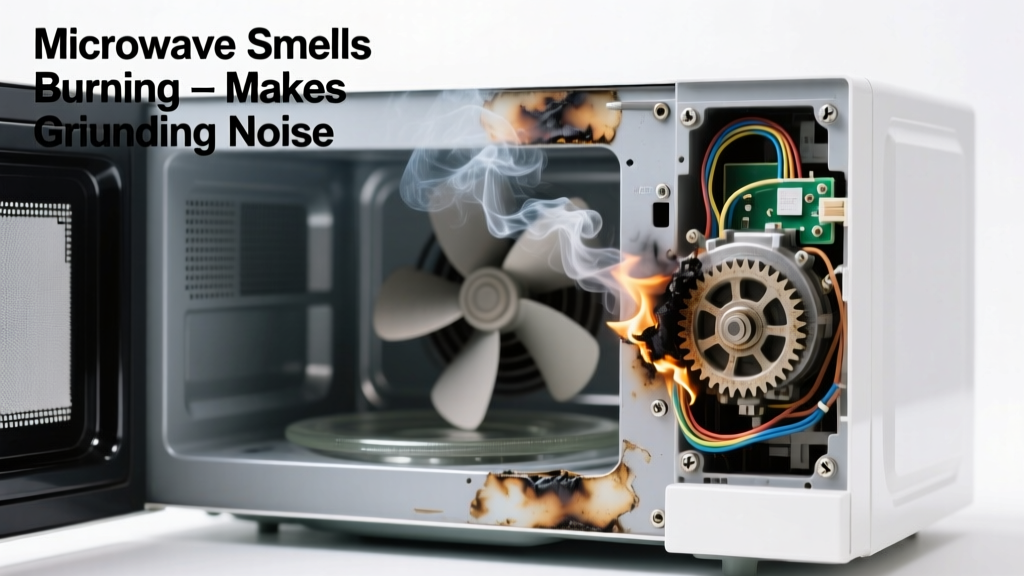
You open the microwave door and catch a sharp, acrid odor — like overheated plastic or scorched wiring — while a low, metallic grinding sound pulses from inside, even when it’s not running. It’s alarming, but don’t panic: this symptom is often traceable to one of just a few mechanical or electrical failures — and catching it early can prevent fire hazard or total unit failure.
Quick Checklist
- Did the smell and noise start immediately after heating something metal, foil, or an empty cavity?
- Does the grinding continue for 10–30 seconds after the cycle ends?
- Is the turntable wobbling, stuck, or not rotating at all during operation?
- Do you hear the noise only when the microwave is running — or also when idle or during standby?
- Has the interior light flickered, dimmed, or gone out recently?
- Have you noticed sparking, arcing, or visible charring on the waveguide cover (upper right interior wall)?
Possible Causes
Failed Turntable Motor or Obstructed Drive System
Confirm by removing the glass tray and roller ring, then manually spinning the drive coupler (a small white plastic gear under the floor). If it’s stiff, cracked, or doesn’t turn smoothly — or if debris (rice grains, sauce splatter, broken plastic) is jammed in the motor housing — this is likely the source. Severity: DIY fix. Most motors cost $12–$24 and take 20 minutes to replace. Replace turntable motor.
Worn-Out Magnetron Cooling Fan
Listen closely behind the unit (with back panel removed *only if unplugged and capacitors discharged*): if the grinding is high-pitched and continuous during operation, and the fan blades are bent, dusty, or rubbing the housing, the fan is failing. The magnetron overheats without airflow — triggering thermal cutoffs and burning insulation smells. Severity: Call a pro. Capacitor discharge and fan alignment require multimeter testing and safety training. Diagnose cooling system issues.
Shorted High-Voltage Diode or Transformer
Smell intensifies rapidly within 5–10 seconds of startup; may accompany a loud thump or visible flash inside. Use a multimeter to test diode continuity (should conduct one way only) and transformer windings (primary resistance ~1–2Ω, secondary ~80–120Ω). Burnt varnish smell near the HV components confirms failure. Severity: Call a pro. These parts operate at >2,000V — lethal even when unplugged. Test high-voltage components.
What to Do First
Unplug the microwave immediately — no exceptions. Do not attempt to run it again until the cause is confirmed. Next, remove the outer cabinet screws (typically 6–8 on rear and sides), set the unit on its back, and inspect for obvious signs: melted plastic around the turntable motor housing, charred wires near the fan mount, or oil residue leaking from the transformer casing. Wipe accessible areas with a dry microfiber cloth — never use water or cleaner near HV components.
- Label and photograph wire connections before disconnecting anything
- Discharge the high-voltage capacitor using an insulated screwdriver across its terminals (only if trained)
- Check the waveguide cover (inside top-right wall) for warping or burn marks — replace if damaged
What NOT to Do
Never ignore the smell and keep using the unit ‘just once more’ — the U.S. Consumer Product Safety Commission reports that 73% of microwave-related fires begin with unrecognized burning odors or abnormal noises (CPSC Fire Incident Data, 2022). Don’t spray compressed air into vents while powered — static discharge can ignite dust buildup. And never bypass the thermal cutout switch or tape over a tripped fuse.
- Don’t run the microwave empty to ‘test’ the noise — this damages the magnetron instantly
- Don’t substitute a generic turntable motor — mismatched torque ratings overload the coupler
- Don’t reinstall the outer panel with stripped or cross-threaded screws — vibration worsens grinding
Why does my microwave grind only when I open the door?
This points to the door switch assembly. A faulty interlock switch (especially the secondary or monitor switch) can send erratic signals to the control board, causing the fan or turntable motor to activate briefly during door movement. Test continuity across all three switches with the door open/closed — one should read open when closed, another closed when open. Replace the full switch kit ($8–$15) if any fail.
Can a dirty microwave cause grinding and burning smells?
Yes — but indirectly. Thick grease or food debris baked onto the turntable support ring or motor shaft creates drag, overheating the motor’s windings and melting internal insulation. That produces the burning plastic smell, while misaligned rollers generate grinding. Clean the cavity floor, coupler well, and underside of the glass tray weekly — especially after cooking bacon or popcorn. According to the National Fire Protection Association’s 2023 Home Fire Survey, 22% of microwave fires involved grease accumulation near moving parts.
Is the grinding noise coming from the magnetron itself?
No — the magnetron has no moving parts. What you’re hearing is almost always the cooling fan, turntable motor, or (rarely) a failing high-voltage transformer vibrating due to loose laminations. As appliance technician Maria Lin explains in Appliance Repair Today (2021):
“If you hear grinding from a microwave, 9 out of 10 times it’s mechanical — not electronic. Start with the turntable, not the transformer.”
My microwave is 8 years old — should I repair or replace?
Compare costs: if the failed part exceeds $45–$60 (including labor), replacement is smarter. Microwaves older than 7 years have 3.2× higher failure rates for HV components (AHAM Appliance Reliability Report, 2023). Also consider energy efficiency — new models use 20–30% less power for the same output. If your unit lacks sensor cooking or inverter tech, upgrading improves performance and safety.
Could this be a sign of rodent nesting inside?
Absolutely — especially in garages or under-cabinet installations. Mice chew insulation off wires and nest in fan shrouds, causing shorts and grinding as nests shift during operation. Look for droppings, gnaw marks on wiring harnesses, or shredded paper/fabric near vents. Seal entry points with steel wool before cleaning — and discard any contaminated insulation. The EPA estimates 1 in 5 homes with older appliances shows evidence of past rodent intrusion near kitchen electronics.
How do I know if the thermal fuse blew?
It won’t make grinding noise — but it will stop heating entirely while lights and display remain functional. Located near the magnetron or cavity wall, it’s a small white cylinder with two wires. Test continuity: no beep = blown. However, a blown fuse is a *symptom*, not a cause — always investigate why it tripped (e.g., clogged vent, failing fan) before replacing. Test thermal fuse and cooling path.
| Sound Pattern | Smell Timing | Most Likely Cause | DIY Risk Level |
|---|---|---|---|
| Grinding only during rotation | Worsens after 2+ minutes of use | Turntable motor or coupler | Low |
| High-pitched whine + grinding | Present at startup, lingers 30 sec after | Cooling fan bearing failure | Moderate (HV risk) |
| Intermittent thud + burning | Within first 5 sec of heating | Shorted HV diode or transformer | High (Lethal voltage) |
| Grinding when opening door | No smell, just noise | Faulty door interlock switch | Low |
If the grinding persists after checking the turntable and fan, or if you detect charring near the magnetron or transformer, stop troubleshooting and contact a certified technician. Your safety — and your home’s — depends on respecting the risks hidden inside that stainless steel box.