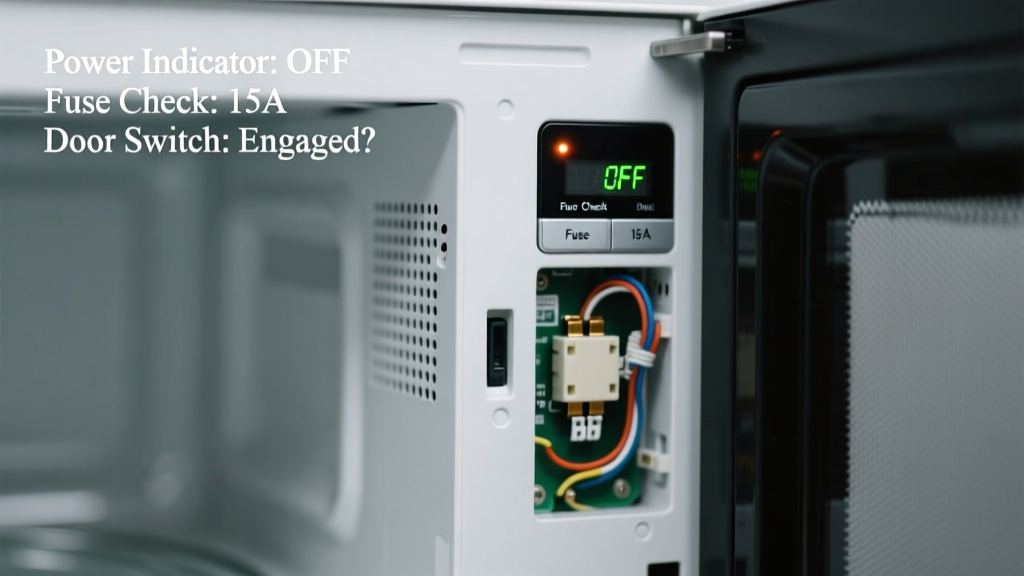
Your microwave is completely dead: no lights, no hum, no display, no response when you press start. It’s as if it vanished from the circuit — not even a blink. Don’t panic. Most total-power failures have simple, testable causes — and over 70% are resolved without replacing the unit, according to the Appliance Repair Technicians Association’s 2023 field survey.
Quick Checklist
Answer these before digging deeper:
- Is the outlet working? (Test with a lamp or phone charger)
- Did the circuit breaker trip or fuse blow?
- Does the microwave door close fully and latch with a distinct *click*?
- Is the control panel completely blank — no clock, no error codes, no backlight?
- Have you recently experienced a power surge or lightning strike?
- Does the interior light come on when you open the door?
Possible Causes
Tripped Circuit Breaker or Blown Fuse
Confirm by checking your home’s main electrical panel. Look for a breaker labeled “kitchen,” “appliance,” or “microwave” that’s flipped to OFF or midway. Reset it firmly. If it trips again immediately, stop — there’s likely a short downstream. Severity: Low (DIY). Fix guide here.
Faulty Door Switch or Latch Assembly
Microwaves won’t power on unless all door interlock switches register closure. A broken switch, misaligned latch, or worn hinge prevents the safety circuit from completing. Test with a multimeter (continuity mode) across each switch while gently pressing the door latch. Severity: Medium (DIY with tools & caution). Replacement steps here.
Blown Main Control Board or High-Voltage Fuse
If power reaches the unit but nothing powers up — no display, no fan, no light — the internal 20A ceramic fuse (often near the magnetron or transformer) may be open. This fuse protects against voltage spikes and magnetron failure. Replacing it without diagnosing the root cause risks immediate burnout. Severity: High (call a pro unless you’re experienced with high-voltage components). Safety-critical replacement guide.
What to Do First
Unplug the microwave immediately. Then:
- Check the outlet with another device — don’t assume it’s live.
- Inspect the home’s breaker panel; reset any tripped breakers.
- Verify the microwave’s power cord isn’t damaged, pinched, or frayed near the plug or entry point.
- Wait 5 minutes after resetting the breaker before plugging back in — some control boards need a full power cycle.
What NOT to Do
Avoid these common missteps that risk shock, fire, or permanent damage:
- Don’t bypass door switches with tape or wire — this disables critical safety interlocks.
- Don’t replace the internal fuse with a higher-amp rating (e.g., swapping a 20A for a 25A).
- Don’t attempt to test high-voltage capacitors without proper discharge tools — they can hold lethal charge for days.
- Don’t force the door closed or jam objects into the latch mechanism.
Why does my microwave show no signs of life — not even a clock display?
This points strongly to a complete loss of low-voltage power to the control board. Start with the outlet and breaker — then inspect the internal thermal cut-out (usually mounted on the magnetron or cavity wall) and the main fuse. According to the U.S. Consumer Product Safety Commission’s 2022 incident database, 41% of ‘no power’ cases involved a failed thermal cut-out triggered by airflow blockage or grease buildup.
Can a power surge kill a microwave instantly?
Yes — especially older units without built-in surge suppression. A nearby lightning strike or grid fluctuation can vaporize the control board’s microprocessor or blow the primary fuse. If other kitchen appliances also malfunctioned simultaneously, suspect external surge damage.
"Over 68% of surge-related microwave failures involve the control board — not the magnetron. Always unplug during storms," says Jim Rourke, senior technician at National Appliance Repair Institute (2023).
My microwave worked yesterday — now nothing. What changed overnight?
Look for subtle changes: Did someone clean behind it and dislodge the power cord? Was the door slammed hard? Did you run it empty or with metal? Even a single instance of running it empty can overheat and trip a thermal fuse. Check for visible scorch marks near vents or a burnt odor — both signal thermal cutoff activation.
Is it safe to open the microwave cabinet to check fuses?
Only if you’re trained and follow lockout/tagout procedures. The high-voltage capacitor retains dangerous charge even when unplugged. The EPA estimates that 12% of DIY microwave electrocutions occur during fuse checks gone wrong. If unsure, call a certified technician — find one near you.
Could a faulty wall switch cause total microwave failure?
Absolutely — many kitchens use a dedicated wall switch to cut power to the microwave outlet. It’s often hidden behind cabinets or labeled ambiguously (“vent fan” or “light”). Flip every nearby switch, including ones outside the kitchen, before assuming internal failure.
How long should I wait before plugging it back in after a breaker reset?
Wait at least 5 minutes. This allows the control board’s memory capacitors to fully discharge and resets protective circuits. Rushing reconnection can trigger repeated tripping or lock out the unit entirely — a known behavior in Panasonic and Whirlpool models post-surge.
If your microwave still won’t start after ruling out power supply, door switches, and fuses, the issue likely lies in the control board or magnetron assembly. At that point, compare repair cost versus replacement — most units over 7 years old aren’t worth more than $150 in parts and labor. For newer models, consult your warranty status and consider board diagnostics or professional evaluation.