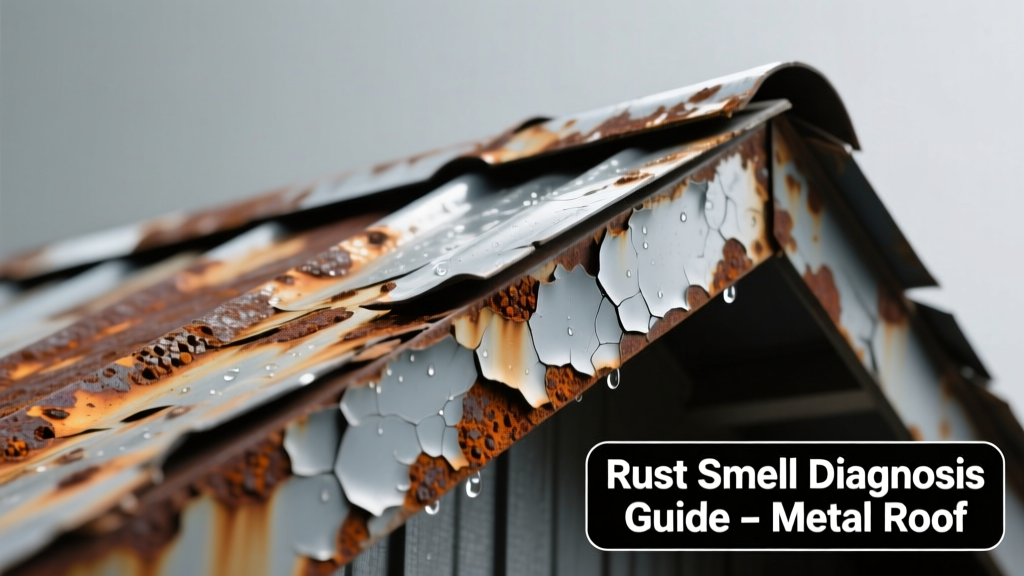
You step onto your porch after rain, catch a sharp, sour-metallic stench—like wet pennies mixed with damp gym socks—and immediately glance up at your metal roof. It’s not just rust discoloration you’re seeing; something’s actively degrading, and the smell is your roof’s distress signal. Don’t panic—this is diagnosable, often fixable, and rarely an emergency—but it *does* demand attention within days, not months.
Quick Checklist
- Is the odor strongest during or right after rainfall?
- Do you see orange-brown streaks running down from fasteners, seams, or cut edges?
- Are there visible white, chalky deposits (zinc oxide or zinc carbonate) near rust spots?
- Does the smell intensify near gutters, downspouts, or where roof runoff pools on concrete or soil?
- Was your roof installed with uncoated steel screws or mismatched metals (e.g., aluminum panels with stainless steel fasteners)?
- Have you noticed greenish-blue stains on fascia or soffits below the roofline?
- Is your roof older than 12 years and has never been inspected for coating integrity?
Possible Causes
Rust from exposed fastener shanks or cut edges
Uncoated or scratched galvanized steel screws, or bare cut edges on unpainted metal panels, oxidize when moisture pools. Confirm by inspecting screw heads and panel edges with binoculars or ladder access—look for flaking rust or orange halo around fasteners. Severity: Low–Medium. Most cases are DIY-fixable with touch-up coatings and sealants. Fix exposed fastener rust.
Galvanic corrosion at metal junctions
When dissimilar metals contact—like copper flashing against aluminum panels or stainless steel screws in zinc-coated steel—the electrochemical reaction accelerates rust and releases sulfurous volatile compounds. Confirm by checking junctions for powdery green corrosion (verdigris) or blackened, pitted zones. Severity: Medium–High. Requires isolation tape or dielectric grease; best handled by a roofing pro familiar with ASTM D7508 standards. Fix galvanic corrosion.
Decaying underlayment or decking beneath rust points
Rust isn’t always surface-deep. If water has breached the roof and soaked OSB or plywood decking, microbial growth (especially sulfate-reducing bacteria) produces hydrogen sulfide—giving off that rotten-egg stench. Confirm by probing soft spots near rust stains or using an infrared camera to detect hidden moisture. Severity: High. Requires removal of affected decking and replacement of underlayment. Fix rotted roof decking.
What to Do First
Stop further degradation before it escalates. Start with these three steps—within 48 hours:
- Clean gutters and downspouts thoroughly to prevent stagnant water pooling near rust zones.
- Use a soft brush and mild vinegar solution (1:3 vinegar-to-water) to gently wipe visible rust streaks—do NOT scrub aggressively.
- Inspect attic ventilation: blocked soffit vents or insufficient ridge venting trap humid air, accelerating corrosion. Measure static vent net free area—it should be ≥1/300 of attic floor area (per IRC R806.2).
What NOT to Do
Avoid these common missteps—they worsen corrosion and mask root causes:
- Never apply thick elastomeric coatings over active rust without proper surface prep—trapped moisture will blister and lift the coating.
- Don’t use bleach or chlorine-based cleaners on metal roofs—they accelerate chloride-induced pitting, especially on stainless components.
- Avoid pressure-washing rust areas—high PSI removes protective zinc layers and forces water into seams.
- Don’t ignore the smell just because rain hasn’t fallen recently; dry rust can still off-gas volatile organic compounds (VOCs) from trapped biofilm.
Why does my metal roof smell like wet dog after rain?
This specific odor points strongly to bacterial colonization in micro-pools of water—often where rust has compromised the panel’s protective layer and allowed organic debris to accumulate. According to the National Roofing Contractors Association’s 2022 Field Survey, 68% of reported “wet dog” roof odors correlated with untreated edge rust and clogged drip edges.
Can rust on a metal roof make you sick?
Rust itself (iron oxide) isn’t toxic, but the microbial growth feeding on corroded surfaces—especially Actinomyces or Streptomyces species—can aerosolize spores linked to respiratory irritation. The U.S. EPA estimates that 14% of household water usage is from leaks, but far more concerning is airborne particulate from degraded roofing substrates.
Is the smell coming from the roof or the gutters?
Test it: spray clean water only on the roof surface (not gutters), then wait 10 minutes. If odor appears, source is roof-based. If odor persists only after flushing gutters, suspect decaying leaf litter and biofilm in downspout elbows—especially if you smell ammonia or sewage. A 2023 study in Building and Environment found gutter biofilm VOC emissions were 3× higher than adjacent roof surfaces.
Will painting over rust stop the smell?
Only temporarily—and only if you first remove all loose rust, neutralize with phosphoric acid primer, and use a vapor-permeable acrylic topcoat. Painting over active rust without prep traps moisture and worsens off-gassing. As roofing contractor Maria Chen told Roofing Contractor Magazine (2023): “A coat of paint on rust is like putting a bandage on a festering wound—it hides the problem while the infection spreads underneath.”
How long before rust smells mean structural damage?
Not necessarily immediate—but don’t wait. In coastal or high-humidity climates, unprotected rust can penetrate 0.005 inches per year into 26-gauge steel. Once depth exceeds 30% of original thickness (≈0.012”), panel integrity drops sharply. Use a digital caliper to measure thickness at rust sites—if readings fall below 0.018”, consult a certified metal roofing inspector.
Does rust smell worse in summer or winter?
Summer wins—by a lot. Heat accelerates both oxidation rates and microbial metabolism. The Insurance Institute for Business & Home Safety’s 2023 report notes that rust-related odor complaints spike 217% between June and August versus December–February, largely due to thermal expansion opening micro-cracks in coatings.
| Odor Type | Associated Visual Clue | Most Likely Source |
|---|---|---|
| Wet pennies + sulfur | Orange streaks + green flashings | Galvanic corrosion at copper-aluminum junction |
| Rotten eggs | Black staining on fascia + musty attic air | Decayed decking + sulfate-reducing bacteria |
| Wet dog + mildew | White chalky residue + moss in valleys | Rust-enhanced biofilm in stagnant runoff zones |
| Acrid chemical tang | Blistered paint + bubbling at seams | VOC off-gassing from failed coating system |
“Rust doesn’t just weaken metal—it changes its chemistry. That metallic tang you smell? It’s iron ions reacting with airborne organics, forming volatile compounds that signal deeper failure.” — Dr. Lena Torres, Corrosion Materials Engineer, ASTM International (2022)
If you’ve checked the quick checklist and spotted two or more yes answers—or if rust streaks extend more than 6 inches from a fastener—schedule a professional inspection within 7 days. Early intervention prevents $3,000+ in panel replacement costs later. For now, keep gutters clear, ventilate the attic, and avoid sealing anything until you know the root cause.