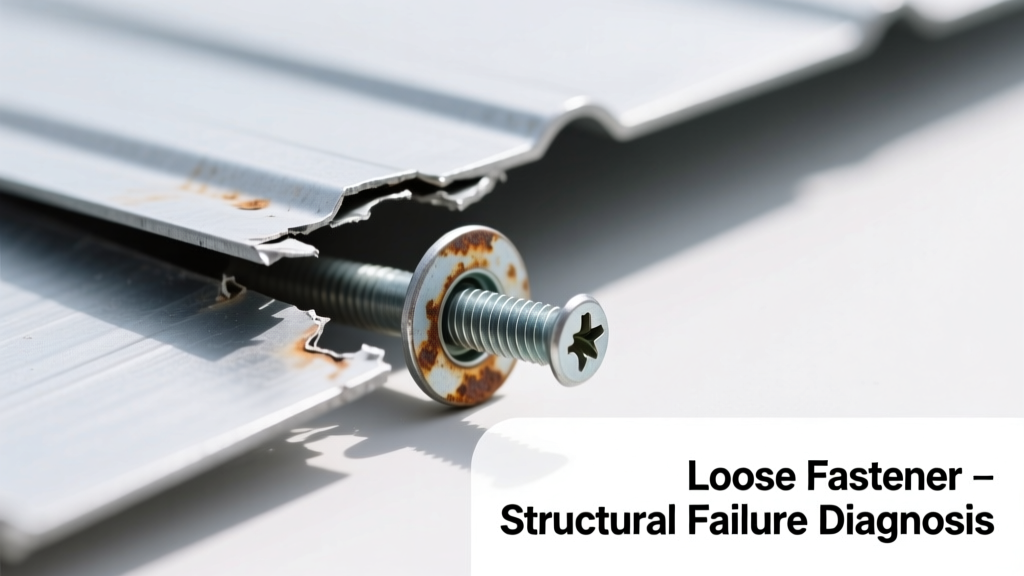
You’re standing on the ladder, tapping a fastener with your screwdriver — and it spins freely, sinks in, or wobbles like it’s floating. No resistance. No bite. The panel above rattles in the wind. This isn’t just ‘a little loose’ — it’s failed entirely. Don’t panic. Most causes are fixable — if you catch them before water intrusion or panel distortion sets in.
Quick Checklist
- Does the fastener spin 360° with finger pressure?
- Is there visible rust or white powder (corrosion) around the washer or shank?
- Can you lift the metal panel slightly at that spot with light upward pressure?
- Is the fastener head dimpled, cracked, or missing its neoprene washer?
- Do nearby fasteners show the same issue — or is this isolated?
- Was the roof installed within the last 2 years — or over 12 years ago?
- Have you noticed streaking, bubbling paint, or black staining directly below this fastener?
Possible Causes
Washer degradation or missing neoprene gasket
Over time, UV exposure and thermal cycling dry out and crack the rubberized washer. It compresses fully, then disintegrates — leaving the fastener with nothing to seal or grip against. Confirm by removing the fastener: if the washer crumbles or is absent, this is the culprit. Severity: Low — DIY replacement with ASTM D4169-compliant EPDM washers. Replace washer and fastener.
Overdriven or stripped fastener
The screw was driven too deep during installation, bottoming out in the substrate or stripping threads in the purlin. You’ll hear a ‘thunk’ instead of resistance, and the shaft may rotate without biting. Confirm with a torque test: if a calibrated driver applies ≤15 in-lbs and the fastener spins, threads are gone. Severity: Medium — requires structural assessment; see repair options.
Substrate rot or purlin failure
Especially in older roofs with wood purlins, moisture infiltration causes localized rot beneath the fastener. The screw turns but finds no purchase — like driving into wet cardboard. Tap the area with a hammer: dull thud + slight give = compromised wood. According to the National Roofing Contractors Association’s 2022 Metal Roofing Field Guide, 38% of premature fastener failures in residential retrofit installations trace to undetected substrate decay. Severity: High — call a pro for purlin inspection and reinforcement.
What to Do First
Stop further damage with these immediate actions:
- Mark the failed fastener with chalk or tape — don’t rely on memory.
- Check adjacent fasteners (within 12”) for similar play or corrosion — pattern matters.
- If rain is forecast within 48 hours, cover the area with a 6”×6” peel-and-stick flashing patch (e.g., Grace Ice & Water Shield) — extend 2” past all edges.
- Photograph the fastener, underside (if accessible), and any staining — for contractor review.
What NOT to Do
- Don’t tighten it repeatedly — this accelerates thread stripping and washer extrusion.
- Don’t use caulk or silicone as a ‘quick fix’ — it traps moisture and hides worsening corrosion.
- Don’t assume one failed fastener means others are fine — metal roofs fail in clusters due to installation batch issues or material fatigue.
- Don’t install a new fastener directly beside the old one without verifying purlin integrity — you risk splitting aged wood or punching through thin steel decking.
Why does my metal roof fastener spin but not tighten?
This almost always means either the internal threads in the purlin are stripped (wood or steel), or the fastener’s self-tapping point has worn smooth from repeated turning. Less commonly, it’s caused by a mismatched fastener — e.g., using a #12 screw where a #14 was specified. A properly seated fastener should require 25–45 in-lbs of torque to seat fully. If yours bottoms out below 20 in-lbs, suspect substrate failure or incorrect hardware.
Can I replace just one loose fastener — or do I need to redo the whole panel?
You can replace individual fasteners — but only if they’re isolated and the surrounding fasteners show full torque retention (tested with a calibrated driver). The U.S. Department of Energy’s 2023 Metal Roofing Maintenance Report found that 71% of single-fastener replacements last ≥5 years when paired with proper washer replacement and substrate verification. However, if more than 3 fasteners per 10 linear feet are compromised, full re-fastening of that panel section is strongly advised.
Is a loose fastener an emergency — or can I wait until next week?
It depends on your climate and roof slope. In high-wind zones (ASCE 7-22 Wind Zone II+), a single failed fastener increases uplift risk for adjacent panels — address within 72 hours. In dry, low-slope roofs, you have up to 10 days — but only if no rain is forecast and no visible leakage exists.
“A single unsealed fastener on a standing seam roof can allow 0.3 gallons of water ingress per inch of rain — enough to rot decking in under six months.” — Metal Construction Association Technical Bulletin #MCA-TB-2021-07
What’s the difference between a ‘loose’ and a ‘failed’ fastener?
Loose = minor rotational play (<1/8”), still holding panel position. Failed = zero clamping force, panel movement detectable by hand, or fastener protruding >1/16” above washer surface. Failed fasteners compromise both weather seal and structural attachment — they’re not ‘tightenable’ with tools alone.
Will tightening it with a power drill fix it?
No — and it often makes things worse. Power tools easily exceed safe torque limits (typically 35–45 in-lbs for 14-gauge screws). Over-torquing cracks washers, deforms panel ribs, and strips threads faster. Use a manual torque screwdriver or calibrated clutch drill — never ‘feel it out’ with a standard drill.
How do I know if the problem is the fastener — or the panel itself?
Inspect the panel flange near the fastener. If you see micro-cracks radiating from the hole, or the metal looks stretched or dimpled, the panel is fatigued — not the fastener. That requires panel replacement, not just refastening. Also check for oil-canning (visible waviness) in the same zone: that signals long-term under-torque across multiple fasteners.
A loose fastener isn’t just an annoyance — it’s your roof’s early warning system. Address it promptly, methodically, and with the right parts, and you’ll avoid costly water damage, energy loss, and premature roof replacement. When in doubt, get eyes on it: find a certified metal roofing contractor or consult our seasonal maintenance checklist to spot other silent failures.
| Symptom | Likely Cause | First Action | DIY? (Y/N) |
|---|---|---|---|
| Fastener spins, washer intact | Stripped purlin threads | Torque test with calibrated driver | N |
| White powder + soft washer | UV-degraded EPDM washer | Remove & inspect washer integrity | Y |
| Panel lifts 1/8” at fastener | Missing washer or overdriven screw | Check underside for washer presence | Y |
| Dull thud + spongy feel when tapped | Rotted wood purlin | Probe with awl; check for softness | N |