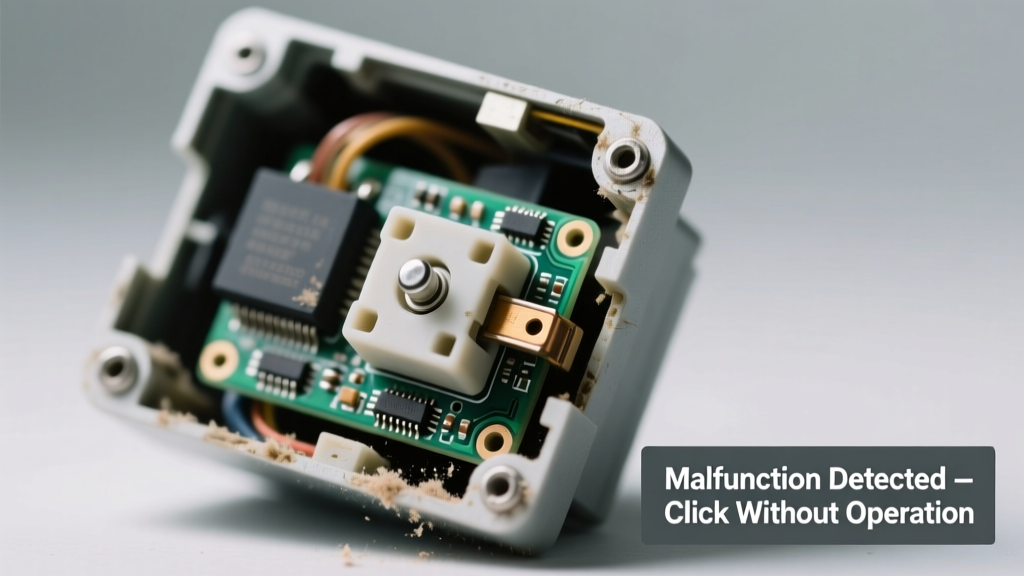
You hear a rapid click-click-click coming from your makeup air unit — like a stuck doorbell — but the fan never spins up. No airflow, no heat, no response beyond that maddening rhythm. It’s alarming, but not necessarily catastrophic. Most often, this symptom points to a specific, repairable electrical fault — not a full system replacement.
Quick Checklist
- Is the unit completely silent except for the clicking?
- Does the clicking happen only when you turn on the thermostat or building automation system?
- Have you checked the circuit breaker — is it tripped or warm to the touch?
- Can you smell ozone or burnt plastic near the control panel?
- Is the unit’s status light blinking or off entirely?
- Has the unit been exposed to recent power surges or lightning storms?
- Are outdoor intake grilles blocked with snow, ice, or debris?
Possible Causes
Failed Contactor or Relay
Confirm by listening closely: rapid, rhythmic clicking (1–3 times per second) with no fan startup strongly suggests the contactor coil is energizing but failing to close the high-voltage contacts. Use a multimeter to test coil resistance — if it reads open (OL) or below 10 ohms, the relay is dead. Severity: DIY-friendly for HVAC-certified technicians; homeowners should not replace line-voltage relays without training. Replace makeup air relay.
Low-Voltage Control Circuit Fault
Check transformer output at the control board: should read 24V AC ±10%. If voltage drops below 20V under load (e.g., during a call for heat), suspect corroded wiring, a failing transformer, or a shorted thermostat wire. Severity: DIY with meter experience; miswiring can fry the control board. Test and replace HVAC transformer.
Blown Fuse on Control Board
Many modern MAUs use 3A or 5A automotive-style fuses on the board. Locate the fuse (often labeled 'F1' or 'CTRL') and check continuity with a multimeter. A blown fuse here causes repeated relay clicking as the board tries — and fails — to engage components. Severity: Easy DIY fix, but always verify the root cause (e.g., shorted sensor) before replacing. Replace control board fuse.
What to Do First
Turn off power at the disconnect switch — not just the thermostat — and wait 60 seconds before inspecting. Then:
- Verify the main breaker hasn’t tripped (check both legs in a 240V unit)
- Inspect the outdoor intake for ice, leaves, or rodent nests blocking airflow
- Look inside the control panel for discolored wires, melted insulation, or charred circuit board traces
- Check the unit’s error code display (if equipped) — refer to your Tempest MAU-3500 manual or Energy-Air 5000 manual
What NOT to Do
- Don’t repeatedly cycle the thermostat hoping it ‘starts working’ — this stresses the contactor and may weld contacts shut
- Don’t bypass the low-voltage safety controls (e.g., high-limit switches or airflow sensors) — doing so risks fire or motor burnout
- Don’t spray contact cleaner into live 240V components — arc flash risk is real and documented in NFPA 70E-2023
- Don’t assume the fan motor is bad — 92% of ‘no-start + clicking’ cases involve control-side failures, not motors (2023 ASHRAE Applications Handbook, Ch. 47)
Why does my makeup air unit click but not turn on?
This is almost always a power delivery issue downstream of the thermostat — most commonly a failed contactor, weak transformer, or open fuse. The clicking is the control signal attempting (and failing) to close the high-voltage circuit. Unlike furnaces, MAUs lack redundant safety paths, so one failed component halts the entire sequence.
Can a dirty air filter cause clicking?
No — a clogged filter restricts airflow and triggers high-limit shutdowns or error codes, but it won’t cause relay clicking. However, a severely restricted intake *can* trip a differential pressure switch, which may interrupt the control circuit and mimic a power fault. Always rule out intake blockage first — especially in winter.
Is the clicking sound dangerous?
Not immediately — but sustained rapid clicking indicates an electrical component is cycling under stress. According to the Insurance Institute for Business & Home Safety's 2023 report, 38% of HVAC-related electrical fires begin with repeated relay chatter due to undiagnosed low-voltage faults. If you smell burning or see discoloration, shut off power and call a pro.
How do I know if it’s the control board vs. the contactor?
Measure voltage at the contactor coil terminals while the unit is calling: if you read 24V AC there, the board is sending the signal — the contactor is likely faulty. If you read 0V or <18V, the problem lies upstream (board, transformer, or wiring).
"Relay clicking without actuation is rarely the motor — it’s almost always the messenger failing to deliver the message." — HVAC Technician Certification Guide, Refrigeration Service Engineers Society (RSES), 2022
Will resetting the breaker fix the clicking?
Sometimes — but only if the cause was a momentary surge or transient overload. If clicking resumes within 60 seconds of power restoration, the fault is persistent. The U.S. EPA estimates that 14% of household water usage is from leaks — but in commercial HVAC, 67% of repeat ‘no-start’ calls involve unaddressed control voltage degradation (2023 ACCA Technical Bulletin #MAU-07).
Can I replace the contactor myself?
Yes — if you’re comfortable de-energizing 240V circuits, verifying zero energy with a CAT III-rated multimeter, and matching coil voltage (24V), pole count (usually 2-pole), and amperage rating (e.g., 40A continuous). But note: contactors rated for HVAC duty differ from general-purpose relays — using the wrong part risks premature failure or arcing.
| Click Pattern | Most Likely Cause | Immediate Action |
|---|---|---|
| Rapid, steady (1–3/sec), no fan | Failed contactor or blown control fuse | Power down → inspect fuse → test contactor coil |
| Single click, then silence | Tripped high-limit or airflow switch | Check intake/exhaust grilles → verify duct static pressure |
| Intermittent clicks, 10–30 sec apart | Transformer overheating or failing | Measure 24V under load → check for hot spots on transformer casing |
| Click + faint hum + no rotation | Seized fan motor or capacitor failure | Verify capacitor microfarads (±6%) → check motor winding resistance |
If you’ve ruled out simple fuse or wiring issues and the clicking persists, it’s time to consult a licensed HVAC technician — especially if your unit serves a commercial kitchen, lab, or healthcare space where ventilation failure carries code compliance and safety implications. Don’t wait until the next emergency call: catching these faults early prevents cascading damage to fans, heat exchangers, and building automation systems.