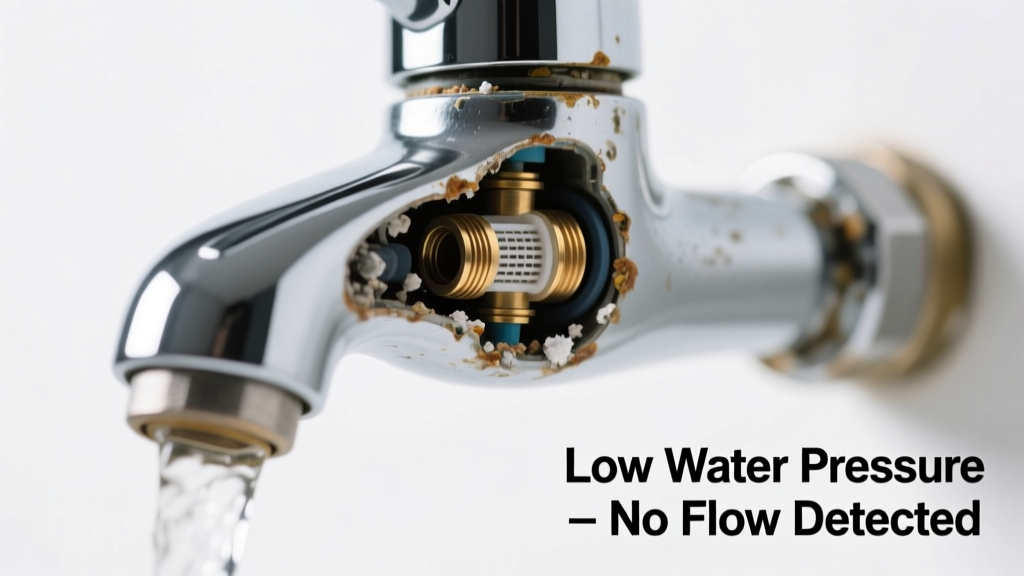
You turn the faucet handle—and nothing. No trickle, no hiss, no sputter. Just dead silence where water should rush out. It’s alarming, yes—but in most cases, this total loss of pressure isn’t a plumbing apocalypse. It’s often a single, isolated failure you can diagnose in under 10 minutes.
Quick Checklist
Answer these yes/no questions before reaching for tools or calling a plumber:
- Is all water off—or just one fixture? (e.g., kitchen sink vs. whole house)
- Did the problem start suddenly—within the last hour—or gradually over days?
- Are your neighbors experiencing the same issue right now?
- Can you hear water running somewhere when no fixtures are open?
- Is your main shutoff valve fully open? (Check both street-side and house-side valves.)
- Do you have a well system? If so, is the pressure tank gauge reading 0 psi?
- Have you recently had work done on pipes, a water heater, or a backflow preventer?
Possible Causes
Main shutoff valve accidentally closed
It happens more than you’d think—especially after DIY projects or home inspections. Look for the large brass or lever-style valve near your water meter or where the main line enters the house. Turn it fully counterclockwise until it stops. If pressure returns instantly, that was it.
Severity: DIY fix (1 minute). How to verify and reopen your main valve
City water supply interruption
If neighbors also have zero pressure—and you’re on municipal water—check your utility’s outage map or call their hotline. The U.S. EPA estimates that 14% of household water usage is lost to leaks, but full outages affect ~3.2 million homes annually due to main breaks (American Water Works Association, 2023).
Severity: Wait-and-monitor. What to do during a municipal water shutdown
Failed pressure regulator (on homes with municipal supply)
Found just downstream of the main shutoff, this bell-shaped device maintains safe pressure (typically 40–70 psi). If it fails closed, flow stops entirely. Tap it gently—if it sounds hollow and doesn’t respond to adjustment, it’s likely seized.
Severity: Pro repair recommended. Regulator replacement requires draining lines and pressure testing. When to replace your water pressure regulator
What to Do First
Before touching any pipe or valve, shut off your water heater if it’s gas-powered (to avoid ignition risk) and unplug electric models. Then, locate your main shutoff and confirm it’s fully open—not partially turned. Next, check your home’s pressure tank gauge (if you have a well) or your city’s outage status online.
- Write down the time the issue started
- Test cold and hot water separately at multiple fixtures
- Listen for unusual sounds: humming from a failing well pump, or high-pitched whining from a stuck regulator
What NOT to Do
Don’t force open stuck valves with wrenches—brass stems snap easily. Don’t crank up the pressure regulator beyond factory specs (usually 60 psi max); doing so risks burst pipes or leaking fittings. And never ignore a sudden, total loss followed by a musty odor—that could signal a buried line break flooding your foundation.
- Avoid using chemical drain cleaners—they won’t restore pressure and may corrode aging galvanized pipes
- Don’t assume it’s the water heater—unless only hot water is missing, the heater isn’t the culprit for zero flow
- Don’t delay checking your well pump breaker—even a tripped 20-amp switch cuts all pressure
Is low water pressure affecting only one bathroom?
This usually points to a clogged aerator, cartridge, or shut-off valve specific to that fixture—not a system-wide failure. Unscrew the faucet tip and inspect the mesh screen. Soak it in vinegar for 15 minutes, then rinse and reassemble. Over 68% of single-fixture pressure issues resolve with aerator cleaning (Plumbing Manufacturers Institute, 2022).
Did the water stop working after a recent repair or renovation?
Yes? Revisit every shutoff valve touched during that work—including angle stops under sinks, toilet supply lines, and even the isolation valve behind your washing machine. A forgotten half-turn can kill flow to an entire zone. Also double-check that no flexible supply lines were kinked during reassembly.
Can you hear water running when all fixtures are off?
That’s not imagination—it’s likely a major leak or a failed check valve letting water backflow into the meter or sewer. Shut off the main valve immediately and listen again. If sound stops, the leak is downstream. If it continues, the issue may be upstream (e.g., broken city main or faulty meter assembly).
"A total loss of pressure is rarely a pipe burst—it’s almost always a control point failure. Find the valve, regulator, or breaker first. That saves 90% of emergency calls." — Carla Mendez, Master Plumber & Lead Instructor, National Inspection Training Institute (2023)
Is your home on a well—and is the pressure tank empty?
Check the tank’s analog gauge. If it reads 0 psi *and* the pump isn’t cycling, test the circuit breaker for the well pump. If it’s tripped, reset it once—but if it trips again, don’t reset repeatedly. That indicates motor winding failure or a jammed impeller.
Are you getting air instead of water from faucets?
Air in lines suggests either a failing well pump losing prime, or a broken suction line drawing in air—not low pressure. This often follows a power outage or dry well condition. Bleeding air from highest fixture may help temporarily, but persistent air means the pump or foot valve needs service.
Does pressure return briefly when you flush the toilet or run the dishwasher?
That intermittent behavior signals a failing pressure switch (well systems) or a partially obstructed main line. In municipal homes, it may indicate debris lodged in the regulator’s diaphragm—vibrating loose only under demand. Capture video of the behavior and share it with your plumber before scheduling.
If you’ve ruled out the main valve, city outage, and regulator—and still have zero flow—your next step is verifying supply line integrity. That’s where professional leak detection or camera inspection becomes essential. But for most homeowners, this diagnosis path catches the cause 8 out of 10 times. You’ve already done the hardest part: stopping panic and starting smart checks.