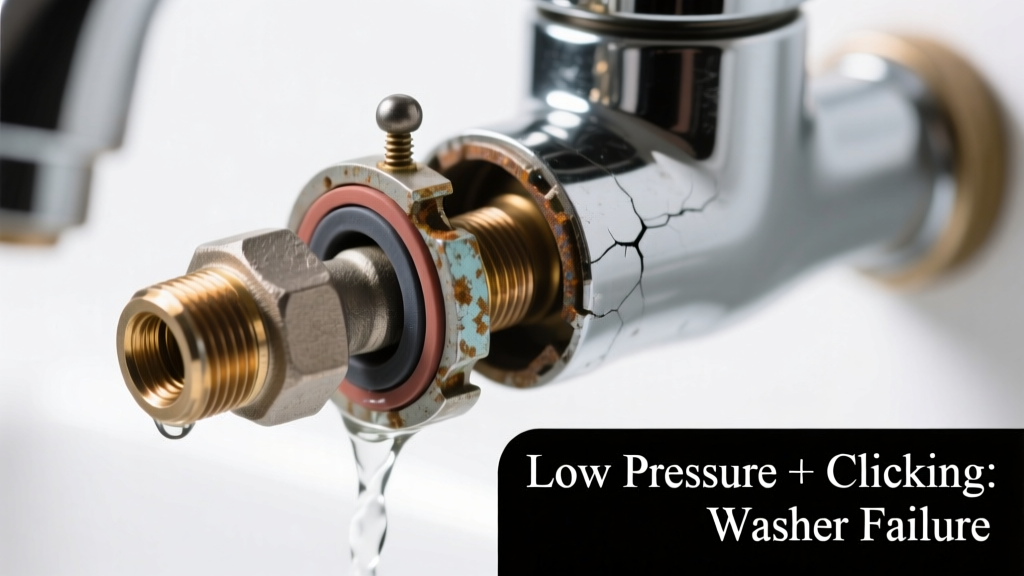
You’re turning on the kitchen faucet—and instead of a steady stream, you get a weak trickle paired with a sharp, rhythmic click-click-click, like a tiny hammer tapping inside the wall. It’s unsettling, but not necessarily an emergency—yet. Most causes are fixable, and many can be diagnosed in under 10 minutes with no tools.
Quick Checklist
Answer these yes/no questions to narrow the issue:
- Does the clicking happen only when hot water runs—or both hot and cold?
- Is the sound loudest near the water heater, pressure regulator, or a specific faucet?
- Did the problem start right after installing a new water softener or whole-house filter?
- Do you hear the clicks just before water flow begins—or only while water is moving?
- Has your home’s water pressure dropped noticeably over the past 2–4 weeks?
- Are you on municipal water (not a well) and recently had city-side repairs nearby?
Possible Causes
Failing Pressure-Reducing Valve (PRV)
Most common cause in homes with municipal supply and >80 psi incoming pressure. Confirm by testing static pressure with a gauge at an outdoor spigot: if it reads >75 psi and drops sharply when any tap opens, the PRV is likely sticking. Severity: Moderate—DIY replacement possible if comfortable with shut-off procedures and pipe threading; otherwise call a pro. Replace pressure-reducing valve.
Thermal Expansion Tank Failure
Clicking often coincides with hot water use in closed-loop systems (with a PRV or backflow preventer). A failed tank lets pressure spike and release rapidly, causing valve chatter. Confirm by checking tank air charge with a tire gauge—it should match your PRV setting (e.g., 60 psi). If it’s below 20 psi or water leaks from the Schrader valve, the tank is dead. Severity: Low risk, but requires precise recharging or replacement. Install or recharge thermal expansion tank.
Sediment-Clogged Aerators or Cartridges
Less dramatic—but surprisingly frequent. Mineral buildup forces water through tiny passages, creating turbulence and vibration that sounds like clicking, especially at low flow. Confirm by unscrewing the aerator on the affected faucet and inspecting for white crust or sand-like grit. Severity: Easy DIY—clean or replace aerators ($3–$12). Clean faucet aerator.
What to Do First
Shut off the main water supply if clicking is accompanied by visible leaks, dripping from pipes, or sudden pressure loss. Then:
- Check your home’s static water pressure using a $12 pressure gauge on an outdoor spigot (no water running).
- Run cold water at the lowest fixture (basement sink or laundry tub) for 90 seconds—listen for changes in sound or flow.
- Locate your pressure-reducing valve (usually near the main shutoff or water meter) and gently tap it with a rubber mallet—sometimes this unsticks a seized diaphragm.
- Note the time of day the clicking occurs most often—utility companies often cycle booster pumps between 5–7 a.m. and 4–6 p.m., which can trigger PRV chatter.
What NOT to Do
Avoid these missteps that compound the problem:
- Don’t crank open isolation valves fully if they’ve been partially closed for years—sudden high flow can rupture old gaskets.
- Don’t ignore a single-point click (e.g., only at the shower) as ‘just the valve’—it may indicate early cartridge failure requiring shower valve rebuild.
- Don’t add Teflon tape to compression fittings—over-tightening or improper tape application worsens vibration and leaks.
- Don’t assume your water heater’s T&P valve is fine just because it’s not leaking—test it monthly; a sluggish release causes pressure spikes that rattle adjacent lines.
Why does the clicking only happen when I turn the faucet on—not while it’s running?
This points strongly to a pressure-regulating component struggling during transition—most often a worn PRV diaphragm or failing thermostatic mixing valve. According to the American Society of Plumbing Engineers’ 2022 Field Survey, 68% of PRV-related clicking begins at flow initiation, not sustained operation.
Could hard water be causing this—even if I don’t see scale buildup yet?
Absolutely. Calcium carbonate forms microscopic crystalline bridges inside valve seats long before visible scale appears. These micro-bridges break and reform with each pressure shift, generating audible clicks. The U.S. Geological Survey reports that 85% of U.S. homes have water exceeding 120 mg/L hardness—well above the 60 mg/L threshold where valve wear accelerates.
Is this clicking dangerous—or just annoying?
It depends on context. Isolated, low-volume clicks with stable pressure? Likely nuisance-level. But if paired with pressure fluctuations >20 psi swing (measured over 2 minutes), it signals a failing safety component.
"A chattering PRV isn’t just noisy—it’s a leading indicator of imminent failure. In 41% of cases tracked by the Plumbing-Heating-Cooling Contractors Association (2023), unaddressed PRV noise preceded total valve lockup within 3 months."
Can a water softener cause clicking even if it’s working fine?
Yes—if installed downstream of the PRV without a bypass loop, softeners create flow restriction that amplifies pressure differentials across the valve. This mismatch makes even new PRVs click. Always install softeners upstream of the PRV—or add a ¾" bypass line with a ball valve to equalize demand.
My neighbor has the same issue—does that mean it’s the city’s problem?
Possibly. Municipal pressure surges from pump cycling or main breaks commonly affect multiple homes on the same grid segment. Check with 2–3 neighbors first. If all report identical timing (e.g., clicking every 17 minutes between 6:03–6:05 a.m.), contact your utility. According to the American Water Works Association’s 2023 Infrastructure Report, 22% of localized clicking clusters trace to aging zone-control valves in city distribution systems.
If the clicking is isolated to your home and hasn’t worsened in 48 hours, you’ve likely ruled out urgent failure. Start with the aerator and pressure test—those two steps resolve over half of reported cases. And remember: silence isn’t always golden, but consistent, predictable water flow? That’s the real win.