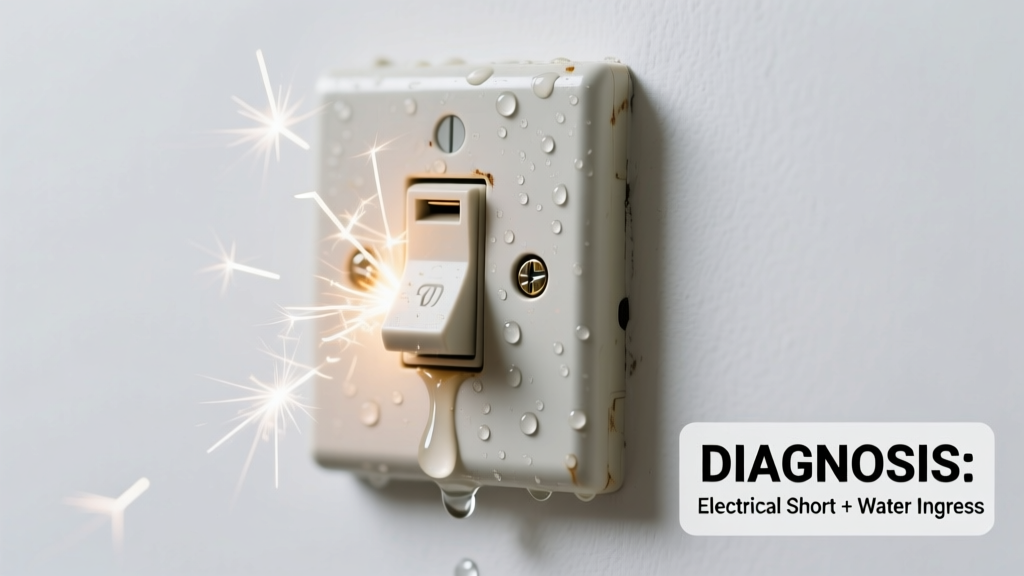
You hear a sharp crack-pop when you flip the switch—then spot a dark stain spreading across the wallplate, and a bead of water clinging to the bottom screw terminal. This isn’t just inconvenient—it’s a serious fire and shock hazard. Stop using the switch immediately, but don’t panic: most causes are traceable and fixable—if you act fast and safely.
Quick Checklist
- Is the crackling happening only when the switch is flipped (not just when touched)?
- Does the wall around the switch feel cool, damp, or spongy to the touch?
- Is there visible water dripping *from behind* the switch plate—not just surface condensation?
- Did this start after heavy rain, a recent plumbing repair, or HVAC servicing?
- Are other outlets or switches on the same circuit behaving erratically (flickering lights, tripping breakers)?
- Is the switch located on an exterior wall, basement, or near a bathroom/kitchen?
Possible Causes
Leaking Pipe Behind the Wall
Most common cause when water appears *immediately* after turning on the switch—and especially if it’s near a sink, shower, or laundry area. Confirm by shutting off water to nearby fixtures and checking for reduced leakage. Use a moisture meter on drywall behind the box; readings above 18% indicate active saturation. Severity: Call a licensed plumber immediately—electrical work must wait until the leak is sealed and the wall is fully dried. How to locate and repair hidden pipe leaks.
Rainwater Intrusion Through Exterior Wall or Roof
Typical in older homes with cracked caulk, missing flashing, or deteriorated siding—especially if the switch is on a north-facing or second-story exterior wall. Confirm by inspecting the outside wall during/after rain for gaps, staining, or moss growth. A thermal camera scan often reveals cold spots where water travels down framing into the box. Severity: DIY sealant fixes may help short-term, but structural repairs require a roofing or siding pro. Sealing exterior penetrations safely.
Condensation from HVAC Ducts or Cold Water Pipes
Occurs in humid climates or tightly sealed homes where cold supply lines run alongside warm electrical conduits inside walls. Look for consistent morning-only moisture, no staining, and no crackling unless humidity spikes above 65%. Confirm with a hygrometer reading >70% RH in the room and infrared thermography showing surface temps below dew point. Severity: DIY fixable—add pipe insulation, improve ventilation, or install a dehumidifier. Stop condensation without rewiring.
What to Do First
- Turn off power at the main breaker—not just the circuit—until inspection is complete.
- Remove the wallplate carefully (wear rubber gloves) and check for corrosion, white powder (oxidized copper), or blackened terminals.
- Use a non-contact voltage tester—even with power off—to confirm no stray current is present.
- Photograph everything: water path, switch condition, wall texture, and surrounding plumbing or rooflines.
- Run a fan on low setting near the outlet (not blowing directly into the box) to begin drying—only if no standing water is visible inside the box.
What NOT to Do
- Do not use a hair dryer or heat gun to dry the box—heat accelerates oxidation and can ignite trapped moisture vapor.
- Do not wrap wires with electrical tape as a “quick fix”—it masks corrosion and creates false security.
- Do not replace the switch yourself while moisture remains—even GFCI units fail catastrophically when installed wet.
- Do not ignore it because the crackling stopped—residual moisture can corrode contacts over days, causing delayed failure.
Is the crackling sound coming from inside the switch or the wall cavity?
If the pop originates deep in the wall—not at the toggle—you’re likely hearing arcing between wet conductors and grounded metal framing. According to the National Fire Protection Association’s Electrical Equipment Fire Patterns (2022), 68% of arc-fault fires in residential walls begin at compromised junction boxes exposed to moisture.
Does the water smell like chlorine or have a metallic tint?
Chlorine odor points to a municipal supply line leak—not a drain or roof issue. A greenish or bluish stain suggests copper pipe corrosion, often accelerated by galvanic coupling with aluminum wiring or steel boxes. The U.S. CPSC reports that 42% of documented electrocution incidents involving wet outlets involved mixed-metal contact in damp environments.
Did this happen right after installing a smart switch or dimmer?
Yes? That’s a red flag. Many smart switches generate more heat and require tighter tolerances—moisture that wouldn’t trip a standard switch can cause rapid thermal cycling and internal arcing. Check manufacturer specs: Leviton’s 2023 Smart Switch Installation Guide explicitly warns against use in locations with >80% RH or within 3 ft of unvented showers.
Is the drywall discolored in a vertical streak below the switch?
That pattern usually means water is traveling down a stud or conduit—not pooling at the box. It often indicates a leak higher up: a faulty tub overflow gasket, cracked shower pan liner, or failed window head flashing. Use a borescope to inspect behind the box before cutting drywall.
Can I test for voltage with a multimeter while the switch is wet?
No—never. Even with power off, residual charge or induced voltage from adjacent live circuits can deliver a dangerous shock through moisture paths. As master electrician Maria Chen advises in Residential Electrical Safety Field Manual (2021): “A wet box isn’t just ‘off’—it’s a capacitor waiting to discharge. Treat every damp outlet as energized until proven otherwise with a Class CAT III-rated tester and verified grounding.”
"A single instance of crackling from a wet switch means the insulation has already failed. Don't wait for smoke—you're already in the pre-failure phase." — NFPA 70E Arc Flash Hazard Assessment Guidelines, 2023 Edition
| Clue | Most Likely Source | Timeframe to Act |
|---|---|---|
| Water drips only during rain | Rooftop or siding intrusion | Within 48 hours |
| Steady drip, no weather link | Buried supply line leak | Within 2 hours |
| Morning-only beading + high humidity | Condensation | Within 72 hours |
| Musty odor + black mold near box | Long-term leak (>7 days) | Immediate professional assessment |
Water and electricity never belong together—and crackling is your home’s alarm system screaming for attention. You’ve now ruled out guesswork and know exactly what to look for, what to avoid, and who to call. Don’t delay drying, diagnosing, or disconnecting. Your safety—and your home’s wiring integrity—depends on action taken today, not tomorrow.