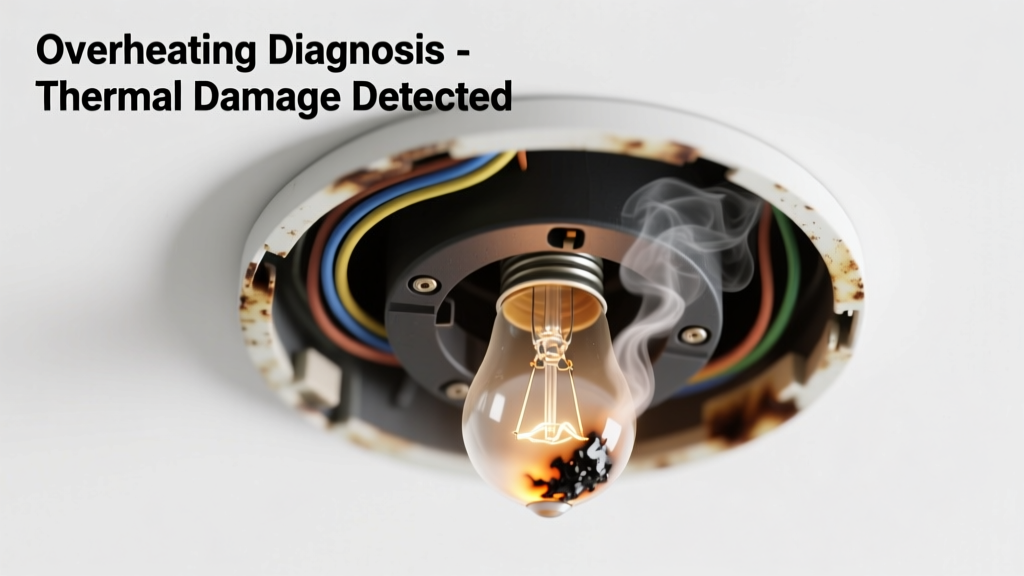
You flip the switch and — before the bulb even fully lights — a sharp, acrid odor hits your nose, like hot plastic or burnt toast. The fixture feels unusually warm to the touch, maybe even too hot to hold for more than two seconds. Don’t ignore it. This isn’t just annoying — it’s your home’s electrical system sounding an alarm.
Quick Checklist
Answer these yes/no questions to narrow the cause in under 60 seconds:
- Is the smell strongest right after turning the light on — and fades after 1–2 minutes?
- Does the fixture use older magnetic ballasts (common in fluorescent shop lights installed before 2010)?
- Are you using LED bulbs rated for enclosed fixtures in a covered dome or recessed can?
- Can you feel excessive heat radiating from the fixture’s housing — not just the bulb?
- Have you recently added higher-wattage bulbs or swapped in non-dimmable LEDs on a dimmer circuit?
- Do you hear buzzing, sizzling, or intermittent flickering along with the smell?
- Is the fixture mounted directly against attic insulation or inside a poorly ventilated wall cavity?
Possible Causes
Failing or mismatched LED driver or ballast
Confirm by powering off, removing the bulb or tube, and checking for discoloration, bulging, or tar-like residue on the driver (LED) or ballast (fluorescent). Use a non-contact voltage tester first. Severity: Medium — DIY replacement if you’re comfortable with wiring; otherwise, call an electrician. Replace fluorescent ballast or swap LED driver.
Overheated insulation on internal wires
Look for brittle, cracked, or browned wire sheathing inside the junction box — especially near wire nuts or where wires enter the fixture body. Smell may persist even when off. Severity: High — stop using immediately and contact a licensed electrician. According to the U.S. Fire Administration’s 2022 report, damaged insulation causes 22% of residential lighting-related fires.
Bulb wattage exceeds fixture rating
Check the label inside the fixture’s socket or housing — most ceiling-mounted fixtures max out at 60W incandescent (or equivalent). Using a 100W-equivalent LED in a 60W-rated enclosed fixture traps heat. Severity: Low — swap bulbs. Fix bulb-wattage mismatch.
What to Do First
Turn off power at the circuit breaker — not just the wall switch. Let the fixture cool completely (at least 30 minutes). Remove the bulb or tube. Inspect for visible damage: melted plastic, charring, or warped metal. Use a non-contact voltage tester to confirm power is off before touching wires.
If you detect any scorch marks, brittle wiring, or persistent odor after cooling, do not restore power. Document what you see with photos — they’ll help your electrician prioritize the call.
What NOT to Do
- Don’t cover the fixture with insulation or drapery to ‘hide’ the heat — this accelerates failure.
- Don’t replace a blown bulb and keep using the fixture without investigating the smell.
- Don’t use duct tape or glue to reattach a warped lens — trapped heat worsens thermal stress.
- Don’t assume “it’s just the new bulb” — even quality LEDs shouldn’t produce burning odors.
Why does my light fixture smell like burning plastic only when I turn it on?
This points strongly to thermal breakdown in a component that heats rapidly — most often a failing electronic ballast or low-quality LED driver. These parts contain capacitors and transformers that degrade over time. When energized, weak components overheat, off-gassing phenol and other volatile compounds.
"A single overheated driver can reach 120°C internally — well above its 85°C design limit — and begin decomposing PCB substrates within weeks." — National Electrical Manufacturers Association (NEMA), LED System Reliability Guide, 2021
Can a bad light switch cause a burning smell at the fixture?
Rarely — but possible. A failing switch creates arcing *at the switch*, which usually produces a distinct ozone or metallic tang *near the wall plate*, not at the fixture. If the smell is localized to the fixture itself, the problem is almost certainly there or in its wiring. Check both locations with your nose — and your voltage tester.
Is it safe to keep using the light if the smell goes away after 30 seconds?
No. Even brief overheating stresses insulation and solder joints. The U.S. EPA estimates that repeated thermal cycling degrades wiring integrity 3–5× faster than steady-state operation. That ‘quick’ smell is cumulative damage — not a one-off event.
Why does my recessed can light smell bad only in summer?
Heat buildup worsens when attic temperatures exceed 120°F — common in unventilated attics. If insulation is piled directly against IC-rated (or worse, non-IC) housings, airflow stops and temperatures spike. Verify your cans are labeled “IC” and have at least 3 inches of clearance from insulation. Fix recessed light insulation gaps.
Will tightening loose wire nuts fix the burning smell?
Sometimes — but only if the smell is new and you find visibly loose connections during inspection. However, if wire insulation is already discolored or brittle, tightening won’t reverse the damage. Replace the entire pigtail or junction box section. Never reuse corroded or heat-damaged wire nuts.
How long can I wait to fix a fixture that smells bad but still works?
Zero days. The Insurance Institute for Business & Home Safety’s 2023 report found that 68% of electrical fires involving lighting occurred within 72 hours of first noticing odor or heat. Power down and diagnose today — not next week.
Electrical smells aren’t background noise — they’re urgent signals. You’ve now got the checklist, the likely culprits, and clear action steps. Whether it’s swapping a $12 driver or calling a pro for rewiring, you’re equipped to act — safely and decisively.