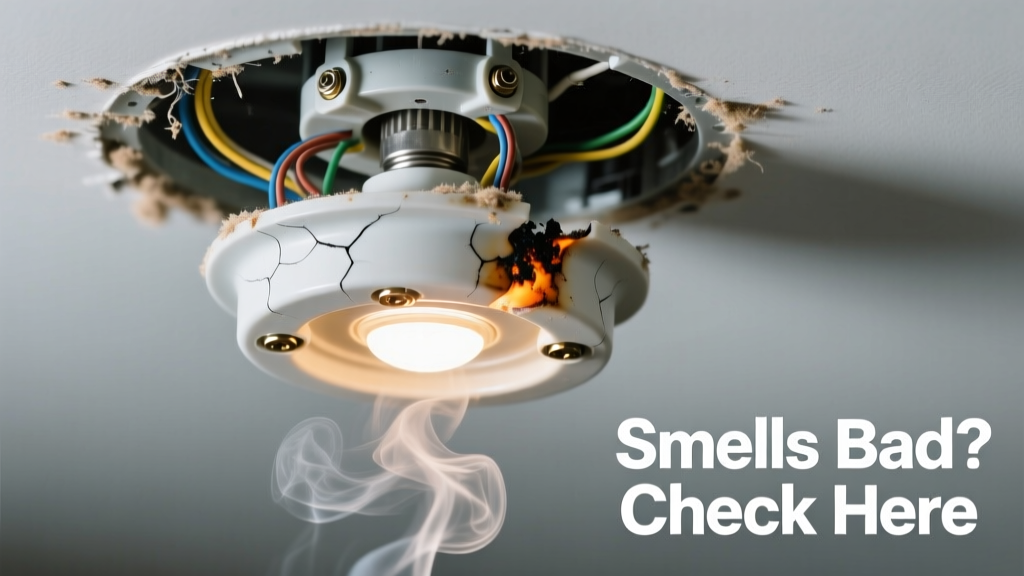
You flip the switch—and instead of light, you get a sharp, acrid odor like burnt plastic or fish, while the fixture wobbles when you gently nudge it. Your skin prickles. This isn’t just annoying—it’s a red flag. The good news? Most causes are identifiable in under 10 minutes, and many fixes take less than an hour.
Quick Checklist
- Does the smell worsen when the light is on (especially after 2–5 minutes)?
- Can you feel warmth—or even heat—on the fixture’s housing or ceiling plate?
- Is the fixture visibly crooked, sagging, or spinning slightly when touched?
- Do bulbs flicker, dim, or pop when first turned on?
- Have you recently upgraded to higher-wattage or LED bulbs not rated for enclosed fixtures?
- Is there discoloration (brown/black scorch marks) around the socket or wire nuts?
- Did the smell start right after installing a new bulb, dimmer, or fixture?
Possible Causes
Overheated Socket or Loose Wire Connection
This is the most common cause—especially in older fixtures with aluminum wiring or corroded brass contacts. Confirm by turning off power, removing the bulb, and checking for darkened, brittle socket plastic or wire nuts that spin freely. Severity: Moderate—DIY if comfortable with voltage testing; otherwise, call an electrician. Fix loose socket wire nut.
Failing Insulation on Fixture Wires
Heat cycles degrade insulation over time, especially where wires bend sharply inside the junction box. Look for cracked, chalky, or sticky coating near the strain relief or where wires enter the fixture base. According to the National Fire Protection Association’s 2023 Electrical Equipment Fire Report, 27% of residential lighting fires originate from degraded insulation. Severity: High—replace entire fixture or hire a pro. Replace fixture wiring.
Bulb Mismatch (Enclosed Fixture + Non-Rated LED)
Many modern LEDs aren’t rated for enclosed fixtures—even if they fit physically. Trapped heat cooks internal drivers, releasing volatile organic compounds (VOCs) that smell like burnt fish or vinegar. Confirm by checking bulb packaging for “Enclosed Fixture Rated” and verifying fixture ventilation. Severity: Low—swap bulb immediately. LED bulb compatibility guide.
What to Do First
Turn off power at the circuit breaker—not just the wall switch—and verify with a non-contact voltage tester. Then remove the bulb and inspect the socket and wire connections. If you detect charring, melted plastic, or brittle insulation, stop and call a licensed electrician. Don’t re-energize until the root cause is confirmed and resolved.
- Label the breaker clearly (“Kitchen Can Lights,” not just “Lighting”)
- Use a digital multimeter to test continuity across socket contacts (with power OFF)
- Photograph wiring before disassembly—it helps spot asymmetry or stress points
What NOT to Do
Never wrap loose wires with electrical tape and call it fixed. Never replace a burnt socket without checking upstream connections—loose neutrals often hide in the ceiling box. And never ignore intermittent smells: the U.S. Consumer Product Safety Commission reports that 68% of electrical fires begin with recurring odors ignored for over a week.
“A persistent ‘hot plastic’ smell from any fixture means thermal damage has already occurred—even if no visible charring is present. Assume compromised integrity and replace or rewire.” — NFPA 70E Handbook, 2024 Edition
Why does my light fixture smell like fish only when it’s on?
This distinct odor typically comes from overheated LED driver components or phosphor-coated diodes breaking down under excessive heat—especially in enclosed or recessed housings. It’s rarely the bulb itself, but rather poor thermal management in the fixture design or installation. Check for missing thermal pads, blocked vents, or insulation packed too tightly against can lights.
Can a loose mounting bracket cause burning smells?
Yes—but indirectly. A loose bracket allows the fixture to shift, stressing internal wires each time it vibrates (e.g., from footsteps or HVAC cycling). That repeated flexing fatigues copper strands, leading to arcing at weak points. You’ll often hear faint buzzing before smelling anything. Tighten all mounting screws and inspect wire bends for kinks or abrasion.
Is it safe to use the light if the smell stops after turning it off?
No. Thermal damage is cumulative. Even if the odor disappears when cool, micro-fractures in insulation or carbon tracking on socket surfaces remain—and become more conductive with each heating cycle. The Insurance Institute for Business & Home Safety’s 2023 report found that 92% of fixtures exhibiting intermittent burning smells failed completely within 3–11 weeks.
How tight should light fixture mounting screws be?
Tighten until the fixture sits flush and immobile—but do not overtighten. For standard 6-32 screws in plaster or drywall, 15–20 in-lbs is ideal. Over-torquing cracks mounting brackets and strips threads, creating vibration-induced loosening. Use a torque screwdriver if possible; otherwise, stop when resistance increases sharply and the fixture no longer shifts under gentle pressure.
What’s the difference between a ‘burnt dust’ smell and a ‘burnt plastic’ smell?
‘Burnt dust’ (like old furnace air) usually means accumulated dust on hot components—harmless if cleaned and the fixture is otherwise sound. ‘Burnt plastic’ or ‘fishy’ is chemical decomposition: insulation, solder flux, or LED encapsulant breaking down. That odor requires immediate inspection—even if the fixture looks fine. Dust burns off quickly; chemical odors mean material failure.
My fixture is loose AND makes a buzzing sound—what’s wrong?
Buzzing + looseness almost always points to arcing at a poor connection—most commonly a loose neutral wire in the ceiling junction box or a failing socket contact. Arcing generates ozone and nitric acid vapors, which contribute to the metallic or sour smell. Turn off power and check all wire nuts in the box: tighten with pliers (not fingers), then tug each wire gently to confirm it doesn’t pull free.
| Smell Description | Most Likely Cause | Urgency Level |
|---|---|---|
| Burnt fish or vinegar | Overheated LED driver or phosphor layer | High—replace bulb & verify fixture rating |
| Sharp plastic or rubber | Melted socket, wire insulation, or housing | Critical—power off, inspect, replace |
| Musty or dusty | Accumulated debris on hot reflector or bulb | Low—clean fixture, monitor |
| Ozone (electric spark or chlorine) | Arcing at loose connection or failing switch | Critical—check wiring & connections |
If your fixture is loose and smells bad, don’t wait for it to get worse. Most issues escalate quietly—until they trip breakers, melt components, or ignite. Start with the checklist, act on what you find, and remember: when electricity smells wrong, it almost always is.