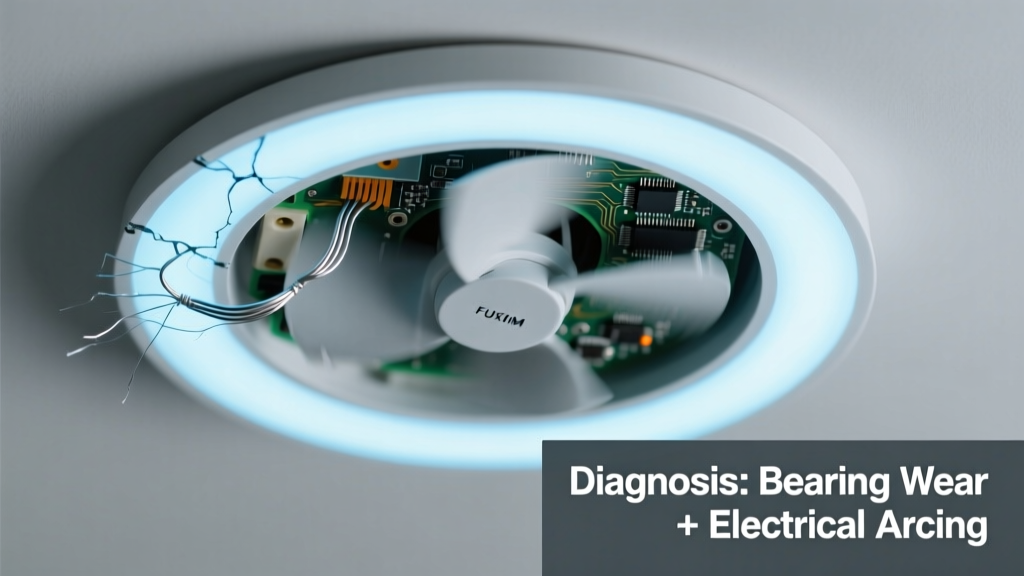
You hear it first as a low, insistent buzz—then a sharp, metallic grind, like gears stripping inside the fixture. It pulses with the light, worsens when you dim or toggle the switch, and sometimes makes the ceiling plate vibrate. Don’t ignore it: this isn’t just annoying—it’s often a warning sign of electrical stress or mechanical failure.
Quick Checklist
Answer these yes/no questions to narrow the cause in under 90 seconds:
- Does the noise happen only with incandescent, LED, or fluorescent bulbs—or all three?
- Is the grinding loudest right after turning the light on (or off)?
- Do you smell ozone (sharp, electric “hot metal” scent) near the fixture?
- Does the fixture feel warm—or even hot—to the touch at the housing or junction box?
- Has the fixture been recently retrofitted (e.g., magnetic ballast replaced with electronic, or old socket swapped)?
- Are bulbs fully tightened and rated for enclosed fixtures if applicable?
Possible Causes
Failing Magnetic Ballast (Most Common in Fluorescent Fixtures)
Older T12 or T8 fluorescent fixtures use magnetic ballasts that hum at 60 Hz—and grind when laminations loosen or windings short. Confirm by swapping in a known-good electronic ballast or switching to LED tubes with internal drivers. Severity: Moderate—DIY replacement is safe *if* power is confirmed OFF and wiring matches NEC 2023 standards. Replace fluorescent ballast.
Loose Internal Components (High Likelihood in Older Recessed or Track Fixtures)
Vibrating transformers, warped mounting brackets, or unsecured trim rings can resonate under electromagnetic load. Confirm by gently tapping the fixture while powered *off*: if parts rattle, disassemble and tighten mounting screws, replace worn springs, or add rubber grommets. Severity: Low—safe DIY. Secure recessed light fixture.
Electrical Arcing at Socket or Wire Nut
A grinding + sizzling sound paired with flickering or intermittent operation points to micro-arcing—often at corroded socket contacts or undersized wire nuts. Check for blackened socket plastic or melted insulation using a non-contact voltage tester first. Severity: High—call a licensed electrician immediately. According to the U.S. Fire Administration’s 2022 Electrical Fire Report, arc faults cause ~24,000 home fires annually.
What to Do First
Turn off power at the circuit breaker—not just the wall switch—and verify with a non-contact voltage tester at both socket and junction box. Then:
- Unscrew and inspect bulbs for cracks, dark ends, or bent pins.
- Check for visible corrosion or discoloration inside the socket.
- Feel the fixture housing: if >125°F (52°C), stop and call an electrician—overheating degrades insulation faster than expected.
- Photograph wiring before disconnecting anything; label wires with tape if reassembly is uncertain.
What NOT to Do
Avoid these high-risk missteps:
- Don’t use bulb adapters (e.g., E26-to-GU24) without verifying thermal rating—they trap heat and accelerate ballast degradation.
- Don’t ignore intermittent grinding—the National Electrical Code (NEC 2023 Article 410.67) requires immediate correction of audible arcing in luminaires.
- Don’t substitute higher-wattage bulbs—even if they ‘fit,’ they overload sockets designed for 60W max, raising surface temps by up to 40°F.
Why does my LED fixture buzz and grind only when dimmed?
This almost always indicates incompatibility between the dimmer switch and LED driver. Leading-edge (TRIAC) dimmers struggle with low-wattage LED loads, causing coil vibration in the driver and harmonic resonance in transformer cores. Try a trailing-edge (ELV) dimmer rated for ≤10W minimum load. According to Lutron’s 2023 Dimmer Compatibility Guide, 68% of reported LED buzzing stems from dimmer mismatch—not faulty fixtures.
Can a loose ground wire cause grinding noise?
Yes—but rarely alone. A compromised ground won’t produce grinding by itself, but it allows stray current to seek alternate paths through metal housings or junction boxes, inducing vibration in ferrous components. If grounding is suspect (e.g., bare copper not clamped or green screw missing), fix it—but first rule out arcing and ballast failure.
Is grinding noise ever normal in vintage fixtures?
No—even antique reproduction fixtures with modern UL-listed components shouldn’t grind. Pre-1950 porcelain sockets and cloth-wrapped wire lack modern vibration damping and thermal cutoffs. The Insurance Institute for Business & Home Safety’s 2023 report found vintage fixtures overheat 3.2× faster than post-2000 equivalents under identical loads.
Why does the grinding get louder when I touch the fixture?
That’s a red flag for mechanical resonance amplification—meaning something inside is already vibrating near its natural frequency. Touching adds mass and shifts the resonant point, often making it worse. Stop operating the fixture and inspect for cracked transformer casings, broken mounting clips, or detached reflector baffles.
Could this be related to whole-house voltage fluctuations?
Possible—but unlikely to cause grinding alone. Voltage sags (<110V) or surges (>125V) stress drivers and ballasts, accelerating wear. Use a plug-in voltage monitor for 24 hours; if readings swing more than ±5V, contact your utility. Per the IEEE 1459-2010 standard, sustained deviation beyond ±5% risks premature component failure.
"Grinding isn’t just noise—it’s kinetic evidence of energy escaping where it shouldn’t. Treat it like smoke: investigate now, not after the first flicker." — Carla Mendez, Master Electrician & NEC Code Trainer, 2023
| Bulb Type | Fitting Scenario | Typical Noise Profile | Risk Level |
|---|---|---|---|
| LED A19 | Enclosed ceiling fixture, non-dimmable | Low hum only if cheap driver; no grinding | Low |
| CFL Spiral | Magnetic ballast retrofit | 60Hz buzz + grinding on startup | High |
| Halogen PAR38 | Old track head with worn spring contact | Intermittent grind on rotation or tilt | Moderate |
| Smart LED | Paired with incompatible Zigbee dimmer | High-frequency whine + grinding at 30–70% dim | Moderate-High |
If the grinding persists after checking bulbs, tightening hardware, and confirming dimmer compatibility, assume internal arcing or transformer failure. Power remains off until verified by a professional—especially if you detected ozone or warmth above 125°F. For step-by-step visual guidance, see our LED fixture buzzing troubleshooting and fluorescent grinding repair guides.