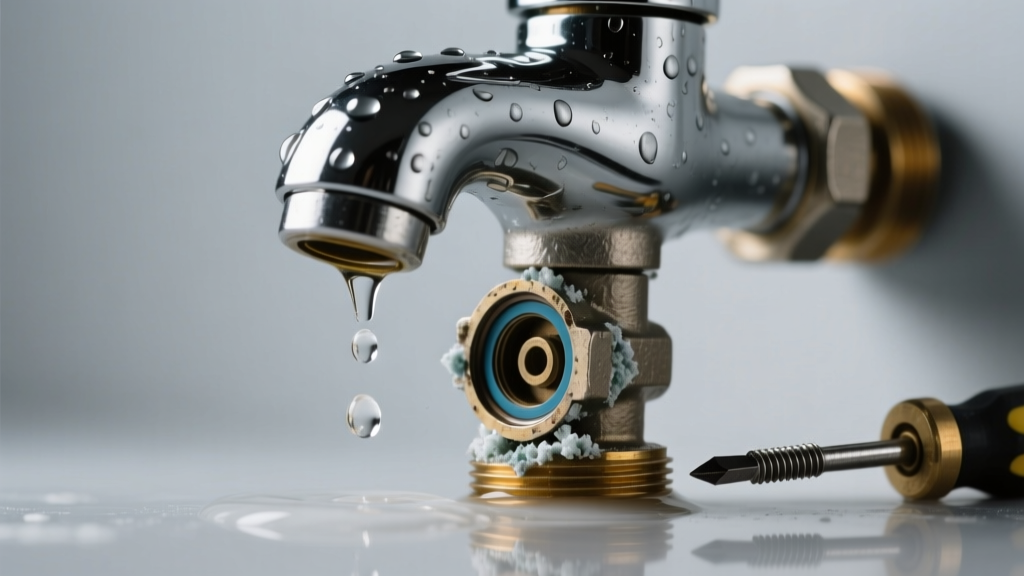
You turn the handle—and instead of a smooth click or gentle flow, you hear a gritty, metallic grinding noise, followed by a steady drip from the spout. It’s unsettling, inefficient, and often a sign that internal parts are failing under friction or corrosion. The good news? Most causes are identifiable in under 10 minutes—and many are fixable without calling a plumber.
Quick Checklist
- Does the grinding happen only when you first turn the faucet on or off?
- Is the leak constant—or does it start or worsen after the grinding sound?
- Does the handle feel stiff, gritty, or require extra force to move?
- Have you recently had hard water scale buildup or low water pressure in other fixtures?
- Is your faucet a single-handle cartridge type (e.g., Moen, Delta) or a two-handle compression model?
- Did the noise begin shortly after installing a new aerator or replacing a valve stem?
Possible Causes
Worn or Grit-Embedded Cartridge (Most Common)
Cartridge faucets—especially Moen and Delta models—rely on tight tolerances between plastic or brass components. When mineral deposits or metal shavings embed in the cartridge, rotation grinds against housing walls. Confirm by removing the handle and inspecting the cartridge for visible scoring, white crust, or resistance during manual rotation. Severity: Low—DIY replacement takes <20 minutes. Moen cartridge replacement guide.
Sediment or Debris in Valve Seat (High Likelihood in Older Homes)
Particulates from aging galvanized pipes or water heater sediment can lodge between the valve seat and washer or ceramic disc. This creates abrasion during operation and disrupts sealing. Confirm by shutting off water, disassembling the valve, and checking for sand-like grit or rust flakes under the seat. Severity: Medium—requires cleaning or seat resurfacing; valve seat repair steps here.
Loose or Cross-Threading on Stem or Cartridge Mount
If the cartridge wasn’t fully seated or was twisted during reassembly, its internal alignment shifts—causing metal-on-metal scraping. Confirm by turning the faucet on/off slowly while watching for lateral wobble in the cartridge body. Severity: Low—re-seating usually resolves it. common stem installation errors.
What to Do First
Stop using the faucet immediately—continued operation accelerates wear and may crack ceramic discs or strip threads. Shut off the local shutoff valves (usually under the sink) and open the faucet to relieve pressure. Then, place a towel beneath the fixture and check for active drips to gauge leak volume. According to the U.S. EPA, a faucet leaking at one drip per second wastes over 3,000 gallons annually—so even small leaks matter.
- Turn off hot and cold supply lines
- Drain residual water from the line
- Photograph the assembly before disassembly
- Collect all small parts in a labeled container
What NOT to Do
Don’t crank the handle harder to ‘force’ it shut—this increases torque on brittle ceramic components and can fracture them. Don’t use pipe dope or Teflon tape on cartridge threads; it interferes with precise alignment and heat dissipation. And never ignore the noise just because the leak seems minor: grinding indicates active metal fatigue.
- Avoid pliers on plastic or chrome handles—they’ll mar or crack surfaces
- Don’t substitute generic O-rings without matching durometer and size
- Never reinstall a cartridge without lubricating with silicone-based grease (not petroleum)
Why does my kitchen faucet grind only when I turn it off?
This points strongly to debris trapped in the closing mechanism—often near the cartridge’s lower seal or poppet valve. As pressure drops during shutoff, particles shift and scrape. Try flushing the line: remove the aerator, turn on full cold for 30 seconds, then repeat with hot. If grinding persists, the cartridge is likely compromised.
Can hard water cause grinding in a brand-new faucet?
Yes—even new fixtures suffer if installed in homes with >7 grains per gallon (gpg) hardness. The Insurance Institute for Business & Home Safety's 2023 report notes that unconditioned hard water reduces cartridge lifespan by up to 60% in high-use kitchens. Install a point-of-use filter or whole-house softener before replacing hardware.
Is the grinding noise coming from inside the wall?
Unlikely—but possible if the shutoff valve itself is failing. Test by turning the faucet on, then slowly closing the supply valve under the sink. If grinding occurs *there*, replace the angle stop valve—not the faucet. These rarely outlast 15 years in corrosive water conditions.
Why does my bathroom faucet grind but only leak when hot water is running?
Heat expands metal components, worsening misalignment in worn cartridges or loose stems. The thermal expansion also loosens mineral bonds, letting debris migrate into the flow path. This is why leaks often appear only at temperature extremes—confirm by testing both handles independently with cold water first.
Will tightening the packing nut stop the grinding?
No—over-tightening compresses the stem or cartridge housing, increasing friction and accelerating wear. It may silence the noise temporarily, but worsens long-term damage. As plumbing contractor Maria Lin states in Modern Residential Repair Handbook (2022): “If grinding stops after tightening, you’ve just turned a $12 cartridge into a $95 service call.”
“If grinding stops after tightening, you’ve just turned a $12 cartridge into a $95 service call.” — Maria Lin, Modern Residential Repair Handbook, 2022
Next Steps
Once you’ve matched your symptoms to a likely cause, gather the right replacement part—most cartridges are model-specific and not interchangeable across generations. Check your faucet’s model number (often stamped inside the handle or on the base), then verify compatibility before ordering. If you’re unsure about disassembly or see cracked ceramic discs, schedule a licensed plumber—but bring your photos and checklist so they can diagnose faster and skip the diagnostic fee.
| Faucet Type | Top Cause | DIY Difficulty |
|---|---|---|
| Single-handle Moen | Worn 1225 cartridge | Easy (20 min) |
| Delta Touch2O | Debris in solenoid valve | Moderate (requires electronics caution) |
| Two-handle compression | Corroded brass valve seat | Medium (reaming tool needed) |
| Peerless or Price Pfister | Cross-threaded stem | Easy (reseat + grease) |