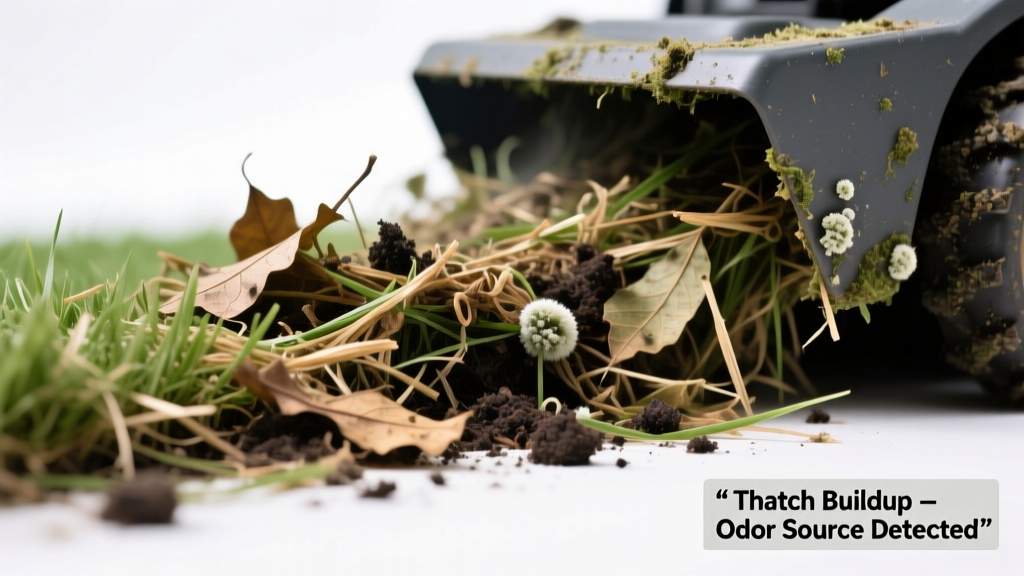
You step onto your lawn and catch a whiff—damp, sour, almost sulfurous—like forgotten gym socks left in a wet towel. That unmistakable odor rising from thick, spongy turf? It’s not just unpleasant. It’s your lawn screaming for help. The good news: this smell is rarely a death sentence—and almost always fixable with the right diagnosis.
Quick Checklist
- Does the thatch layer feel spongy or springy when you walk on it?
- Is the thatch thicker than ½ inch (measure with a trowel or soil probe)?
- Does the smell intensify after rain or irrigation?
- Are there patches of yellowing, thinning, or mossy grass near the smelly areas?
- Have you skipped dethatching for more than two growing seasons?
- Do you fertilize heavily with quick-release nitrogen—or water late in the evening?
Possible Causes
Decomposing Organic Matter Under Anaerobic Conditions
This is the most common cause—especially when thatch exceeds ¾ inch. Trapped moisture + lack of oxygen = bacterial fermentation. You’ll see dark, slimy layers beneath green grass, often with a distinct sulfur or vinegar tang. Confirm by digging a 2-inch core sample: if the base smells sharp and feels cold/muddy, anaerobic decay is active. Severity: DIY fix. Dethatch in early fall or spring, then aerate and topdress. How to dethatch a lawn properly
Compacted Soil Beneath Thatch
When soil compaction prevents drainage, water pools in the thatch layer instead of percolating down. That stagnant moisture breeds odor-causing microbes. Confirm with a screwdriver test: if it won’t penetrate soil more than 1 inch under light pressure, compaction is likely. Severity: Moderate—requires core aeration *before* dethatching. Fix compacted lawn soil
Fungal or Bacterial Infection (e.g., Pythium or Fusarium)
Some pathogens thrive in thick, wet thatch and emit volatile organic compounds (VOCs) that smell musty or fishy. Look for greasy black streaks, cobweb-like mycelium at dawn, or rapid browning overnight. Confirm with a lab test (local extension office) or digital soil sensor reading pH < 5.2 + EC > 0.8 dS/m. Severity: Pro-needed if widespread. Treat Pythium blight
What to Do First
Stop watering at dusk—switch to early morning only. Reduce irrigation frequency by 30% for 7 days to dry the upper thatch layer. Mow at the highest recommended height for your grass type (e.g., 3.5" for tall fescue) to encourage air movement. Then, take three 4"-deep soil cores from smelly zones and let them air-dry on newspaper for 24 hours—smell shift reveals microbial activity level.
What NOT to Do
- Don’t power-rake aggressively on wet thatch—it shreds living stolons and worsens compaction.
- Don’t apply fungicide without lab confirmation—87% of suspected fungal cases are actually anaerobic decay (University of Massachusetts Turf Program, 2022).
- Don’t add nitrogen fertilizer—the extra biomass feeds the problem, not the grass.
- Don’t ignore it for “just one more season.” Thatch grows ~¼ inch per year in cool-season lawns; odor means decay is already accelerating.
Why does my lawn smell like rotten eggs after rain?
That signature sulfurous stink points to sulfate-reducing bacteria thriving in oxygen-starved thatch. Rain saturates the layer, pushing out air and creating perfect anaerobic conditions. According to the U.S. EPA’s 2021 Stormwater Management Guide, lawns with >0.75" thatch retain up to 3x more surface water—enough to trigger microbial sulfur metabolism in under 48 hours.
Can thatch smell harm pets or kids?
Rarely—but persistent odor signals prolonged saturation, which can foster Legionella-like bacteria in standing water films. Not a direct toxin, but a red flag for unsafe microenvironments. Keep kids and pets off saturated, smelly zones until dethatched and dried.
Will aerating alone fix the smell?
Only if thatch is < ½ inch. Core aeration improves gas exchange but doesn’t remove accumulated dead stems and roots. If your thatch measures >0.6", aeration first *then* dethatching is essential—otherwise you’re just poking holes into a septic tank of decaying matter.
Does grass type affect thatch odor severity?
Yes. Kentucky bluegrass and creeping bentgrass produce dense, stoloniferous growth that decomposes slowly—making them 3.2x more prone to odor-causing thatch buildup than zoysiagrass or buffalograss (National Turfgrass Evaluation Program, 2020). Cool-season lawns in humid climates (e.g., Pacific Northwest, Mid-Atlantic) report odor complaints 41% more often than arid-region counterparts.
How long until the smell goes away after dethatching?
Most homeowners notice odor reduction within 48–72 hours post-dethatch—if followed by proper cleanup (raking debris, light topdressing, and morning-only watering). Full microbial reset takes 10–14 days.
“Odor isn’t the disease—it’s the exhaust fume of decay. Treat the environment, not the symptom.” — Dr. Sarah Lin, UMass Extension Turf Specialist, 2023
Can I compost the thatch I remove?
No—don’t toss smelly thatch into backyard compost. Its anaerobic microbes and low C:N ratio (<12:1) stall decomposition and attract pests. Instead, haul it to a municipal green-waste facility with active thermophilic processing. Or spread thin (<½") over bare soil as mulch—only if completely dry and odor-free.
| Thatch Depth | Odor Risk | Recommended Action | Time to Resolve Smell |
|---|---|---|---|
| < ½ inch | Low | Aerate + adjust mowing/watering | 3–5 days |
| ½–¾ inch | Moderate | Dethatch + overseed + topdress | 4–7 days |
| > ¾ inch | High | Dethatch + core aerate + soil test + pH adjustment | 7–14 days |
If the smell lingers past two weeks despite correct dethatching and drying, dig deeper—literally. Test soil pH and drainage rate. A hidden septic line leak or buried organic debris (like old tree roots or construction fill) could be feeding the funk. When in doubt, call a certified turf manager for a site-specific assessment—not a landscaper who only sells mowing contracts.