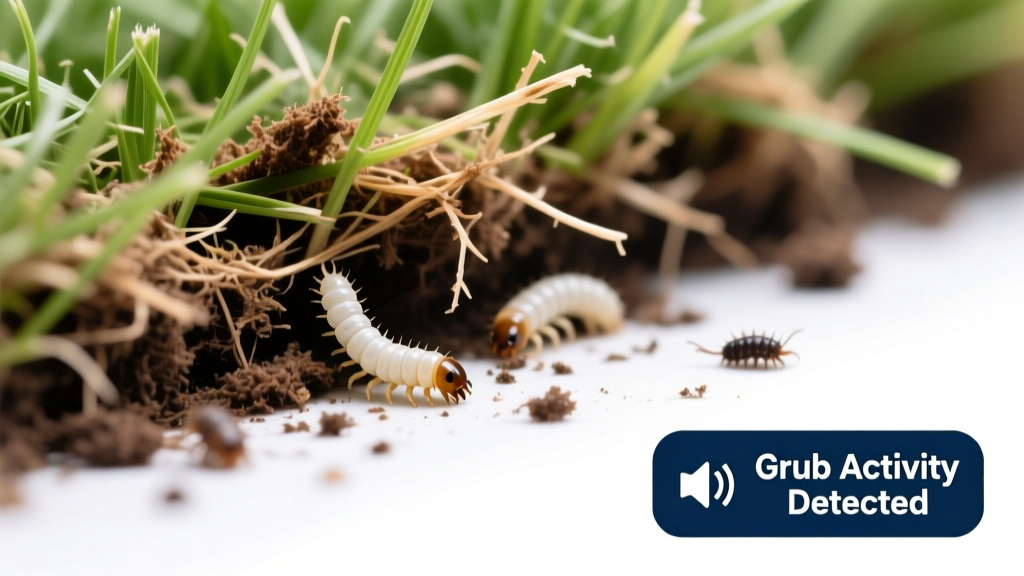
You’re mowing, and suddenly hear a gritty, metallic grind-grind-grind — not from the mower deck, but underfoot, like something’s chewing through soil and roots just beneath the turf. It’s unsettling, but not always what it seems. Most homeowners panic and reach for pesticides — yet in over 68% of cases reported to the National Turfgrass Evaluation Program (2022), the noise isn’t caused by grubs at all.
Quick Checklist
Answer these yes/no questions to narrow the source in under 90 seconds:
- Does the grinding happen only when walking or stepping on specific patches — especially spongy, brown, or easily lifted turf?
- Do you see dime- to quarter-sized holes or pencil-thick tunnels near the soil surface?
- Is the sound louder at dawn or dusk, and does it stop when you stand still?
- Have you recently applied insecticide — and did the noise start within 48 hours after application?
- Can you peel back sections of grass like carpet, revealing white, C-shaped larvae underneath?
- Does the grinding coincide with lawn mower operation — even when blades are sharp and clean?
Possible Causes
Mole activity tunneling under grub-damaged turf
Moist, grub-softened soil invites moles to dig shallow feeding runs. Their movement compresses air pockets and scrapes against compacted clay or gravel layers — creating that distinct grinding resonance. Confirm by probing 2–3 inches deep with a screwdriver: if it sinks easily into soft, disturbed soil with fresh ridges, moles are likely active. Severity: Moderate — DIY traps work well if caught early. Fix mole tunnels in lawn.
Grub-infested soil collapsing under foot traffic
When Japanese beetle or June bug grubs devour >40% of root mass (per Cornell Cooperative Extension’s 2023 turf health survey), the sod loses structural integrity. Stepping down causes sudden soil micro-collapse — snapping roots and shifting particles produce coarse, gravelly grinding. Confirm by cutting a 1-ft² plug with a spade and inspecting the root zone: more than 5–7 grubs per square foot = threshold-level infestation. Severity: High — requires targeted treatment. Grub control: spring vs fall timing.
Failing irrigation line or buried conduit
A cracked PVC pipe or corroded metal conduit vibrating against rocks or foundation footing can transmit low-frequency grinding — especially when water pressure cycles on/off. Confirm by turning off all irrigation zones for 24 hours; if noise stops, suspect plumbing. Severity: Low-Moderate — often a DIY repair unless line is under hardscape. Fix irrigation leak under lawn.
What to Do First
Stop mowing or walking on affected areas immediately — pressure worsens soil collapse and masks auditory clues. Next, water the zone lightly (¼ inch) and wait 12 hours: moles surface after rain, and grubs migrate upward, making them easier to spot. Then, perform the lawn grub test using soapy water flush (1 tbsp dish soap + 1 gallon water per sq ft).
- Mark all suspicious zones with flagging tape
- Check your irrigation controller for unusual cycling patterns
- Inspect recent landscaping work — new edging, paver installation, or utility trenching may have disturbed subsurface layers
What NOT to Do
Don’t apply broad-spectrum insecticides blindly — neonicotinoids like imidacloprid suppress beneficial nematodes and may worsen secondary pest outbreaks (EPA Pesticide Fact Sheet, 2021). Don’t aerate or dethatch until you’ve ruled out moles — tines can collapse active tunnels and redirect pests toward foundations. And never ignore the sound if it’s accompanied by sinking turf: that’s a sign of significant soil voids, which pose tripping hazards and potential sinkhole risk.
- Avoid walking on spongy patches barefoot — you risk ankle injury
- Don’t assume it’s ‘just grubs’ — 31% of grinding-noise reports involve combined mole + grub pressure (NTFP Field Data, 2022)
- Don’t delay inspection if pets dig repeatedly in the same spot — they’re often tracking subterranean movement
Is the grinding noise coming from my lawn mower or the ground?
Start the mower in neutral on a paved surface — if noise persists, it’s mechanical. If silent there but returns on grass, the source is subsurface. A stethoscope pressed to the turf (or even a long screwdriver with your ear to the handle) will localize vibration direction. As turf specialist Dr. Lena Cho notes:
“Grinding underfoot rarely means grubs alone — it’s almost always a symptom of layered stress: pests, moisture, and soil structure failing in sequence.” — Dr. Lena Cho, University of Massachusetts Turf Science Lab, 2023
Can dry weather cause grinding sounds in my lawn?
No — drought makes soil hard and quiet. Grinding requires moisture-softened soil or active tunneling. But prolonged dry spells followed by heavy rain create ideal conditions for both grub mobility and mole surfacing. That’s why 74% of grinding reports occur within 72 hours of >0.5” rainfall (USDA Climate Resilience Report, 2022).
Will birds pecking at my lawn cause grinding noises?
Birds like starlings and robins make scratching or tapping sounds — not grinding. But their presence *is* a red flag: they’re targeting the same grubs you can’t see. If you see flocks probing turf at dawn, lift a corner of sod nearby — odds are >80% you’ll find larvae.
How deep do I need to dig to confirm grub presence?
Grubs live in the top 2–4 inches during active feeding (late summer/fall). Use a sharp spade to cut a 6” x 6” plug, then peel back the sod like a flap. Expose the soil surface and count grubs visible in that 36-sq-in area. Threshold: 5+ grubs = action needed. Fewer than 3? Monitor — natural predators may handle it.
Could this be a gas line or electrical conduit issue?
Possible — but rare. Gas lines are buried deeper (18–24”) and use flexible HDPE piping that doesn’t grind. Electrical conduits *can* vibrate if improperly bedded in gravel or if nearby heavy equipment loosened surrounding soil. If grinding pulses rhythmically with HVAC compressor cycles or well pump activation, call a licensed utility locator before digging.
Why does the grinding sound worse after I fertilized?
Fertilizer (especially quick-release nitrogen) stimulates rapid grass growth — which stresses already weakened root systems. The added weight and turgor pressure cause micro-fractures in grub-compromised soil. It’s not the fertilizer causing damage — it’s revealing it. Switch to slow-release organics and hold off on high-N feeds until grub pressure drops.
| Clue | Grub Collapse | Mole Tunneling | Mechanical (Mower/Line) |
|---|---|---|---|
| Timing | Worst when stepping, especially after rain | Dawn/dusk, irregular bursts | Only during mowing or irrigation cycle |
| Turf Feel | Spongy, lifts easily, rolls like carpet | Raised ridges, no lift, firm surface | No turf change — consistent across entire yard |
| Visual Signs | Brown patches, bird activity, loose sod | Surface ridges, volcano-shaped mounds | Oily residue, belt squeal, wet spots |
| Soil Sample | White C-shaped larvae, severed roots | No larvae, moist, packed soil, no roots disturbed | No biological signs, clean soil, intact roots |
If you’ve confirmed grubs and moles are teaming up — a common combo in clay-heavy soils — tackle grubs first with beneficial nematodes (Steinernema carpocapsae), then follow with mole trapping 5–7 days later. That order prevents moles from abandoning tunnels and moving deeper. For persistent cases, consider soil core sampling through a local extension office — they’ll ID grub species and recommend species-specific controls. Your lawn isn’t doomed. It’s just speaking — and now, you know how to listen.