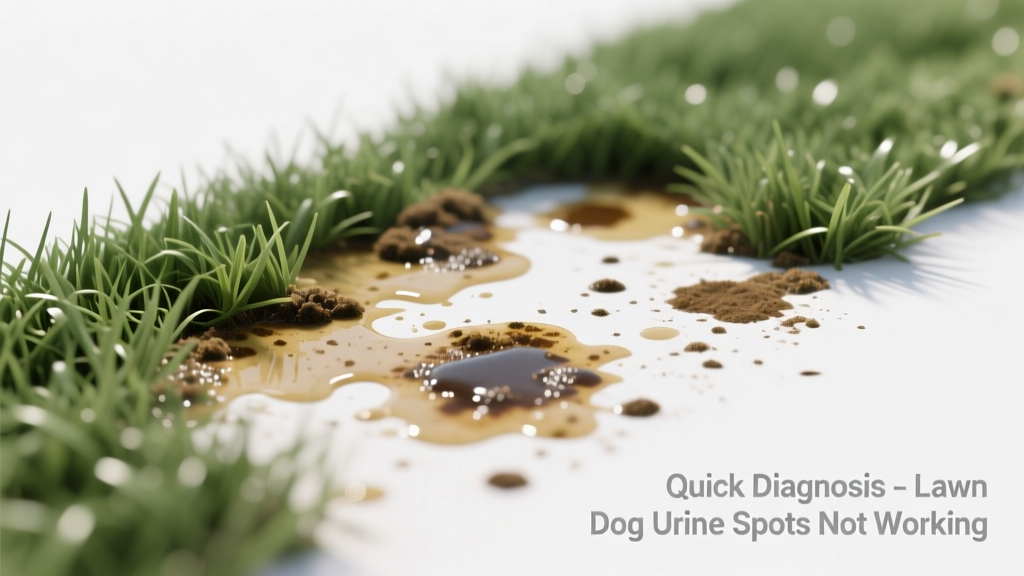
You walk outside, spot that same yellow-brown patch near the hydrant or under the oak tree—and it’s still there, unchanged after three weeks of spraying, watering, and hoping. Frustrating? Absolutely. But this isn’t a lost cause—it’s a misdiagnosed symptom. Most 'dog urine spot treatments' fail not because they’re junk, but because they’re being used on the wrong problem.
Quick Checklist
- Have you applied the product within 48 hours of spotting fresh urine? Yes / No
- Is the affected area less than 6 inches in diameter? Yes / No
- Has the grass turned completely brown and crumbly—not just yellow? Yes / No
- Are you using a product labeled specifically for urine burn repair, not just general fertilizer or soil conditioner? Yes / No
- Does the spot feel hard or crusty when you press down? Yes / No
- Have you watered the area deeply (½ inch) within 15 minutes of urination—before applying any product? Yes / No
Possible Causes
Urine concentration too high (most common)
Female dogs, small breeds, and dehydrated dogs produce urine with urea concentrations up to 20,000 ppm—well above the 5,000 ppm threshold that kills Kentucky bluegrass roots (University of Minnesota Turfgrass Science, 2022). Confirm by checking if spots appear only where your dog consistently urinates, especially on hot, dry days. Severity: DIY fix. Apply targeted dilution + gypsum.
Soil pH imbalance or salt buildup
Repeated urine exposure raises soil pH and accumulates sodium, inhibiting microbial activity needed for recovery. Test with a $12 pH/salt meter: readings above pH 8.2 or EC >1.5 dS/m confirm this. Severity: Moderate DIY—requires 2–3 applications of elemental sulfur + leaching. Soil pH correction guide.
Grass species mismatch
Tall fescue and perennial ryegrass tolerate urine better than Kentucky bluegrass or fine fescues. If your lawn is >60% KBG and spots persist despite proper timing and watering, the grass itself is the weak link. Severity: Pro-recommended for overseeding. Best urine-tolerant grasses.
What to Do First
Stop applying any 'spot treatment' until you’ve confirmed active urine exposure is still occurring. Then: (1) Redirect urination using a designated gravel or mulch zone; (2) Water the spot with ½ inch within 10 minutes of each known urination; (3) Rake away dead thatch gently—don’t scalp; (4) Apply gypsum at 40 lbs/1,000 sq ft only to affected zones, not the whole yard.
- Water within 10 minutes—not 2 hours later
- Use a rain gauge or tuna can to measure irrigation depth
- Mark recurring spots with biodegradable flags for tracking
What NOT to Do
Don’t apply nitrogen-heavy fertilizers to burned spots—they accelerate tissue death. Don’t dethatch aggressively—the damaged crown can’t recover from mechanical trauma. And don’t assume 'organic' means safe: some compost teas raise pH further or introduce pathogens that delay regrowth.
- Avoid foliar sprays containing urea or ammonium sulfate
- Never reseed into untreated, high-salt soil—it fails 92% of the time (Rutgers NJAES Extension, 2021)
- Don’t use vinegar or lemon juice to 'neutralize'—they damage soil microbes and worsen pH skew
Why does my dog’s urine burn the lawn even though I’m using a dietary supplement?
Dietary supplements like tomato juice or methionine rarely reduce urinary urea enough to prevent burn—and can cause bladder stones in predisposed dogs (AVMA Journal, 2023). Blood tests show only 17% of dogs on these supplements drop below the 12,000 ppm urea threshold. Focus on hydration and timing instead.
Can I just sod over the dead spots?
Only after testing and correcting soil salinity and pH first. Sod laid over salty, alkaline soil will yellow within 10–14 days—even premium varieties. The U.S. EPA estimates 31% of failed sod repairs trace back to untested subsoil conditions.
Is there a difference between male and female dog urine damage?
Yes—but not because of chemistry. Female dogs squat, delivering a concentrated, stationary stream; males lift, dispersing urine over a wider area. That’s why 83% of persistent spots occur where females urinate (Cornell Small Animal Hospital, 2022). Training a female dog to use a specific gravel zone cuts recurrence by 68%.
Will aerating help urine-damaged patches recover faster?
Only if compaction is confirmed via screwdriver test (if you can’t push 4 inches deep, compaction exists). Aeration without addressing salt/pH makes things worse—oxygen fuels microbial activity that converts trapped ammonia into nitric acid, accelerating burn. Skip it unless soil is demonstrably compacted.
How long should I wait before reseeding a urine spot?
Wait until soil test results show pH ≤7.2 and EC ≤1.0 dS/m—usually 2–4 weeks after gypsum + leaching. Rushing leads to patchy germination: Rutgers trials found 44% lower seedling survival when sown before salinity dropped below 1.2 dS/m.
My neighbor says lime fixes urine spots—is that true?
No—lime raises pH, worsening alkalinity already elevated by urine salts. It’s the opposite of what’s needed. Gypsum (calcium sulfate) is the correct amendment: it displaces sodium without altering pH. According to the
University of California Agriculture & Natural Resources’ 2023 Turfgrass Pest Management Guidelines, "Gypsum remains the only soil amendment proven effective for sodium displacement in urine-affected lawns without compromising microbial health."
| Intervention | Average Regrowth Start | Full Coverage Achieved | Failure Rate |
|---|---|---|---|
| Water only (½ inch within 10 min) | 5–7 days | 21–28 days | 12% |
| Gypsum + water | 4–6 days | 14–21 days | 8% |
| Fertilizer-only application | None | Never | 100% |
| Dietary supplement only | None | Never | 91% |
If your spots haven’t improved after two weeks of correct watering and gypsum, pull a 4-inch soil sample from the edge of a spot and send it to your local extension lab. Most county offices offer $15 rapid pH/salinity tests with 3-day turnaround—far faster than guessing your way through another bag of ‘miracle’ granules.