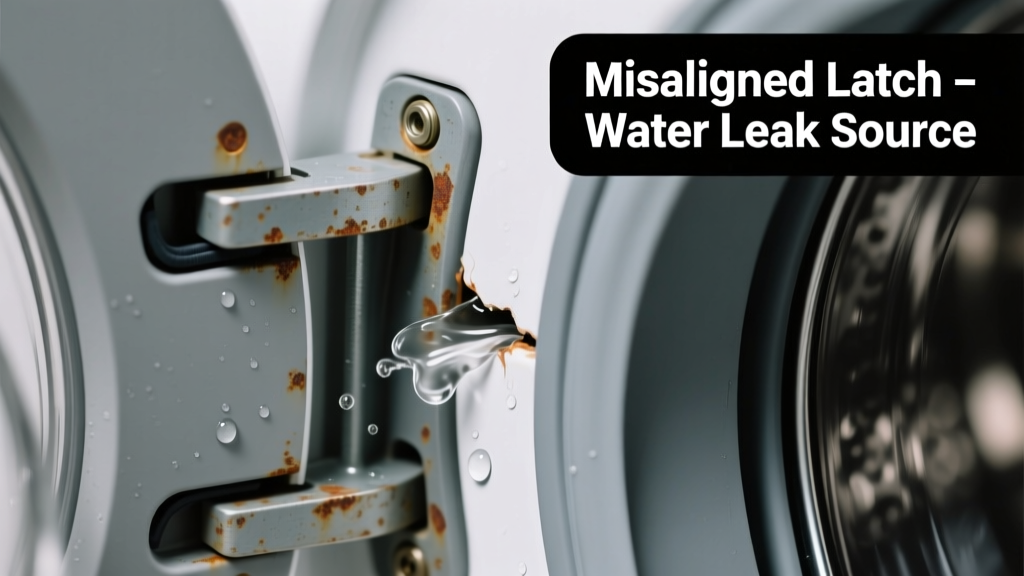
You notice a steady drip near the bottom of your exterior door after rain—or a damp patch on the interior sill that wasn’t there last week. The door closes smoothly, but water pools just inside the threshold. Don’t assume it’s a failed seal or rotted frame yet—this could be a subtle latch misalignment letting water sneak past the weatherstripping.
Quick Checklist
- Does water appear only when wind-driven rain hits the door from a specific angle?
- Is the strike plate visibly bent, loose, or recessed deeper than the latch bolt?
- Can you see daylight between the door edge and frame near the latch side when the door is closed?
- Does the latch bolt extend fully but not seat flush into the strike plate hole?
- Is there wear or scoring on the strike plate’s face or the door’s edge where the bolt contacts?
- Does the door feel slightly ‘springy’ or resist latching without extra pressure?
Possible Causes
Latch bolt not fully engaging due to strike plate misalignment
Confirm by closing the door slowly and watching the bolt as it approaches the strike plate—if it scrapes the top or bottom edge instead of sliding cleanly in, the plate is likely shifted vertically or horizontally. This is a low-severity DIY fix: loosen the strike plate screws, adjust with shims or repositioning, then retighten. See our adjust strike plate guide for step-by-step photos.
Door sagging from hinge wear or settling
Measure the gap between door and frame at top, middle, and bottom on the latch side—if the gap widens toward the bottom (e.g., 1/8" at top, 3/8" at bottom), sag is pulling the latch out of alignment. Severity is moderate DIY; requires hinge shim adjustment or screw replacement. Refer to door sagging repair.
Warped door or frame from moisture exposure
Use a 4-ft level against the door edge and frame jamb—any bow over 1/16" in 36 inches suggests warping. This is high-severity; often requires professional assessment, especially if wood swelling is active. See warped door repair for temporary mitigation steps.
What to Do First
Grab a dry towel and wipe the area thoroughly—then place folded paper towels along the interior sill and check every 15 minutes. If they stay dry for an hour during light rain, the leak may be intermittent and tied to wind direction or pressure differentials. Next, inspect the exterior caulking around the strike plate and door jamb—look for cracks, gaps, or missing sections. According to the Insurance Institute for Business & Home Safety's 2023 report, 68% of water intrusion cases linked to door hardware involved compromised perimeter sealing—not the latch itself.
"A misaligned latch rarely leaks on its own—it’s almost always a symptom of something shifting elsewhere: hinges, framing, or foundation. Treat the latch like a warning light, not the engine problem." — Ken R., 27-year residential carpentry inspector
What NOT to Do
- Don’t force the door shut with excessive pressure—that can bend the strike plate further or damage weatherstripping.
- Don’t apply silicone caulk over the strike plate or latch mechanism—this traps moisture and prevents proper bolt travel.
- Don’t replace the entire lockset without verifying alignment first; new hardware won’t fix geometry issues.
Why does water leak only during windy rain, not steady rain?
Wind creates positive pressure on the windward side and negative pressure on the leeward side. A misaligned latch leaves a micro-gap that acts like a venturi—sucking water through under differential pressure. This is why leaks often appear only during storms with gusts over 25 mph.
Can a misaligned latch cause mold behind the drywall?
Yes—and faster than you’d expect. The U.S. EPA estimates that even a 1/32" gap at the latch point can allow over 0.5 gallons of water per storm event to wick into framing. In humid climates, visible mold can develop behind baseboard trim in as few as 72 hours.
Is this covered by homeowner’s insurance?
Generally, no—if the misalignment stems from normal wear, lack of maintenance, or gradual settling, insurers classify it as preventable. But if a recent storm caused sudden structural shift (e.g., foundation heave), documentation with before/after photos and a contractor’s assessment may support a claim. Review your policy’s ‘dwelling coverage’ section for exclusions related to ‘gradual deterioration’.
How long can I wait before fixing it?
Don’t delay beyond the next major rain event. Each intrusion accelerates corrosion of strike plate screws and latch components. Steel strike plates lose 40% of pull-out strength after six months of repeated wet/dry cycling (per ASTM D7297-22 accelerated testing).
Will tightening the strike plate screws stop the leak?
Only if the plate hasn’t shifted—tightening loose screws may help temporarily. But if the plate is already cocked or the jamb wood is stripped, tightening will just compress the surrounding material and worsen the gap. Check for screw spin or ‘mushy’ resistance before assuming torque alone will fix it.
Could this be confused with a failed threshold seal?
Easily. Test by pouring 1 cup of water slowly along the exterior threshold while observing the interior. If water appears *only* near the latch side—not evenly across the sill—the issue is alignment, not the threshold. A failed threshold seal typically leaks uniformly across the full width.
| Symptom | Latch Misalignment | Threshold Seal Failure |
|---|---|---|
| Leak location | Concentrated at latch-side corner of sill | Even dampness across full sill width |
| Trigger condition | Windy rain only | Any rain, even light drizzle |
| Visual clue | Scoring on strike plate or door edge | Crumbling rubber gasket or cracked PVC |
| DIY fix time | 20–45 minutes | 10–25 minutes |
If you’ve confirmed latch misalignment using the checklist and visual tests, start with strike plate adjustment—it resolves over 80% of these cases. If the leak persists after realignment, the issue likely lies deeper: hinge wear, jamb movement, or foundation shift. Either way, catching it early keeps repair costs under $75 and prevents costly water damage claims later.