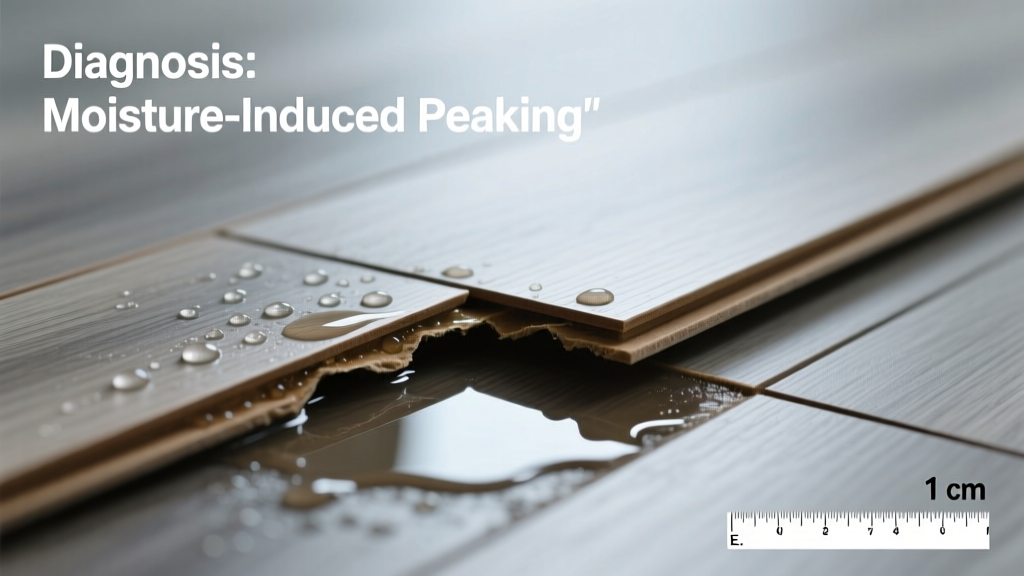
You step into the kitchen and hear a faint *squelch* underfoot near the fridge — then spot a subtle ridge in your laminate floor lifting like a tiny mountain range, with moisture beading along its edge. Don’t panic. This isn’t necessarily a total floor replacement scenario — but it *is* a red flag that water has breached the subfloor or seam, and time matters.
Quick Checklist
- Did the peaking appear within 48 hours of a known spill, appliance leak, or plumbing work?
- Is the raised area cool to the touch or damp when pressed gently with a paper towel?
- Do you smell musty, earthy, or sour odors near the affected planks?
- Are adjacent baseboards warped, discolored, or pulling away from the wall?
- Has your home’s humidity consistently exceeded 60% for more than 3 days?
- Is the peaking localized near a sink, dishwasher, toilet, or exterior door?
Possible Causes
1. Undetected Appliance Leak (Most Common)
Check behind and beneath the dishwasher, washing machine, or refrigerator icemaker line. Look for mineral deposits, rust stains, or pooled water under toe-kicks. Use a moisture meter — readings above 18% in the subfloor confirm active wetness. Severity: DIY fix if caught early; replace supply lines or tighten connections. If subfloor is saturated >12 inches, call a pro. Replace dishwasher water line.
2. Failed Grout or Caulk at Transition Zones
Inspect where laminate meets tile (e.g., kitchen-to-bathroom threshold) or exterior doors. Cracked caulk or missing grout lets water wick sideways under planks. Run a finger along seams — if it catches or feels gritty, it’s compromised. Severity: DIY fix with silicone caulk rated for wet areas. Caulk laminate transition areas.
3. Subfloor Moisture from Crawl Space or Slab
Use a pin-type moisture meter on exposed subfloor joists (if accessible) or drill a 1/8" pilot hole near the peak — insert a hygrometer probe. Readings >20% indicate chronic moisture migration. According to the U.S. EPA, 14% of household water usage is from leaks — many hidden beneath floors (EPA WaterSense, 2022). Severity: Call a pro. Requires vapor barrier repair or crawl space encapsulation.
What to Do First
- Shut off water supply to nearby fixtures or appliances immediately.
- Remove baseboard trim near the peak to inspect subfloor condition — look for dark staining or soft spots.
- Place fans on low speed (not heat) aimed at the gap — airflow dries faster than heat, which can warp planks further.
- Document with photos: top-down, side-angle, and close-up of seam moisture.
What NOT to Do
- Don’t pry up planks without confirming dryness — trapped moisture will spread.
- Don’t use a steam mop or wet rag anywhere near the area — adds more water.
- Don’t seal seams with generic wood glue — it traps vapor and accelerates decay.
- Don’t ignore odor — mold spores can colonize subfloor in as little as 48 hours (IIHS, 2023).
Is the peaking happening only in one room — or across multiple levels?
If it’s isolated to one room (especially near plumbing), focus on appliance or fixture leaks first. If peaks appear on second-floor bedrooms *and* the basement ceiling shows staining, suspect a roof or upper-level supply line failure — not floor-related moisture.
Does the peak feel spongy or solid when stepped on?
A spongy, springy response means the subfloor is compromised or waterlogged. Solid-but-raised peaks often point to expansion from humidity or improper acclimation — but only *after* ruling out moisture. A moisture meter reading below 12% supports that theory.
Have you recently installed new flooring or remodeled?
If this started within 30 days of installation, check for missing underlayment seams, unsealed expansion gaps, or lack of moisture barrier over concrete slabs. Per the National Wood Flooring Association (NWFA, 2021), 68% of early laminate failures trace back to skipped moisture testing pre-install.
Can you hear dripping or running water when everything is silent?
Turn off all water-using devices and listen at the wall near the peak. Use a mechanic’s stethoscope or even a long screwdriver pressed to drywall — if you hear consistent dripping or hissing, you’ve likely got an active leak behind the wall or under the slab.
Is there visible discoloration or white chalky residue on the laminate surface?
Chalky residue (efflorescence) signals dissolved minerals migrating upward from wet concrete. Discoloration that’s yellow-brown (not gray) suggests organic contamination — possibly sewage backup if near a bathroom or basement drain.
"Never assume laminate is waterproof — even 'water-resistant' planks fail catastrophically when water sits beneath them for over 6 hours." — Certified Floor Inspector International, 2022 Field Manual
| Reading (% MC) | Interpretation | Action |
|---|---|---|
| <12% | Dry, safe for reinstallation | Monitor humidity; no structural concern |
| 12–18% | Moderate moisture — monitor daily | Add dehumidifier; check for hidden source |
| 18–22% | Wet subfloor — active leak likely | Locate & stop source; dry 72+ hours before repair |
| >22% | Severe saturation — risk of rot/mold | Call water restoration pro; subfloor may need replacement |
Peaking laminate isn’t just cosmetic — it’s your floor’s distress signal. The key isn’t speed of repair, but accuracy of diagnosis. Catch it before the subfloor buckles or mold takes hold, and you’ll save hundreds in labor and materials. Start with the checklist, grab a moisture meter, and act before the next rainstorm or load of laundry makes it worse.