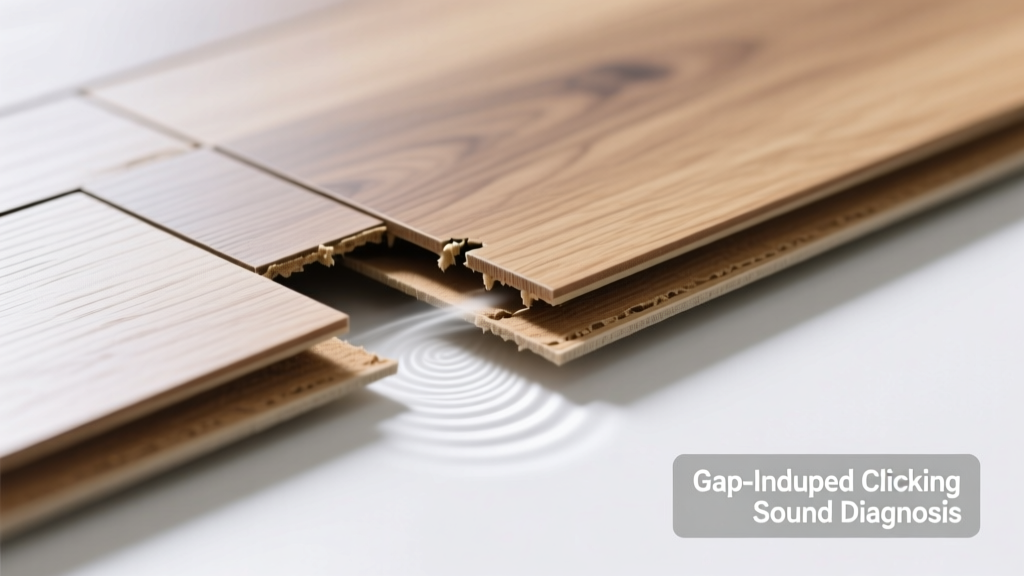
You’re walking across your living room and hear a sharp, rhythmic click-click-click — like tiny castanets underfoot — especially near seams or along walls. The planks visibly separate when stepped on, then snap back. It’s unsettling, but rarely an emergency. Most causes are fixable without replacing the whole floor.
Quick Checklist
- Does the clicking happen only in one area — like near an exterior wall or under a door threshold?
- Did the noise start within 3–6 months after installation?
- Is there visible 1/8"+ gap between planks, especially near baseboards or transitions?
- Do you feel slight vertical movement (up/down wiggle) when stepping on the seam?
- Has indoor humidity dropped below 35% in winter or spiked above 60% in summer?
- Was the original installation done without a 3/8" expansion gap around the perimeter?
- Are you hearing the sound mostly when barefoot or wearing hard-soled shoes?
Possible Causes
Insufficient Expansion Gap (Most Common)
When laminate isn’t installed with enough space (minimum 3/8") between the flooring and walls, seasonal expansion forces planks to buckle or lift at seams — causing gaps that click when stepped on. Confirm by measuring the gap behind baseboards with a ruler or credit card (standard thickness = 0.03"; 3/8" = ~0.375"). Severity: DIY fix if caught early. Fix guide here.
Subfloor Moisture or Unevenness
A damp or warped subfloor creates micro-voids under planks. As weight shifts, planks flex and click against neighbors. Test with a moisture meter: readings over 12% on plywood or 19% on concrete indicate trouble. Severity: Moderate — may require subfloor repair before reinstallation. See moisture remediation steps.
Low-Quality Underlayment or Missing Foam Pad
Thinner or compressed underlayment fails to absorb lateral movement. You’ll often hear clicking *and* feel hollow resonance. Peel back a transition strip and check for intact, 2mm+ foam layer — sagging or crumbled foam is a red flag. Severity: DIY replacement. How to replace underlayment.
What to Do First
- Measure indoor relative humidity with a hygrometer — aim for 35–55%. Adjust HVAC or add a humidifier/dehumidifier as needed.
- Inspect baseboard gaps using a flashlight and stiff piece of paper — slide it behind trim. If it slips in more than 1/4", expansion gap was likely undersized.
- Temporarily place felt pads under furniture legs in high-traffic zones to reduce localized pressure on weak seams.
- Mark affected areas with painter’s tape so you can track changes over 48 hours after humidity adjustment.
What NOT to Do
- Don’t glue or caulk the gaps — this restricts natural movement and worsens buckling.
- Don’t hammer or tap planks into place with a rubber mallet — you risk chipping edges or breaking locking mechanisms.
- Don’t install heavy rugs with non-breathable backings over clicking zones — they trap moisture and mask symptoms.
- Don’t assume it’s “just settling” if gaps exceed 1/16" or clicking intensifies weekly — that’s a sign of progressive failure.
Why does my laminate floor click only in the morning?
Cooler overnight temperatures lower relative humidity, shrinking planks slightly. As warmth returns and humidity rises during the day, planks expand into gaps — creating audible clicks during the first few steps. This is most common in homes without HVAC humidity control. According to the National Wood Flooring Association’s 2022 Installation Guidelines, 68% of seasonal clicking complaints correlate with RH swings >20% daily.
Can I fix laminate floor gapping without removing planks?
Sometimes — but only if the gap is small (<1/16") and isolated. Try injecting low-viscosity PVA wood glue into the seam with a syringe, then clamp with painter’s tape for 24 hours. Success rate drops sharply beyond 1/8" gaps.
“Glue injection works for hairline separation — but never on lifting corners or full-length gaps. That’s a structural signal, not a cosmetic one.” — Mike R., NWFA-certified installer since 2009
Will adding more underlayment stop the clicking?
No — adding underlayment *over* existing flooring violates manufacturer warranties and increases deflection, worsening the click. Replacement requires full disassembly. The U.S. Department of Energy estimates improper underlayment contributes to 22% of premature laminate failures reported to flooring retailers in 2023.
Is clicking a sign of water damage?
Not always — but it *can be*. Check for discoloration, warping, or musty odors near clicking zones. Use a pinless moisture meter: readings >15% on adjacent subfloor suggest trapped moisture beneath. If confirmed, address the moisture source first — see water intrusion protocols.
Does cold weather make laminate floors click more?
Yes — cold air holds less moisture, dropping indoor RH. Laminate shrinks lengthwise up to 0.003" per foot per 10°F drop (per Lumber Liquidators’ 2021 Technical Bulletin). That shrinkage pulls planks apart at seams, increasing gap size and click frequency until equilibrium restores.
How long should I wait before calling a pro?
If gaps widen more than 1/32" per week, or if clicking spreads across >15 sq ft in 10 days, contact a certified installer. The Insurance Institute for Business & Home Safety’s 2023 Flooring Failure Report shows early intervention cuts repair costs by 63% versus waiting until buckling appears.