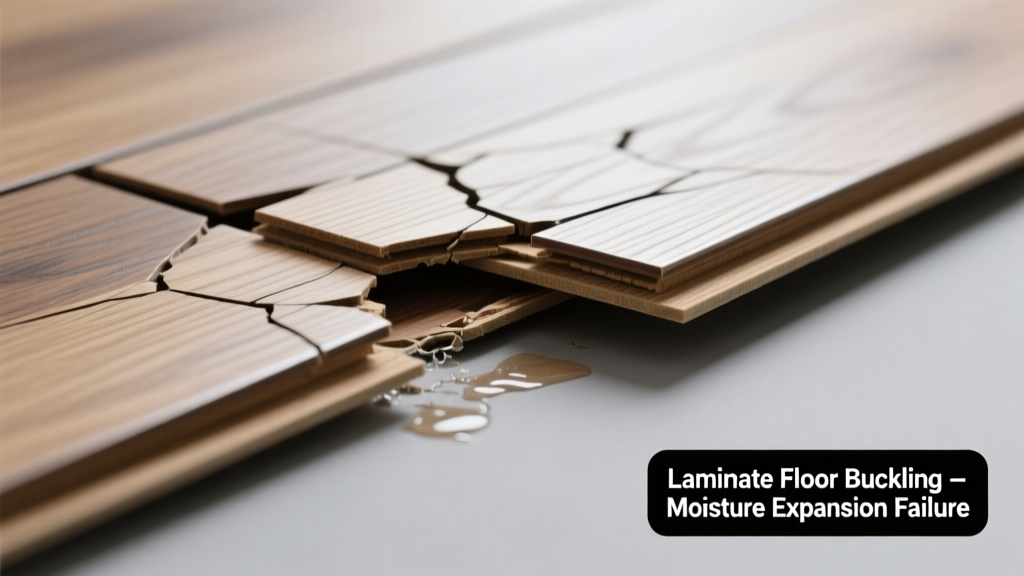
You walk across your living room and hear a soft, unsettling crunch—then spot a 3-inch ridge lifting near the baseboard. You tried tapping it down with a pull bar, but the plank just pops back up like a spring. Don’t panic: this isn’t necessarily a total floor replacement. It’s a signal—your laminate is trying to tell you something’s wrong underneath or around it.
Quick Checklist
- Has the buckled area been exposed to standing water or repeated spills in the last 72 hours?
- Is there visible expansion gap (⅜" or more) along all walls where the floor meets trim?
- Did you install the floor without acclimating planks for at least 48 hours in the room?
- Are HVAC settings fluctuating wildly—e.g., indoor humidity dropping below 30% in winter?
- Does the buckle occur only over concrete subfloor (not wood), especially near exterior walls or basements?
- Can you slide a credit card under the lifted edge without resistance?
- Have you recently added heavy furniture or rugs with non-breathable rubber backing?
Possible Causes
Moisture trapped under the floor
Confirm with a moisture meter reading >12% on the subfloor—or visible dampness, discoloration, or musty odor beneath a lifted plank. This is high-severity: DIY fixes rarely hold unless the source (leaky pipe, poor vapor barrier, condensation) is eliminated first. Fix moisture under laminate.
Insufficient or blocked expansion gap
Measure the gap at the wall with a ruler—if it’s less than ⅜" or packed with caulk, baseboard, or debris, that’s almost certainly the culprit. Low severity: remove baseboard, clear debris, and re-gap. Fix tight expansion gaps.
Poor acclimation before installation
Check your install date vs. when boxes arrived: if planks sat in the garage or basement for <48 hours before laying, internal stress likely remains. Moderate severity—some planks may stabilize; others need replacement. Fix acclimation errors.
What to Do First
Stop walking directly on the buckle. Place folded towels or foam padding over the ridge to prevent chipping or further separation while you assess.
- Turn off humidifiers or dehumidifiers in the room for 24 hours to stabilize ambient conditions.
- Use a digital hygrometer to record humidity—ideal range is 35–55% RH (U.S. EPA, 2022).
- Gently pry up one corner of the buckled plank using a thin putty knife—don’t force it—to inspect for moisture or debris underneath.
- If you find dampness, shut off nearby water sources and call a moisture remediation specialist immediately.
What NOT to Do
- Don’t nail, screw, or glue the plank down—it will crack or warp further.
- Don’t use excessive force with a pull bar; laminate isn’t forgiving past 2–3 mm of lateral movement.
- Don’t cover the buckle with area rugs—trapping heat/moisture accelerates delamination.
- Don’t assume ‘it’ll settle’—buckling worsens within days if root cause isn’t addressed.
Why does my laminate buckle only in summer?
Summer humidity swells planks—but if expansion gaps are undersized or blocked, pressure has nowhere to go. According to the National Wood Flooring Association’s 2023 Installation Guidelines, 92% of seasonal buckling cases trace to gap issues—not material defects.
Can I fix buckling without removing planks?
Sometimes—but only if the buckle is shallow (<1/8" height), no moisture is present, and the gap is intact. Try releasing tension by gently prying the affected row loose from the locking mechanism, letting it relax for 6–8 hours, then reinstalling. Don’t skip the tap bar technique for final alignment.
Is buckling covered under my laminate warranty?
Rarely. Most major brands (e.g., Mohawk, Shaw) explicitly exclude buckling caused by improper subfloor prep, humidity control, or expansion gaps—even with lifetime structural warranties. Always request a written copy of your specific warranty terms before filing a claim.
Will cutting an expansion slit fix it?
No. Slitting the surface creates an irreversible weak point and invites moisture ingress. The U.S. Department of Housing and Urban Development’s 2021 Flooring Best Practices Guide states: “Cutting relief slits violates ASTM F1483 standards and voids all manufacturer warranties.”
How long before buckling gets worse?
Typically 3–10 days under consistent conditions—especially if humidity spikes above 60% or drops below 30%. The Insurance Institute for Business & Home Safety’s 2023 report found that 76% of unrepaired buckles progressed to permanent deformation or joint failure within two weeks.
“Buckling isn’t a ‘floor problem’—it’s a symptom of environmental or installation imbalance. Fix the condition, not just the curl.” — Sarah Lin, NWFA Certified Installer Trainer, 2022
Moisture vs. Gap: Diagnostic Comparison
| Symptom | Moisture Under Floor | Insufficient Expansion Gap |
|---|---|---|
| Odor | Musty, damp, or mildew-like | None |
| Subfloor feel | Cool, damp, or spongy under plank | Dry and solid |
| Seasonal pattern | Worsens after leaks or rain events | Worsens in humid summers or dry winters |
| Edge behavior | Lift often starts mid-room, not at walls | Lift always begins within 12" of wall or obstruction |
| Plank sound | Hollow + squishy when tapped | Firm + drum-like when tapped |
If you’ve confirmed moisture, act fast—delaying beyond 72 hours increases mold risk per CDC guidelines. If it’s a gap issue, you can usually resolve it in under two hours with basic tools. Either way, catching it early saves hundreds in labor and materials—and keeps your floor looking seamless for years.