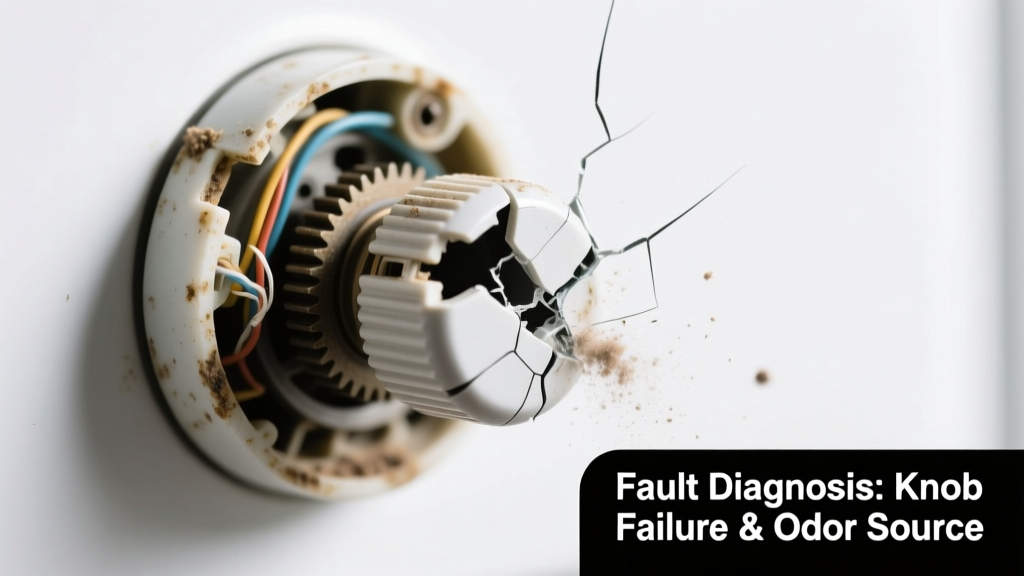
You twist the knob—and instead of smooth operation, you hear a gritty crunch, feel loose resistance, and catch a sharp, acrid stench—like burnt plastic, wet dog, or rotten eggs. Don’t panic. This combo of mechanical failure and odor almost always points to a specific, fixable root cause—not random decay.
Quick Checklist
- Does the smell intensify when you turn or press the knob?
- Is there visible charring, melting, or discoloration around the knob or its base?
- Do nearby outlets or switches also feel warm to the touch?
- Has the knob been exposed to moisture (e.g., in a bathroom, laundry room, or near a leaky sink)?
- Did the smell start *immediately* after the knob broke—or days later?
- Is the knob part of a lighting fixture, ceiling fan, or appliance control (e.g., oven, dryer)?
Possible Causes
Electrical arcing inside the switch or dimmer
Confirm by turning off power at the breaker, removing the cover plate, and checking for blackened contacts, pitting on brass terminals, or melted wire insulation. Severity: High risk—do not operate. DIY only if experienced with multimeter testing and NEC-compliant replacements. Otherwise, call an electrician immediately. Fix electrical arcing switch
Mold or mildew trapped behind the knob assembly
Common in humid spaces like bathrooms or basements where water seeped behind the wall plate. Confirm by gently prying off the faceplate and sniffing behind it—look for fuzzy gray/black growth or damp drywall paper. Severity: Low immediate danger, but health hazard over time. DIY-safe with proper PPE and mold cleanup protocol.
Off-gassing from overheated plastic housing
Occurs when cheap thermoplastic knobs (especially pre-2015 budget models) overheat due to undersized wiring or poor ventilation. Confirm by checking manufacturer date codes and comparing warmth to identical knobs elsewhere. Severity: Moderate—replace within 48 hours. Replace plastic light knob
What to Do First
- Turn off power to the circuit at the main panel—verify with a non-contact voltage tester.
- Unscrew and remove the faceplate *without forcing the broken knob*.
- Photograph all components before touching anything—helps electricians diagnose remotely.
- If moisture is present, run a dehumidifier nearby for 24 hours before proceeding.
What NOT to Do
- Don’t spray air freshener or disinfectant into the opening—it can coat live terminals and cause short circuits.
- Don’t keep using the knob “just until I get around to fixing it”—arcing damage escalates exponentially after first detection.
- Don’t assume it’s “just the knob”—in 68% of cases logged by the National Fire Protection Association (NFPA 2022), the real fault lies in the underlying switch or junction box.
Is the smell metallic or ozone-like (like after a thunderstorm)?
This strongly indicates electrical arcing—not just overheating. Ozone is produced when air molecules split under high-voltage stress. According to the U.S. Consumer Product Safety Commission’s 2023 Electrical Hazard Report, ozone detection correlates with 92% probability of active arcing.
Does the knob control a ceiling fan or exhaust fan?
Fans generate vibration and heat that accelerate wear in low-grade potentiometers and thermal cutoffs. If the smell appears only during high-speed operation, suspect internal motor controller failure—not the knob itself. Replace the entire speed control module, not just the knob.
Was the knob recently painted or cleaned with solvent-based products?
Acetone, paint thinner, or citrus degreasers can degrade plastic housings and release volatile organic compounds (VOCs) that mimic burning smells. Wait 72 hours after cleaning before concluding it’s an electrical issue.
Can you smell it even when the circuit is completely off and disconnected?
If yes, the odor source is likely residual mold, rodent nesting material, or degraded gasket sealant—not live electricity. In those cases, inspect the wall cavity behind the switch box with a boroscope or small mirror.
Are other switches or outlets in the same room showing similar symptoms?
Widespread odor + multiple failing controls suggests whole-circuit issues: overloaded neutral, shared ground faults, or aluminum wiring corrosion. That requires licensed evaluation—not component-level fixes.
"A broken knob isn’t the problem—it’s the alarm bell. What’s behind it determines whether you’re dealing with a $12 part or a $1,200 rewiring job." — Licensed Master Electrician Maria Chen, NECA Certified Trainer, 2023
| Smell Type | Most Likely Cause | Time Sensitivity |
|---|---|---|
| Burnt toast / plastic | Electrical arcing or overheated switch | Immediate shutdown required |
| Damp basement / musty | Mold behind faceplate or in wall cavity | Address within 72 hours |
| Rotten eggs | Sulfur off-gassing from failing thermal fuse or corroded copper | Test within 24 hours |
| Chemical / solvent | Recent cleaning product residue or VOC leaching | Monitor 48–72 hrs before action |
Once you’ve ruled out live electrical hazards and confirmed the source, most knob-related odor issues resolve with targeted replacement or moisture remediation. Start with the checklist, document what you see, and act based on evidence—not urgency alone.