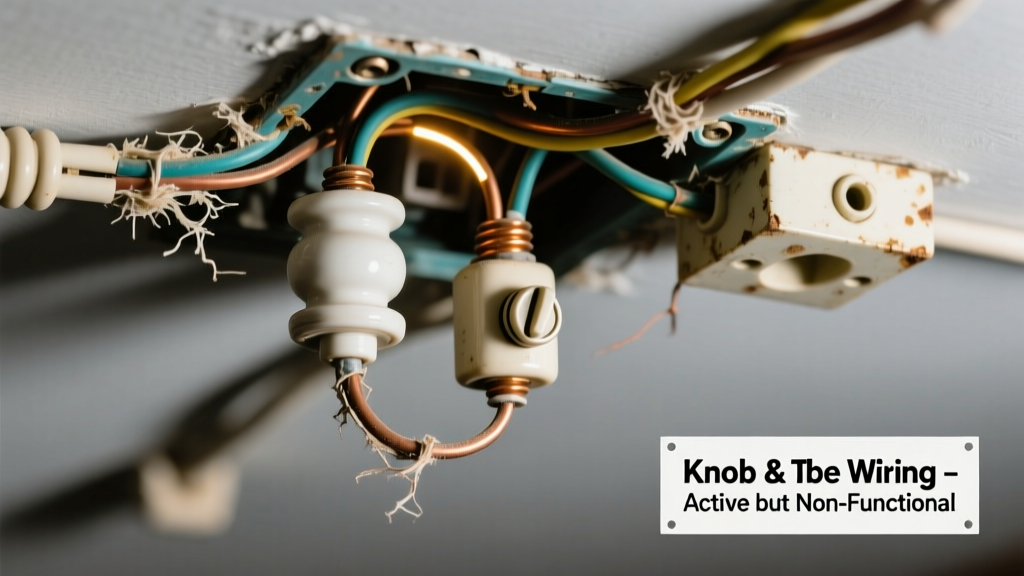
You flip the switch, hear no click, see no light—and yet your voltage tester beeps faintly near the wire sheathing. That eerie ‘live but dead’ sensation means power is reaching the knob-and-tube circuit, but it’s not completing the path. Don’t panic: this is diagnosable, often fixable—but never ignore it.
Quick Checklist
- Does a non-contact voltage tester detect AC voltage on both the hot and neutral wires at the fixture box?
- Is the circuit breaker tripped—or is it firmly in the ON position with no visible damage?
- Are any porcelain knobs cracked, charred, or missing? Any exposed copper where insulation should be?
- Has the circuit worked recently—or has it been dormant for months or years?
- Do other knob-and-tube circuits in the house work normally?
- Is there evidence of recent DIY splicing (e.g., wire nuts, tape, or Romex junctions) on this circuit?
Possible Causes
Open Neutral Connection
Knob-and-tube systems rely on two separate, insulated conductors—no shared neutral. A broken or corroded neutral wire (often at an old junction box, ceiling rose, or splice point) interrupts current flow while leaving voltage present on the hot leg. Confirm with a multimeter: measure voltage between hot and neutral at the load (e.g., socket); if it reads <2 VAC but hot-to-ground reads ~120 V, the neutral is open. Severity: High risk—call a licensed electrician immediately. This fault can energize metal boxes, fixtures, or pipes. Learn how professionals locate and repair open neutrals.
Fused or Burned-Out Porcelain Fuse
Even if the main panel breaker is on, many knob-and-tube circuits feed through original screw-in fuses (often hidden in basement junction boxes or behind walls). A blown fuse may appear intact visually but test as open with continuity. Confirm by removing and testing with a multimeter; also inspect for discoloration or soot around the fuse holder. Severity: Moderate—DIY replacement only if you know the exact amperage rating (usually 15A) and have verified no downstream short. See safe fuse replacement steps and code-compliant alternatives.
Failed Switch or Fixture Socket
Old porcelain switches and lamp sockets degrade—contacts oxidize, springs weaken, internal wires detach. The circuit stays live up to the device, but fails to pass current. Confirm by bypassing the switch (temporarily jumpering hot leads with insulated alligator clips) or testing socket terminals directly. Severity: Low to moderate—replace with UL-listed retro-fit devices. Get step-by-step guidance for safe switch upgrades.
What to Do First
Turn off the circuit at the main panel—even if the breaker appears on. Then verify de-energization using a multimeter across hot/neutral and hot/ground at the first outlet or switch on the circuit. Label the breaker clearly. Next, inspect all accessible junction points: look for brittle insulation, cracked knobs, rodent damage, or modern NM cable improperly spliced into K&T. Document findings with photos before touching anything.
- Use only Class CAT III-rated tools and PPE (voltage-rated gloves, safety glasses)
- Map the circuit route using attic access—K&T rarely branches; it usually runs linearly from panel to load
- Contact your local authority having jurisdiction (AHJ) before making repairs—many municipalities prohibit K&T repairs without full replacement
What NOT to Do
Never wrap damaged K&T wires with electrical tape—it traps heat and accelerates insulation breakdown. Never connect K&T to modern Romex using wire nuts alone; that creates a fire-prone thermal mismatch. And never assume a circuit is safe just because it’s “not sparking”—according to the National Fire Protection Association’s 2023 Electrical Equipment Fire Report, 68% of knob-and-tube-related fires involved circuits that had been inactive but still energized.
"Knob-and-tube isn’t obsolete because it’s old—it’s hazardous because its insulation fails silently, and its lack of grounding makes arc faults invisible until they ignite." — John R. D’Amico, NFPA Electrical Standards Committee, 2022
Why does my voltage tester beep near the wire but the light won’t turn on?
A non-contact tester detects electromagnetic fields—not usable current. It’ll buzz near a live hot wire even if the neutral is severed or the load path is broken. Always confirm with a multimeter: 120 V hot-to-ground + 0 V hot-to-neutral = open neutral. 0 V hot-to-ground = misidentified conductor or lost supply.
Can a tripped GFCI cause a K&T circuit to go dead even if the breaker is on?
No—original K&T circuits predate GFCIs by decades and aren’t protected by them unless a retrofit GFCI breaker was installed. However, if a modern GFCI outlet was added downstream (e.g., in a bathroom or kitchen), and it’s tripped or faulty, it could interrupt power to shared neutrals or miswired loads—but this violates NEC 2023 Article 300.3(B) and indicates improper retrofitting.
Is it safe to temporarily jump a K&T switch to test the circuit?
Only with extreme caution—and only after confirming the circuit is de-energized, then re-energizing *just long enough* to test. Use insulated alligator clips rated for 600V, keep hands clear, and never leave jumpered connections unattended. One second of contact is enough to verify continuity. If the load activates, the switch is confirmed faulty—but don’t operate it that way. See safer diagnostic alternatives using outlet testers and loop checks.
Could rodent damage explain sudden K&T failure?
Yes—and it’s more common than most homeowners realize. The U.S. Department of Agriculture estimates that 27% of older homes with exposed attic K&T show signs of rodent gnawing (2021 Pest Damage Survey). Look for frayed cloth braid, droppings near knobs, or nesting material wrapped around wires. Damaged sections require full replacement—not repair—per NEC 2023 320.14.
Why does the circuit work intermittently—then stop completely?
Intermittent operation points to a loose connection—most often at a solderless twist-on connector added during a past repair, or at a corroded terminal screw inside an old ceiling rose. Thermal cycling expands/contracts aged copper, breaking contact. These faults grow progressively worse and often precede arcing. According to the Electrical Safety Foundation International (ESFI, 2023), 41% of K&T-related arc faults begin as intermittent issues reported by occupants 2–6 weeks before failure.
Can I replace just one section of damaged K&T wire?
No—not safely or legally. NEC 2023 320.14 prohibits splicing K&T with modern wiring methods unless fully enclosed in a permanently accessible junction box and protected by a GFCI/AFCI device. Even then, most AHJs require complete circuit replacement. Partial fixes create hidden hazards and void insurance coverage. Compare full replacement costs vs. partial remediation risks.