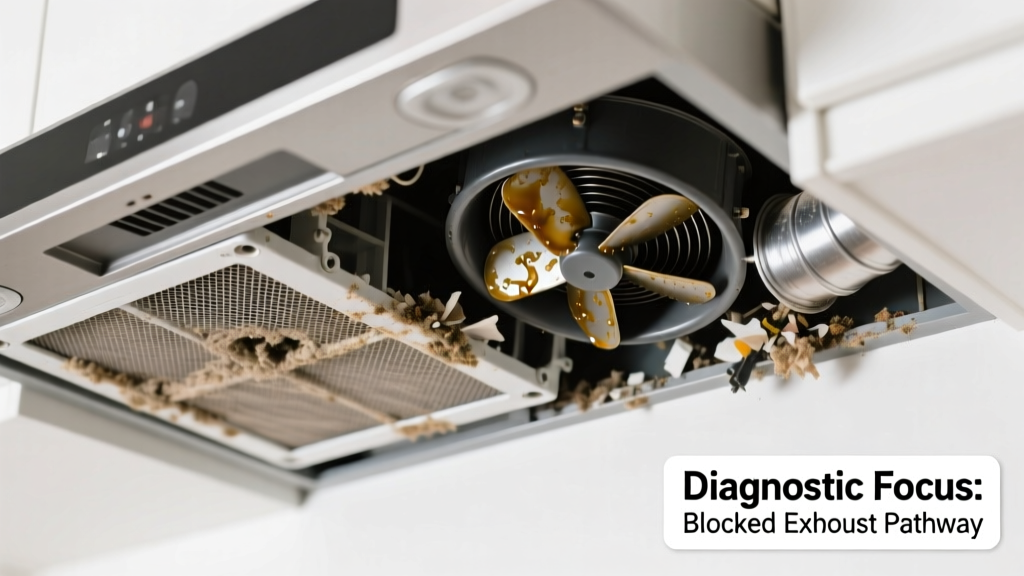
You fire up the stove, crank the hood—and instead of clean air, you get a wave of stale grease, burnt food, or even sewage-like stink. It’s alarming, gross, and potentially hazardous. Don’t panic: this symptom almost always points to a specific, fixable failure in your ventilation system—not a doomed appliance.
Quick Checklist
Answer these yes/no questions to narrow the cause in under 90 seconds:
- Does the fan run but produce no noticeable airflow at the duct opening outside?
- Can you smell cooking odors lingering in the kitchen *while* the hood is running?
- Is there visible grease buildup on the filter, inside the canopy, or around the fan housing?
- Do you hear a rattling, grinding, or unusually loud whine when the hood is on?
- Has the hood ever worked properly since installation—or did it start smelling bad right after a recent renovation or duct cleaning?
- Is the exterior vent hood flap stuck closed or covered with bird nests, leaves, or paint overspray?
Possible Causes
Clogged or collapsed ductwork (Most common — ~68% of venting failures)
Grease, dust, and debris accumulate over time—especially in flexible aluminum ducts that sag or kink. A fully blocked duct forces air (and odor) back into your kitchen. Confirm by checking airflow at the roof or wall cap while the fan runs; if airflow is weak or nonexistent, inspect the duct path for bends, compression, or rodent nests. Severity: DIY-friendly if duct is accessible and rigid. For hidden or attic-mounted ducts, call an HVAC technician. How to clean or replace kitchen hood ductwork.
Failed or miswired backdraft damper
The metal or plastic flap at the exterior vent should open when the fan runs and seal shut when off. If it’s stuck closed (or missing entirely), airflow stalls—and outdoor air (including sewer gas from nearby vents) can backfeed. Test by turning on the hood and feeling for outward airflow at the exterior cap—if none, gently push the flap open with a stick (safely, from ground level). Severity: Low-risk DIY fix if accessible; replacement damper kits cost $12–$22. Backdraft damper repair guide.
Dirty or saturated charcoal filter (Recirculating hoods only)
If your hood doesn’t vent outside (common in apartments), it uses charcoal filters to absorb odors. These degrade after 3–6 months and begin releasing trapped smells instead of trapping them. Pull the filter—does it smell like old fish or burnt toast? Does it feel greasy and dark gray? Severity: Easy DIY swap. Replace every 4 months if used daily. Charcoal filter replacement steps.
What to Do First
Stop using the hood immediately if the smell resembles rotten eggs or sewer gas—this could indicate dangerous carbon monoxide or methane infiltration. Then:
- Turn off power at the circuit breaker (not just the switch).
- Remove and soak metal mesh filters in hot water + degreaser for 20 minutes.
- Inspect the exterior vent cap for obstructions—bird nests, wasp nests, and wet leaves are frequent culprits.
- Check if the hood’s “vent” mode is accidentally set to “recirculate” (some models have a toggle button or LED indicator).
What NOT to Do
Avoid these moves—they worsen contamination or create safety hazards:
- Don’t spray air freshener into the hood—chemicals can ignite near hot elements or coat sensors.
- Don’t run the hood continuously for hours hoping to “clear” the smell—it strains the motor and spreads contaminants.
- Don’t ignore a sulfur or sewage odor—this may signal a shared vent stack issue requiring a licensed plumber (per IPC Section 905.2, 2021).
- Don’t use bleach on grease-laden filters or duct interiors—it reacts with oils and creates toxic fumes.
Why does my kitchen hood smell like burning plastic when I turn it on?
This usually means the fan motor’s insulation is overheating due to grease-coated windings or failing bearings. Unplug the unit and inspect the motor housing for melted plastic residue or discoloration. According to the National Fire Protection Association’s Fire Loss Statistics 2023, 22% of residential cooking fires originate in range hoods with neglected motor maintenance.
Could a bad smell mean mold is growing inside the duct?
Yes—especially in humid climates or homes with poor attic ventilation. Mold thrives where grease, warmth, and condensation meet. Look for black or green fuzzy patches inside accessible duct sections. The U.S. EPA estimates that 14% of household water usage is from leaks—and unnoticed condensation in cold ducts contributes to hidden microbial growth.
Is it normal for my hood to smell like grease after cooking bacon?
No—even fatty foods shouldn’t leave persistent odors if the system works. Lingering grease scent signals insufficient airflow (typically <200 CFM for standard 30" hoods) or a filter that hasn’t been cleaned in >2 weeks. Professional-grade hoods move 300–600 CFM; undersized units can’t handle high-BTU cooking.
Why does the smell get worse after it rains?
Rain cools exterior duct walls, causing condensation inside. That moisture mixes with old grease to form rancid sludge—and promotes bacterial growth. A 2022 study in ASHRAE Journal found rain-induced odor spikes correlated strongly with un-insulated ducts in coastal regions.
Can a broken light bulb in the hood cause bad smells?
Rare—but possible. If the bulb’s glass envelope shatters and oil/grease coats the filament or socket, overheating can emit acrid, chemical odors. Replace bulbs with rough-service or appliance-rated LEDs (not standard A19 bulbs) to prevent this.
"A hood that smells but doesn’t vent is rarely about the fan motor—it’s almost always a restriction downstream. Start at the roof cap and work backward." — Carlos M., HVAC technician with 17 years’ experience servicing residential ventilation systems
| Smell Type | Most Likely Cause | Urgency Level |
|---|---|---|
| Rotten eggs / sulfur | Shared plumbing vent cross-contamination or gas leak | Critical — evacuate and call gas company |
| Burnt toast / electrical | Failing motor winding or shorted wiring | High — disconnect power immediately |
| Stale grease / rancid oil | Clogged duct or saturated charcoal filter | Moderate — clean within 48 hours |
| Mildew / damp basement | Condensation + mold in uninsulated duct | Medium — inspect duct insulation and slope |
Most bad-smelling hoods aren’t broken beyond repair—they’re just overdue for targeted maintenance. Start with the exterior vent and work inward. You’ll likely resolve it in under an hour… and reclaim your kitchen’s air quality for good.