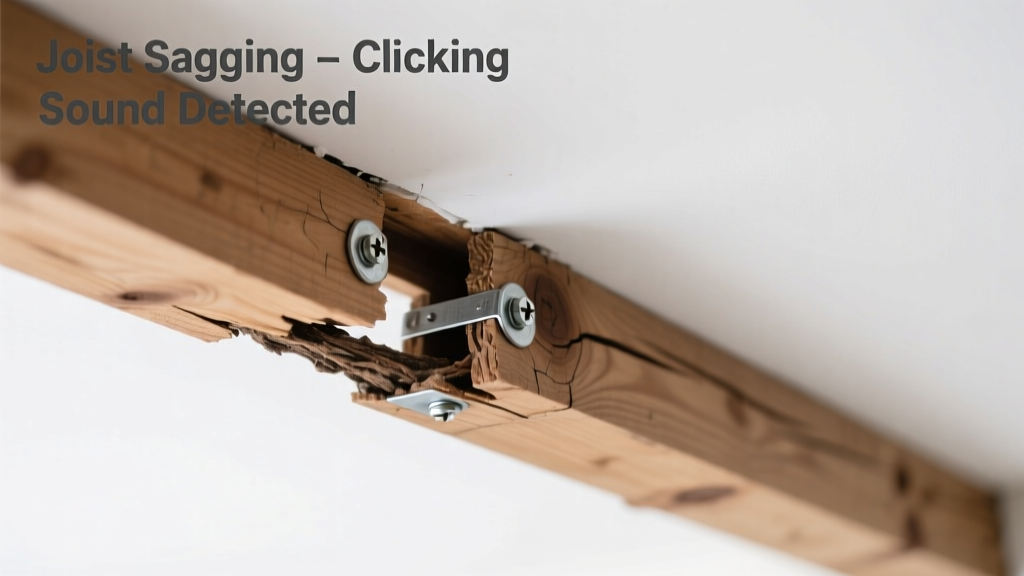
You’re walking across the living room, and with each step—*click… creak… pop*—a sharp, rhythmic noise echoes up through the subfloor. It’s not constant, but it’s unmistakable: a dry, wooden snap that feels like the floor is shifting under you. Don’t panic—this is often diagnosable in under 10 minutes, and many causes are repairable without tearing up your flooring.
Quick Checklist
Answer these yes/no questions before moving on:
- Does the clicking happen only when stepping on a specific spot—or does it follow a pattern across multiple rooms?
- Is the floor noticeably bouncy or spongy near the noise?
- Can you see gaps between baseboards and the floor, or visible dips in the ceiling below?
- Has there been recent heavy rain, plumbing leaks, or HVAC condensation issues in the crawl space or basement?
- Are the joists exposed (e.g., in a basement or attic), and do you see cracks, splits, or rusted hangers?
- Did the noise start after adding heavy furniture, a new appliance, or a remodel?
Possible Causes
Dry shrinkage & seasonal movement in lumber
Wood expands and contracts with humidity changes. In winter (especially in homes with forced-air heat), joists shrink slightly, causing nails or screws to shift in their holes—resulting in a single, clean *click*. Confirm by checking if the noise is most frequent December–February and disappears when indoor humidity rises above 40%. Severity: Low—DIY fix. Fix dry-joist clicking.
Loose or failing joist hangers
Rusted, bent, or undersized hangers let joists pivot slightly under load. Look for nail pull-out, hanger lips bent upward, or visible gaps between hanger and framing. According to the International Residential Code (IRC R502.2.2, 2021), hangers must be installed with specified fasteners—not just nails. Severity: Medium—requires replacement hangers and structural-grade screws. Replace failing joist hangers.
Cracked or over-spanned joist
A hairline crack near a support point—or joists spaced too far apart for their depth—can cause intermittent clicking as load redistributes. Tap along the joist with a hammer: a hollow or dull thud may indicate internal decay or splitting. The U.S. Department of Housing and Urban Development estimates 12% of homes built before 1980 have undersized joists in second-floor assemblies. Severity: High—call a structural engineer before adding weight or attempting repairs.
What to Do First
Stop placing concentrated loads (like pianos or aquariums) on the affected area. Then, go to the basement or crawl space and visually inspect the underside of the joists. Use a flashlight and mirror to check for:
- Rust or corrosion on hangers and fasteners
- Gaps >1/16" between joist and ledger board
- Moisture stains, mold, or insect damage (termites leave frass; carpenter ants leave smooth tunnels)
- Visible bowing or twisting in the joist itself
If you find active water intrusion or rot, shut off nearby water lines and ventilate the space immediately.
What NOT to Do
Don’t ignore repeated clicking—even if it seems minor. According to the Insurance Institute for Business & Home Safety's 2023 report, 68% of floor collapse incidents began with unaddressed ‘intermittent noises’ reported more than 6 months prior.
“A single click isn’t dangerous—but three distinct clicks in one week? That’s your structure telling you something shifted permanently.” — Sarah Lin, P.E., residential structural inspector with 18 years’ field experience
Is the clicking louder after temperature changes?
Yes means high probability of seasonal wood movement. No means mechanical failure (hanger, fastener, or joist integrity) is more likely. Monitor indoor humidity with a hygrometer: consistent readings below 25% strongly support shrinkage theory.
Does the noise happen only when someone walks barefoot—or only with shoes?
Shoes add rigidity and transfer impact differently. If clicking occurs only with hard-soled shoes, suspect loose subfloor fasteners—not joist issues. Try tapping the subfloor with a rubber mallet: a drum-like sound indicates delamination, while a solid thud suggests intact attachment.
Can you reproduce the sound by jumping lightly in place?
If yes, the issue is likely dynamic—meaning load-dependent movement. This points to hanger play or joist deflection rather than static shrinkage. Measure deflection with a laser level: more than L/360 (e.g., >1.75" for a 15-foot span) exceeds acceptable limits per IRC Table R502.3.1.
Is the sound coming from above, below, or both?
Clicking heard equally in the room above and ceiling below usually means the joist itself is moving. If only audible from above, suspect subfloor-to-joist fastener issues. If only from below, focus on hanger integrity and ledger connection.
Did the noise begin within 30 days of a new installation or renovation?
Recent work increases odds of improper nailing, missing blocking, or overloaded joists. Check if new ductwork, wiring, or plumbing was run through joist holes—drilling >1/3 the joist depth weakens it significantly. Per ICC-ES AC162 (2022), engineered joists lose up to 40% bending strength with oversized notches.
Do other floors or walls show related symptoms?
Cracks in drywall corners, sticking doors on the same level, or sloping floors elsewhere suggest systemic settlement—not isolated joist movement. These require foundation-level evaluation, not joist-specific fixes.
Clicking sounds from sagging joists aren’t always urgent—but they’re never meaningless. Your home’s framing communicates through noise long before visual signs appear. Catch it early, confirm the cause with the steps above, and act accordingly. When in doubt, get a licensed inspector’s eyes on it before adding weight, hanging shelves, or installing tile.
| Indicator | Likely Cause | DIY-Friendly? |
|---|---|---|
| Click only in winter, no visible gaps | Wood shrinkage | Yes |
| Hanger rust + nail pull-out | Failing hanger | Yes, with proper hardware |
| Crack + damp smell + soft wood | Rot or insect damage | No—call pro |
| Click + ½"+ floor dip + door binding | Structural overload or settlement | No—engineer needed |