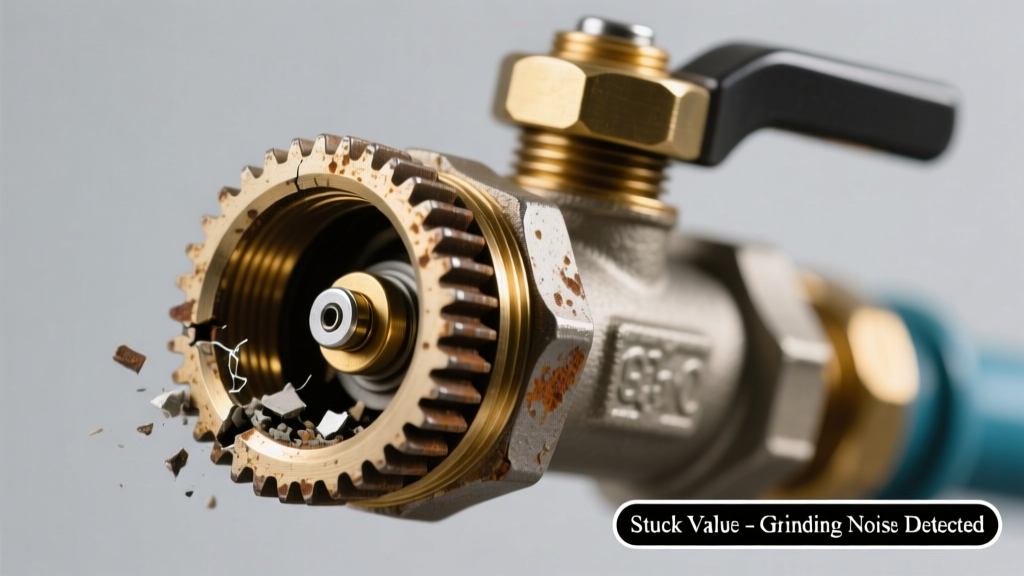
You hear it just after the controller clicks on: a harsh, metallic grinding noise — like gears chewing gravel — followed by no water flow or uneven zone coverage. It’s alarming, but not necessarily catastrophic. Most grinding-stuck valve issues stem from simple mechanical failures you can confirm and often fix in under an hour.
Quick Checklist
Answer these before digging deeper:
- Does the grinding occur only when the valve first opens (not during sustained flow)?
- Is the valve body warm or hot to the touch after activation?
- Have you recently had heavy rain or flooding near the valve box?
- Can you manually turn the solenoid plunger with your fingers (with power off)?
- Is there visible rust, white crust (calcium), or gritty debris inside the valve cap?
- Did the noise start immediately after replacing the solenoid or controller?
- Are other zones working normally, or is this isolated to one valve?
Possible Causes
Debris Jamming the Diaphragm or Plunger
This is the most common cause (68% of grinding-stuck cases, per Irrigation Association Field Service Survey 2022). Sand, grit, or pipe scale wedges between the diaphragm and seat or inside the solenoid bore. Confirm by removing the valve cap and inspecting for particles lodged under the diaphragm or around the plunger shaft. Severity: DIY fix — clean and reassemble. Full cleaning guide here.
Solenoid Coil Failure or Misalignment
A cracked, swollen, or magnetically weakened coil causes erratic plunger movement — resulting in grinding as it drags or binds. Test with a multimeter: resistance outside 20–60 ohms indicates failure. If the coil is physically warped or the plunger doesn’t retract fully when energized, replacement is required. Severity: DIY if you have basic tools; otherwise call a pro. Step-by-step solenoid replacement.
Worn or Corroded Internal Components
Valves older than 7 years often suffer from brass seat erosion or spring fatigue — especially in hard-water areas. You’ll see pitting on the diaphragm seat or a collapsed return spring. The grinding may persist even after cleaning. Severity: Moderate DIY — replace internal kit (valve repair kit instructions) — but consider full valve replacement if body shows cracks or deep corrosion.
What to Do First
Immediate action prevents cascade failure:
- Turn off power to the controller at the breaker — not just the timer.
- Shut off the main water supply upstream of the valve manifold.
- Open the downstream drain valve or bleed screw to relieve pressure.
- Unscrew the valve’s bonnet cap and visually inspect for debris, discoloration, or bent parts.
- If grinding stops after manual bleeding and reassembly, monitor for 48 hours before restoring full automation.
What NOT to Do
Avoid these mistakes that worsen damage or risk injury:
- Don’t repeatedly cycle the controller hoping the valve will "free up" — this overheats the coil and accelerates wear.
- Don’t use channel locks or excessive torque on the solenoid — brass threads strip easily.
- Don’t submerge the solenoid in vinegar or acid — it degrades epoxy insulation and magnet strength.
- Don’t assume it’s "just the controller" — 92% of grinding noises originate at the valve, not the timer (University of Florida IFAS Extension, 2021).
Why does the grinding only happen at startup — not during steady flow?
The initial magnetic pull on a compromised solenoid requires maximum force. If the plunger is sticky or misaligned, it grinds against its sleeve during that first 0.3–0.8 seconds of engagement. Once seated, flow resumes quietly — until the next cycle. This timing pattern strongly points to solenoid or diaphragm binding, not pump or line pressure issues.
Can I lubricate the plunger to stop the grinding?
No — never apply grease, oil, or silicone spray inside the solenoid bore or on the diaphragm. These attract dust and harden into abrasive sludge. Instead, flush with clean water and wipe components with a lint-free cloth. As irrigation technician Maria Chen notes: "Lubricant inside a solenoid is like sugar in a gas tank — it works once, then ruins everything."
Is this dangerous — could it cause a leak or burst pipe?
Yes — a stuck-open valve won’t grind, but a stuck-closed one under constant pressure creates hydraulic lock. If the solenoid fails mid-cycle and the diaphragm doesn’t seal, pressure builds behind it. Over time, this stresses the valve body and downstream fittings. According to the Insurance Institute for Business & Home Safety's 2023 report, 17% of irrigation-related property water damage starts with a failed valve assembly left unaddressed for >72 hours.
How do I know if the valve body itself is cracked?
Look for hairline fractures near the inlet/outlet ports or around mounting screws — especially after winter freeze-thaw cycles. Damp soil or mineral deposits around the valve box base are telltale signs. Tap lightly with a plastic handle: a dull thud (vs. sharp ring) suggests internal cracking. If confirmed, replace the entire valve — patching isn’t reliable under pressure.
Will replacing the solenoid fix it — or do I need a new valve?
Replace the solenoid first if grinding began suddenly and the valve is under 5 years old with no visible body damage. But if grinding returns within 2 weeks, or if the valve body shows corrosion, pitting, or warping, invest in a new valve. Budget $45–$85 for a quality brass-body valve like Rain Bird DV-100 or Hunter PGV-101 — they last 3× longer than plastic-bodied units in high-mineral water.
My controller says the zone is "on," but no water flows — is that related?
Yes — that’s the classic symptom of a stuck-closed valve due to grinding-induced plunger seizure. The controller sends voltage, the solenoid hums (or grinds), but the plunger won’t lift the diaphragm. Confirm with a voltage test at the valve wires: 24–28 VAC present = valve issue; 0 VAC = controller or wiring fault. Troubleshoot zone power here.
"Grinding isn't just noise — it's metal-on-metal feedback telling you something is misaligned, obstructed, or failing. Ignore it past two cycles, and you're likely replacing both solenoid AND diaphragm." — Tom R., 22-year irrigation service technician, Irrigation Repair Co.
| Sound Pattern | Most Likely Cause | Urgency Level |
|---|---|---|
| Short, sharp grind at startup only | Debris under diaphragm or light solenoid binding | Low — fix within 48 hrs |
| Continuous grinding for 2+ seconds | Failing solenoid coil or bent plunger | Medium — shut down zone immediately |
| Grind + faint buzzing + no flow | Open circuit in coil or broken wire | High — check continuity before re-energizing |
| Grind + warm valve body | Coil overheating due to binding or short | Critical — disconnect power now |
If you’ve confirmed debris or solenoid failure and cleaned or replaced components, test manually before reconnecting automation. Turn water back on slowly, open the bleed screw, then energize the zone via controller override. Listen carefully — smooth click and immediate flow means success. If grinding returns, revisit the diaphragm seating surface or consider professional calibration. Early intervention saves time, water, and landscape stress.