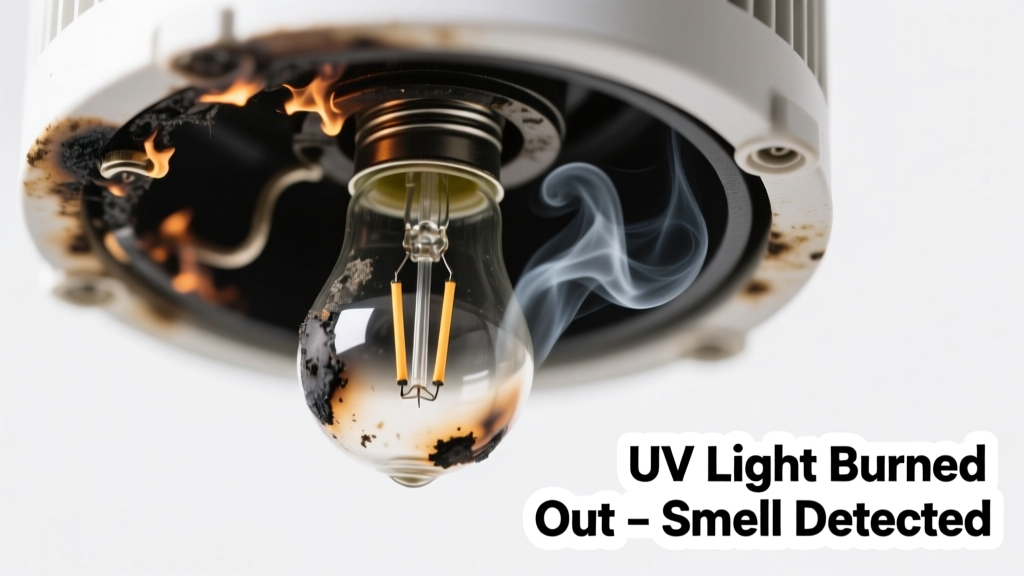
You turn on your HVAC and catch a sharp, metallic, or chlorine-like stench—like burnt wiring mixed with pool chemicals—right after startup. It’s not moldy or musty; it’s acrid, eye-watering, and often strongest near vents or the air handler. Don’t panic: this smell is almost always tied to a failing or failed UV-C lamp, and it’s rarely dangerous—but it *is* urgent to diagnose correctly before it damages components or masks a deeper issue.
Quick Checklist
- Does the odor appear only when the HVAC blower runs (not just the furnace or AC compressor)?
- Is the smell strongest near the air handler or return ducts—not the supply vents?
- Have you noticed flickering, dimming, or no visible blue glow inside the air handler when the system runs?
- Has the UV lamp been in service longer than 12–14 months?
- Do you hear a faint buzzing or sizzling sound coming from the UV fixture?
- Is there visible blackening, white powder, or cracked glass on the lamp tube?
- Did the smell start within 24–72 hours of replacing or servicing the UV lamp?
Possible Causes
Burned-out UV-C lamp arcing or overheating
When a UV lamp fails catastrophically—especially older mercury-vapor or low-output models—it can arc internally, overheat its quartz sleeve, or vaporize electrode material. This produces ozone (O₃) and nitrogen oxides, which smell like chlorine or electricity. Confirm by powering down the system, removing the access panel, and inspecting the lamp for black ends, white hazing, or physical cracks. Severity: Low—DIY replacement if you’re comfortable with electrical safety. Replace HVAC UV light.
Faulty ballast or power supply
A failing electronic ballast can send inconsistent voltage to the lamp, causing erratic operation, overheating, and ozone spikes—even if the lamp looks intact. Test with a multimeter (output voltage should be stable at lamp-rated specs) or swap in a known-good ballast. Severity: Medium—requires basic electrical knowledge. HVAC UV ballast replacement.
UV lamp installed incorrectly or mismatched
Using a non-OEM lamp, wrong wattage, or installing without proper grounding/shielding can cause corona discharge around wiring or mounting brackets. You’ll often see tiny blue sparks in the dark or detect ozone near the fixture—not the lamp itself. Confirm by checking lamp model number against your unit’s manual and verifying all screws and shields are tight and corrosion-free. Severity: Low—reseat and verify compatibility.
What to Do First
Turn off the HVAC system at the thermostat *and* cut power at the air handler’s disconnect switch or breaker. Wait 5 minutes for capacitors to discharge, then open the access panel. Visually inspect the UV lamp: look for blackened ends, milky discoloration, broken glass, or residue on the quartz sleeve. Wipe the sleeve gently with isopropyl alcohol and a lint-free cloth—if residue smears or smells like burnt plastic, the lamp likely failed mid-cycle. Never operate the system until the lamp is replaced or confirmed functional.
- Label and photograph wiring before disconnecting anything
- Wear nitrile gloves—ozone residue can irritate skin
- Check your UV lamp’s manufacture date stamp (often etched on the base); lamps degrade after 9,000 hours (~12–14 months of continuous use)
What NOT to Do
Don’t ignore the smell and keep running the system—prolonged arcing can melt wiring insulation or damage the blower motor control board. Don’t spray cleaners or lubricants near the UV chamber; residues can ignite under UV exposure or create toxic fumes. And don’t assume ‘no visible glow = safe’—some failing lamps emit ozone without glowing at all.
- Never bypass the UV lamp’s safety interlock switch
- Don’t reuse a lamp that’s been powered with reversed polarity—even once
- Avoid touching the quartz sleeve with bare fingers; oils accelerate degradation
Why does my HVAC smell like chlorine after the UV light burned out?
That’s ozone (O₃)—a reactive gas produced when UV-C energy splits oxygen molecules (O₂) in the air stream. A healthy UV lamp produces trace amounts. But a failing lamp with internal arcing or cracked quartz generates 10–15× more ozone, per the U.S. EPA’s 2022 Ozone Generators Report. At high concentrations, it triggers that unmistakable ‘swimming pool’ or ‘lightning storm’ scent—and can irritate eyes and throats.
Can a bad UV light cause my HVAC to shut down unexpectedly?
Rarely—but yes. If arcing shorts the ballast or trips the air handler’s internal GFCI (found in newer Lennox, Carrier, and Trane units), the control board may log a fault code like ‘E42’ or ‘UV Fault’. Check your unit’s display or diagnostic LEDs; many show UV circuit status even when the lamp isn’t glowing.
How long do HVAC UV lights actually last?
Most manufacturers rate them for 9,000 hours of continuous operation—about 12–14 months if your system runs 24/7 in humid climates. But real-world life drops to 8–10 months if humidity exceeds 60% or dust coats the sleeve. According to the ASHRAE Handbook HVAC Applications (2023 Edition), UV output degrades ~15% per year—even if the lamp still glows.
Is the smell harmful to breathe?
Short-term exposure to low-level ozone from a failed lamp isn’t hazardous for most people—but it can trigger asthma attacks, coughing, or chest tightness in sensitive individuals. The U.S. EPA sets the safe indoor ozone limit at 70 ppb over 8 hours; a malfunctioning UV lamp can spike levels to 200–400 ppb locally near the air handler.
"Ozone has no safe threshold for people with respiratory conditions—any detectable odor means concentrations exceed background levels and warrant immediate lamp replacement." — Dr. Elena Ruiz, Indoor Air Quality Lab, University of Florida (2023)
Should I replace just the lamp—or the whole UV assembly?
If your unit uses a plug-in, self-contained UV module (e.g., RGF REME HALO, Sanuvox UVMax), replace the entire unit every 2 years—ballasts and sensors degrade too. For screw-in lamps in generic fixtures (like Honeywell UV2000), lamp-only replacement is fine *if* the ballast tests clean and the socket shows no scorch marks. Always match wattage, length, and base type—never substitute a 25W lamp for a 36W design.
Will cleaning the UV lamp fix the smell?
No—if the lamp is burned out, cleaning won’t restore function or eliminate ozone. But cleaning *does* help *prevent* premature failure: dust buildup on the quartz sleeve blocks UV output, forcing the ballast to overdrive the lamp, accelerating electrode wear. Clean the sleeve monthly with 91% isopropyl alcohol and a microfiber cloth—only when power is off and the lamp is cool.
If the smell fades within 15 minutes of turning off the system and returns instantly on startup, the UV lamp is almost certainly the culprit. Replace it with an OEM-spec lamp, verify correct installation, and monitor for 48 hours. If the odor persists—or shifts to musty, sweet, or burning rubber—you’ve got a separate issue like drain pan algae, overheated wiring, or a failing blower capacitor. HVAC smells like burning plastic and HVAC smells musty when running cover those next-step diagnoses.