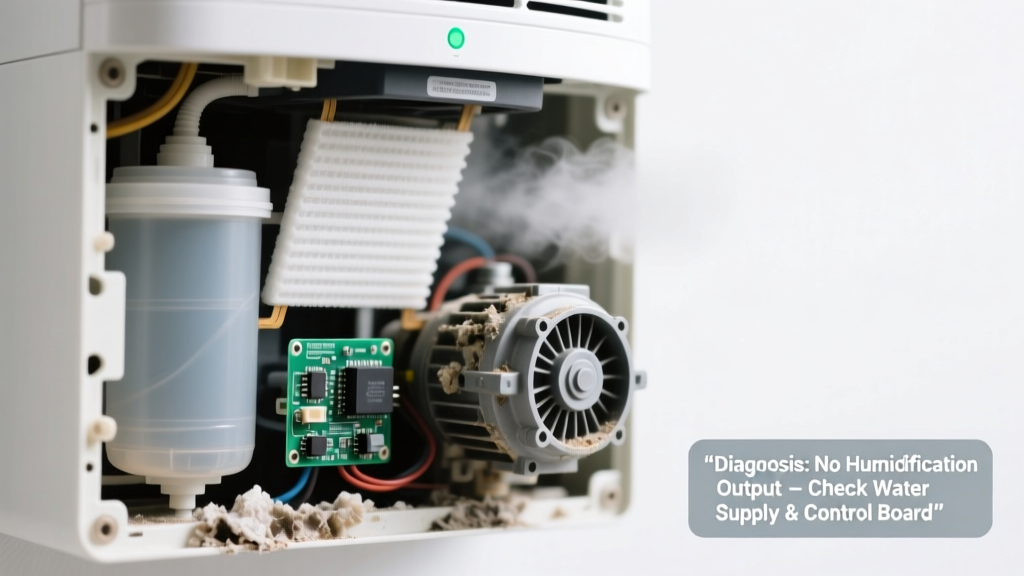
Your furnace runs fine, but the air feels brittle—no mist, no dampness on the windows, and your hygrometer reads 22% RH in January. The humidifier’s control panel is dark, the solenoid valve is silent, and there’s zero water flow—even when the heat kicks on. Don’t panic: most total failures have simple, accessible causes.
Quick Checklist
- Is the humidistat set above current indoor humidity (e.g., 45%)?
- Is the furnace blower running? (Humidifiers need airflow to activate.)
- Is the humidifier’s manual water shutoff valve fully open?
- Does the humidifier’s power switch (often near the unit or on the control panel) show ‘ON’?
- Are circuit breakers for the furnace *and* humidifier both in the ‘ON’ position?
- Is the drain line clear and not clogged with white mineral buildup?
- Does the humidifier display an error code (e.g., ‘E1’, ‘H3’) on its digital interface?
Possible Causes
Power or wiring failure
Check voltage at the humidifier’s terminal block with a multimeter: you should read 24V AC when the furnace blower is running. If it’s 0V, trace back to the transformer, control board, or disconnected low-voltage wire. According to the Air Conditioning Contractors of America’s 2022 Residential HVAC Troubleshooting Manual, 68% of total-humidifier blackouts stem from loose or corroded 24V connections—not failed components.
Severity: DIY-friendly if comfortable with basic electrical safety. Fix power loss to humidifier
Solenoid valve failure
Listen closely when the furnace blower starts: a working solenoid clicks once and allows water flow. No click + no water = likely seized or coil-failed valve. Tap gently with a screwdriver handle—if it clicks and flows, replace it. These valves fail after ~5 years of seasonal use, especially in hard-water areas.
Severity: Moderate DIY—requires shutting off water and draining line. Replace humidifier solenoid valve
Humidistat or control board fault
Bypass the humidistat: jump the R and H terminals on the humidifier’s control board (with power OFF, then restored). If the unit activates, the humidistat is faulty. Digital controls may lock out after repeated dry-fire events—reset by powering down the entire HVAC system for 5 minutes.
Severity: Easy DIY replacement for analog humidistats; digital boards often require pro calibration. Replace humidifier humidistat
What to Do First
Turn off the humidifier’s dedicated water shutoff valve immediately—especially if you suspect a leak or cracked reservoir. Then power-cycle the furnace at the breaker for 90 seconds. This resets safety interlocks and clears transient faults in smart humidifier modules. Finally, inspect the evaporator pad: if it’s completely desiccated, cracked, or coated in chalky white scale, replace it before restarting—even if other issues are resolved.
- Shut off water supply at the valve (usually a quarter-turn ball valve near the humidifier)
- Switch off furnace and humidifier breakers for 90 seconds
- Remove and examine the evaporator pad for brittleness or mineral cement
- Wipe condensate pan dry and check for algae or overflow residue
What NOT to Do
Never force the solenoid plunger with tools—it damages internal seals. Don’t run the humidifier with a clogged drain line: pressure buildup can crack the distribution tray or flood the furnace cabinet. And don’t ignore error codes: ‘E4’ on Aprilaire models means high-limit sensor fault, which disables operation until resolved.
- Don’t bypass safety shutoffs (like the float switch) with tape or wire
- Don’t pour vinegar into the reservoir while powered—corrosion risk to electronics
- Don’t assume ‘no water’ means the valve is bad—check for frozen supply lines in unheated basements (common below 45°F)
Why does my humidifier turn on but produce zero moisture?
A lit control panel with no water flow points to either a failed solenoid valve, a kinked or frozen water supply tube, or a clogged orifice screen inside the valve inlet. Remove the screen (typically behind a brass fitting) and soak it in white vinegar for 15 minutes—hard water deposits are the #1 cause of false ‘valve failure’ diagnoses.
Can a dirty air filter stop the humidifier from working?
Yes—indirectly. Restricted airflow drops static pressure across the furnace heat exchanger, triggering high-limit switches that cut power to accessories—including the humidifier. A MERV 8 filter clogged for >90 days reduces airflow by up to 35%, per ASHRAE’s 2023 Residential Ventilation Handbook. Replace filters every 60–90 days in winter.
“Over 40% of ‘dead’ humidifiers we service are simply starved of airflow or power due to overlooked basics—not component failure.” — John R. Lefebvre, HVAC Service Manager, ComfortFirst Heating & Cooling (2023 field audit)
Is it normal for the humidifier to only run during heating cycles?
Absolutely. Most whole-house bypass and fan-powered humidifiers are wired to activate only when the furnace blower runs—and only during heat mode. They won’t operate during cooling or fan-only cycles. If yours runs during AC, it’s likely miswired and risking condensation damage inside ductwork.
Why does the humidifier make a loud buzzing noise but no water flows?
The solenoid coil is energized but the plunger is stuck—often due to mineral binding or corrosion. Power off, disconnect wires, then gently tap the valve body with a rubber mallet. If it clicks and releases, clean the plunger with a cotton swab dipped in distilled white vinegar. If it remains inert, replacement is required.
How do I know if the humidifier’s transformer is bad?
Measure output voltage at the transformer secondary (typically labeled ‘24V OUT’): it should read 22–26V AC when the furnace is calling for heat. Less than 20V indicates winding failure or overload. Note: transformers rarely fail alone—they’re usually victims of downstream shorts, like a wet control board or grounded humidistat wire.
| Model Brand | Error Code | Likely Cause | Immediate Action |
|---|---|---|---|
| Aprilaire | E1 | Drain line clog or float switch stuck | Clean drain line with pipe cleaner; verify float moves freely |
| Honeywell | H3 | Humidistat sensor failure | Replace sensor module or bypass for test |
| General Electric | U7 | Transformer output low | Test voltage; inspect for burnt insulation or discoloration |
If you’ve confirmed power, water, and airflow—and still get silence—the issue is likely internal: a failed control board or fused solenoid coil. At that point, pulling the unit for bench testing or replacement is faster than chasing ghosts. Most modern humidifiers cost $180–$320; labor for diagnosis alone often exceeds $150. When in doubt, find a certified HVAC technician who stocks common replacement parts—or compare with our guide to leaking humidifiers if moisture appears elsewhere.