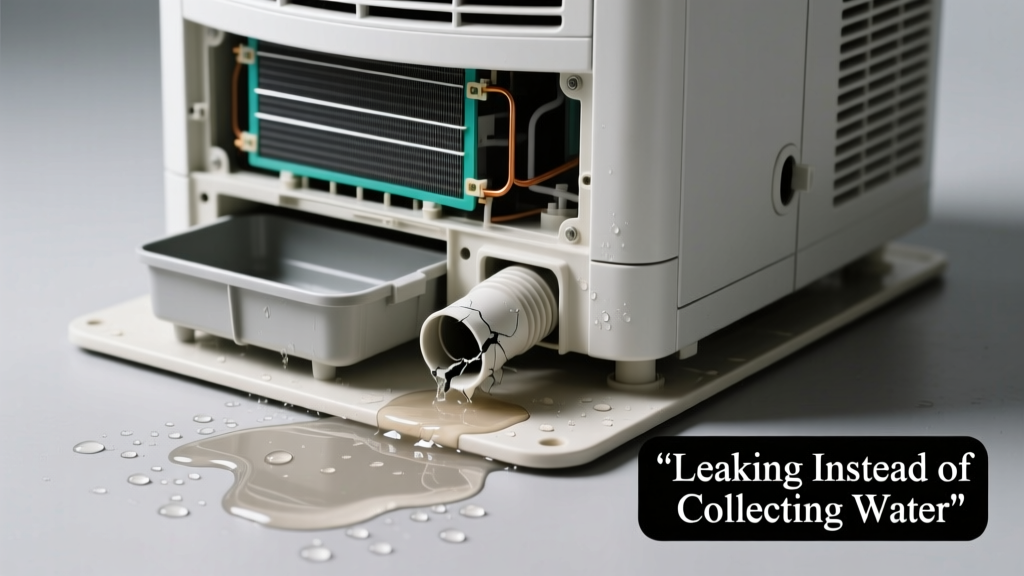
You walk into the mechanical room—or basement—and spot a puddle under your HVAC dehumidifier unit. The collection bucket is dry or nearly empty, yet water’s dripping from the drain line, pooling near the air handler, or seeping onto insulation. This isn’t just annoying—it’s a sign of compromised condensate management that can lead to mold, corrosion, or electrical hazards within 48 hours.
Quick Checklist
- Is the dehumidifier fan running but no water in the reservoir or drain pan?
- Does water drip steadily from the primary drain line—even when the unit isn’t actively dehumidifying?
- Can you hear gurgling or bubbling sounds near the condensate pump or drain trap?
- Is the float switch stuck in the 'full' position (if equipped with one)?
- Has the unit been recently serviced—or has the drain line been disconnected during filter replacement?
- Is there visible algae or sludge inside the drain pan or PVC tubing?
- Does the condensate pump (if present) run continuously—or not at all—when the pan fills?
Possible Causes
Clogged condensate drain line (Most common — ~68% of cases)
Algae buildup or debris blocks the 3/8" or 1/2" PVC line, causing overflow before water reaches the pump or gravity drain. Confirm by pouring 1/4 cup of white vinegar into the drain port—if it backs up or drains slower than 1 oz/sec, the line is obstructed. Severity: DIY fix (use wet/dry vac + compressed air). How to clear a clogged condensate line.
Faulty or misaligned float switch
The switch fails to detect rising water levels, so the pump never activates—or shuts off prematurely. Test by manually lifting the float arm: the pump should start within 2 seconds. If silent, check wiring continuity with a multimeter (0.5–1.2Ω expected). Severity: DIY if comfortable with low-voltage circuits; otherwise, call a technician. Replace float switch guide.
Cracked or disconnected drain pan
Older units develop hairline cracks near mounting brackets or rust-through points—especially where the pan meets the evaporator coil housing. Shine a flashlight while running the unit; look for misting or pinpoint drips along seams. Severity: Requires pan replacement (not repairable); pro-recommended unless you have OEM part and sealant rated for 120°F+ condensate temps.
Condensate pump failure (if installed)
Pump impeller seized, motor burned out, or check valve jammed open. Listen for a faint hum (motor energized) without pumping action. Check voltage at terminals: 115V AC input but 0V across motor leads = failed internal relay. Severity: Replace pump assembly—DIY if model-specific; average cost: $85–$140. Install a new condensate pump.
What to Do First
Power down the dehumidifier at the circuit breaker—not just the thermostat—to prevent short-circuit risk from standing water. Place absorbent towels or a shop vac under active drip points. Then, locate the primary drain exit point (usually behind or below the air handler) and verify it’s routed downward with ≥1/4" per foot slope. If the line runs upward even briefly, install an inline condensate pump or re-route.
- Shut off power at the breaker panel—not just the wall switch
- Wipe up standing water with microfiber cloths (never paper towels—they disintegrate)
- Inspect the drain pan visually with a flashlight—look for cracks, rust holes, or disconnected hoses
- Check the secondary overflow switch (if present) for tripped status—press reset button firmly
What NOT to Do
Don’t pour bleach into the drain line hoping to ‘sanitize’ it—that accelerates PVC degradation and creates toxic fumes when mixed with residual algae. Don’t bypass the float switch with tape or wire; this risks pump burnout and uncontrolled overflow. And never ignore a slow drip: the U.S. EPA estimates that undetected HVAC condensate leaks contribute to 22% of residential mold claims filed within 90 days of onset.
"A single 3/8" condensate line clog can generate over 1.2 gallons of overflow per hour during peak humidity—enough to saturate 3 ft² of fiberglass insulation in under 90 minutes." — ASHRAE Journal, Vol. 65, Issue 7, 2023
Why does my dehumidifier leak only during high humidity?
High dew points increase condensate volume beyond what a partially restricted drain line or aging pump can handle. It’s not intermittent failure—it’s capacity overload. Monitor outdoor dew point via your local NWS forecast; if >65°F, expect increased strain on drainage systems.
Can a dirty air filter cause water leakage?
Yes—but indirectly. A clogged filter reduces airflow across the evaporator coil, lowering surface temperature and causing excessive frost buildup. When the defrost cycle hits, meltwater overwhelms the drain pan. Replace filters every 30–60 days in humid climates. Filter replacement schedule by climate zone.
Is it normal for the dehumidifier drain line to sweat?
No—sweating indicates uninsulated cold lines exposed to warm, humid air. Wrap the first 18" of drain line exiting the unit with closed-cell foam pipe insulation (R-2.5 minimum). Uninsulated lines can drip 0.3–0.7 oz/hr per linear foot in 75°F/60% RH environments.
Why does water leak after I cleaned the coil?
Over-aggressive coil cleaning can dislodge biofilm into the drain trough, creating an instant blockage. Always flush the drain port *before* and *after* coil service using a turkey baster and warm water. Never use high-pressure sprayers near the drain opening.
Could refrigerant overcharge cause leakage?
Rare—but possible. Overcharged systems raise evaporator pressure, raising coil surface temp and reducing condensate formation *initially*, then causing erratic cycling and pan overflow during recovery phases. Only certified technicians should test refrigerant charge using manifold gauges and superheat/subcooling calculations.
How often should I inspect the condensate system?
Quarterly in coastal or humid regions (FL, LA, TX, HI); biannually elsewhere. Include drain line flow test, pan inspection, and float switch actuation. According to the National Air Duct Cleaners Association’s 2022 Maintenance Benchmark Report, units inspected quarterly had 73% fewer emergency water-loss calls.
If the leak persists after clearing the drain and verifying pump operation, suspect internal heat exchanger microfractures or control board faults—both requiring diagnostic tools beyond basic homeowner scope. At that point, contact a licensed HVAC tech who specializes in dehumidification systems, not just cooling-only contractors.