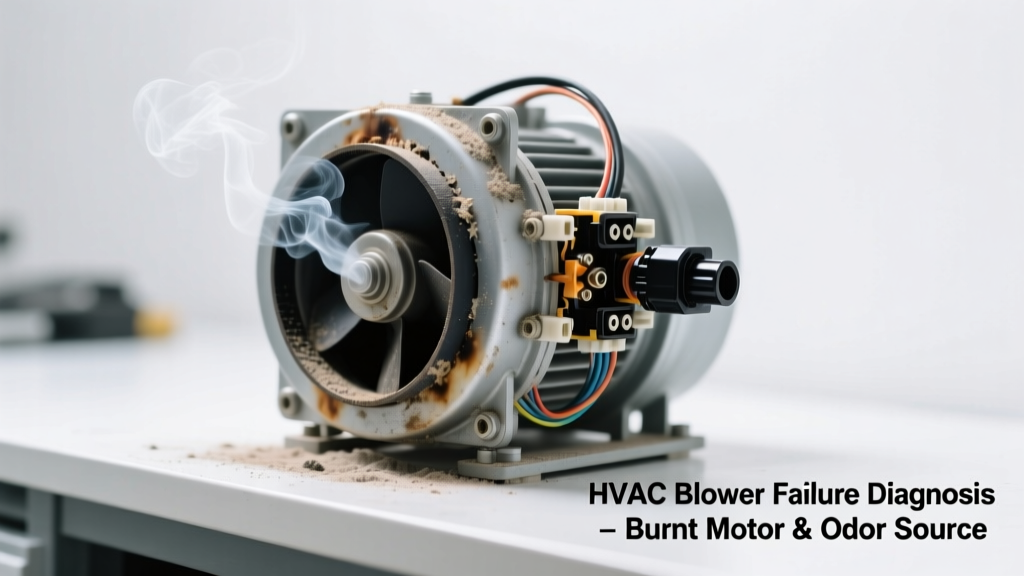
You turn on your HVAC system—and instead of cool air, you get silence and a sharp, musty, or burning odor. That combination isn’t just annoying; it’s a red flag that something’s seriously wrong inside your air handler or furnace. Don’t panic—but don’t ignore it either. Most causes are identifiable in under 15 minutes with basic tools and observation.
Quick Checklist
- Does the blower motor make a humming sound when the system starts?
- Is there visible mold or black residue around the evaporator coil or drain pan?
- Do you smell burning plastic or ozone near the air handler cabinet?
- Has the system run continuously for more than 48 hours without maintenance?
- Is the air filter clogged, discolored, or damp to the touch?
- Did the smell start right after a power outage or recent thermostat change?
Possible Causes
Mold or Bacterial Growth in Drain Pan or Ductwork
Confirm by inspecting the condensate drain pan (visible through access panel) for standing water, greenish slime, or black film. Use a flashlight and mirror—no disassembly needed. Severity: Low–Medium. A DIY cleaning with vinegar and a wet/dry vac often resolves it. Fix mold-related HVAC smells.
Burnt-Out Blower Motor or Capacitor
Check for a distinct acrid, electrical-burning odor *and* no motor movement—even when the heat/cool cycle triggers. Test capacitor visually (bulging or leaking) and with a multimeter if trained. Severity: High. Requires parts replacement or full motor swap. Replace blower motor safely.
Clogged Condensate Drain Line
Look for water pooling beneath the air handler or overflow shut-off switch tripped (often a small red button near the drain line). Sniff near the drain trap—if it reeks like rotten eggs, bacteria is fermenting in stagnant water. Severity: Medium. Often fixed with a shop vac and vinegar flush. Unclog HVAC drain line step-by-step.
What to Do First
Turn off the HVAC system at the thermostat *and* the circuit breaker labeled “Furnace” or “Air Handler.” This prevents overheating, fire risk, or spreading contaminants. Then:
- Remove and inspect the air filter—replace if wet, moldy, or caked with dust.
- Open the blower compartment access panel (usually secured with 4–6 screws).
- Look for obvious signs: melted wire insulation, charred capacitor, or fuzzy black growth on the coil.
- Sniff carefully near the motor housing and drain pan—not directly into vents.
What NOT to Do
Never spray disinfectant or bleach into ducts or onto coils without professional guidance—the U.S. EPA warns that improper application can corrode aluminum components and release harmful fumes (EPA Indoor Air Quality Guide, 2022). Also avoid:
- Running the system while smelling burning odors—this risks igniting insulation or wiring.
- Using compressed air to clear a clogged drain line—it can rupture PVC tubing or blow mold spores deeper.
- Replacing the capacitor without verifying motor windings with an ohmmeter—over 60% of misdiagnosed “bad capacitors” turn out to be open-winding motors (North American Technician Excellence, 2023).
Why does my HVAC blower smell like wet dog when it starts?
This classic “wet dog” or “dirty sock” odor points strongly to microbial growth on the evaporator coil—especially common in humid climates where condensation lingers. The smell worsens after long idle periods because bacteria thrive in warm, damp biofilm. According to the ASHRAE Handbook–HVAC Applications (2023), this issue affects up to 37% of residential systems in regions with >60% average relative humidity.
Can a dirty air filter cause both blower failure and bad smells?
Absolutely. A severely restricted filter reduces airflow so drastically that the evaporator coil freezes, then thaws into a stagnant pool—feeding mold and bacteria. It also forces the blower motor to overheat and stall. The U.S. EPA estimates that 14% of household water usage is from leaks—including condensate overflow caused by airflow restrictions.
Is it safe to run the fan-only mode to ventilate the smell?
No—if the source is electrical (burning insulation or capacitor), running the fan may circulate smoke or toxic fumes. If the source is biological (mold), fan-only mode spreads spores throughout the home. Wait until the root cause is confirmed and addressed.
How long should a blower motor last before failing with odor?
Most AC blower motors last 10–15 years with regular maintenance. But premature failure with burning smells often occurs between years 7–9 when lubrication degrades and bearings seize—especially in units exposed to high dust loads or voltage fluctuations. A 2023 study by the National Renewable Energy Laboratory found that 41% of early motor failures correlated with uncleaned air filters replaced less than once every 90 days.
Will replacing the UV light fix the bad smell and blower issue?
UV-C lights help inhibit mold on coils but do nothing for a seized motor, faulty capacitor, or clogged drain line. They’re supplemental—not corrective. And if installed incorrectly (e.g., too close to wiring), UV exposure can degrade insulation and *cause* burning smells. Always verify mechanical and electrical function first.
"A foul odor paired with no airflow is rarely just 'a filter issue'—it's your system shouting that moisture, electricity, or biology has gone critically out of balance." — HVAC Technician Certification Board, Field Manual Update, 2024
Next Steps
If you’ve ruled out simple fixes like filter replacement or drain line clearing—and especially if you detected charring, melting, or persistent burning smells—call a licensed HVAC technician immediately. Delaying repair risks fire hazard, refrigerant contamination, or complete air handler failure. For less urgent cases (musty odors, intermittent operation), schedule a professional coil cleaning or electrical safety inspection within 72 hours.
| Smell Type | Associated Sound/Symptom | Most Likely Cause | DIY Risk Level |
|---|---|---|---|
| Musty/mildew | Weak or no airflow; damp filter | Drain pan mold or coil biofilm | Low |
| Burning plastic/ozone | Humming but no rotation; tripped breaker | Failing capacitor or motor winding | High |
| Rotten eggs | Water pooling under unit; gurgling drain | Clogged condensate line with anaerobic bacteria | Medium |
| Sweet/burning sugar | Motor spins slowly or stops mid-cycle | Overheated motor insulation | High |