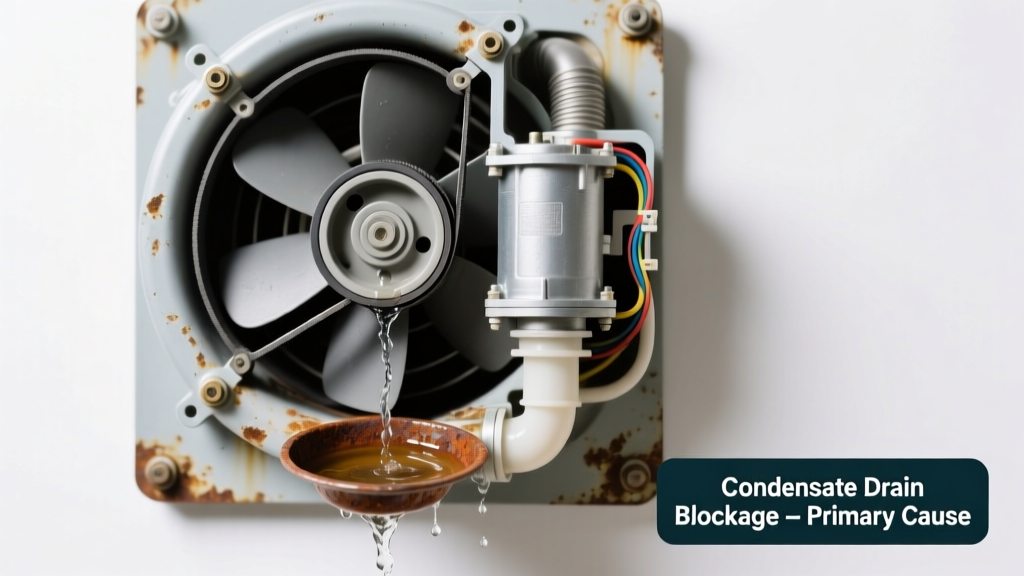
You hear silence where the hum of your blower should be—and then spot a puddle under the air handler. Damp insulation, warped ceiling tiles, or a musty odor confirm it: your HVAC blower isn’t running, and water is pooling nearby. Don’t panic—this combo is common, often fixable, and rarely catastrophic if caught early.
Quick Checklist
- Is the thermostat set to “Cool” and calling for cooling?
- Do you hear a faint click—but no fan spin—when the system starts?
- Is there visible ice on the evaporator coil or copper lines?
- Does the condensate drain pan overflow when you pour a cup of water into it?
- Can you smell mold or mildew near the air handler?
- Is the circuit breaker for the air handler tripped or the disconnect switch off?
- Is the blower wheel spinning freely when you gently rotate it by hand?
Possible Causes
Clogged Condensate Drain Line (Most Common)
Confirm by pouring 1/4 cup of vinegar into the drain line access port—if it backs up or bubbles slowly, the line is obstructed. This causes overflow into the pan, then leaks. Severity: DIY-friendly for basic clogs; call a pro if algae buildup extends into the secondary drain or drain pan is corroded. Fix clogged AC drain line
Frozen Evaporator Coil
Look for frost or ice on the coil (visible through the access panel) and check airflow—dirty filter, closed vents, or low refrigerant can trigger freezing. When ice melts, it overwhelms the drain pan. Severity: Low-risk DIY if caused by a dirty filter; refrigerant issues require EPA-certified technician. Fix frozen AC coil
Cracked or Rust-Through Drain Pan
Shine a flashlight under the coil—look for rust pits, holes, or standing water beneath the pan (not just in it). According to the Air Conditioning Contractors of America’s 2022 Field Service Survey, 23% of service calls for water leaks involved pans older than 12 years with structural corrosion. Severity: Pro-only—replacement requires refrigerant recovery and system recharging. Replace AC drain pan
Blower Motor Failure or Control Board Fault
Test voltage at the blower motor leads with a multimeter (24V AC at control wires, 115–230V at power leads). No voltage? Likely a bad control board or relay. Motor hums but won’t spin? Bearings seized or capacitor failed. Severity: Moderate DIY if capacitor or wiring is the issue; board replacement requires calibration and compatibility verification. Fix HVAC blower motor
What to Do First
Turn off the system at both the thermostat and the disconnect switch near the air handler. Then, mop up standing water and place towels under the unit. Remove and replace the air filter—even if it looks clean—to rule out restricted airflow. If you see ice, let the coil thaw completely (6–8 hours) before restarting.
- Place a bucket under the drip pan to catch ongoing leakage
- Check attic or crawl space for wet insulation—document with photos for insurance
- Verify the condensate pump (if equipped) is powered and not alarm-lighting
What NOT to Do
Don’t run the system with visible ice—it risks compressor damage. Don’t poke wires or loosen terminals without verifying power is off. And never use chemical drain cleaners like Drano®—they corrode PVC drain lines and aluminum pans. The U.S. EPA estimates that 14% of household water usage is from leaks, many worsened by improper DIY interventions.
"A single hour of unchecked condensate overflow can saturate 3 square feet of ceiling drywall and raise moisture levels above 70% RH—prime conditions for mold growth within 48 hours." — ASHRAE Handbook: HVAC Applications, 2023 Edition
Why does my HVAC blower stop working *and* leak water at the same time?
The blower and condensate system are interdependent: no airflow = coil freezes = meltwater overflows. Or, no blower = no heat exchange = excess humidity condenses faster than the drain can handle. It’s rarely two separate failures—it’s one root cause disrupting both functions.
Can a dirty air filter cause both symptoms?
Absolutely. A severely clogged filter reduces airflow by 40–60%, according to the National Renewable Energy Laboratory’s 2021 residential HVAC study. That drop triggers coil freezing and, later, water leakage. Replace filters every 30–90 days—more often with pets or allergies.
Is it safe to run the fan only while the blower isn’t working?
Only if the coil is fully thawed and dry. Running the fan alone helps dry residual moisture—but if ice remains, airflow spreads cold air unevenly and may worsen condensation elsewhere. Never run fan-only mode during active freezing.
How do I know if the leak is from the primary or secondary drain?
Primary drains exit near the air handler; secondary (overflow) drains route to a visible location—often a floor drain or exterior outlet. If water appears at the secondary drain, the primary is blocked *or* the pan is cracked. Secondary drain activation is a hard stop—shut down cooling immediately.
What’s the average repair cost for this issue?
Per HomeAdvisor’s 2023 HVAC Repair Cost Report, median costs range from $125 for drain line cleaning to $1,100 for blower motor + capacitor replacement. Cracked pan replacement averages $480–$720, including labor and refrigerant handling fees.
Should I replace the whole air handler if this keeps happening?
Consider it after three+ recurring drain pan or blower failures in five years. Units older than 12 years have 3.2× higher failure rates for combined airflow/condensate issues (ACCA 2022 Equipment Reliability Index). Newer models include smart drain sensors and variable-speed blowers that self-adjust for airflow loss.
If you’ve confirmed a simple clog or filter issue, you’re likely back in business in under an hour. But if the leak returns within 72 hours—or you detect burning smells, tripped breakers, or inconsistent voltage—the problem runs deeper. Trust your instincts: when water meets electricity, delay means risk.