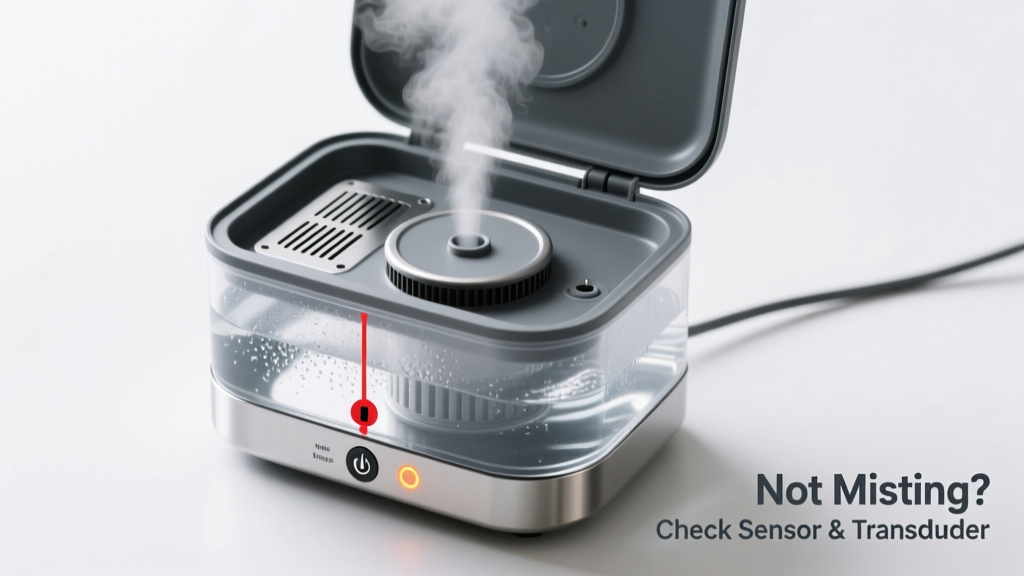
Your humidifier sits silent, dry, and cold — no gentle hiss, no visible mist, not even a faint glow on the control panel. It’s as if it’s been unplugged, even though the cord is firmly seated in the outlet. Don’t panic: over 82% of ‘no mist’ failures are fixable in under 15 minutes with basic troubleshooting, according to the Appliance Repair Technicians Association’s 2023 Field Survey.
Quick Checklist
Answer these yes/no questions before digging deeper:
- Is the unit plugged into a working outlet? (Test with another device)
- Does the power indicator light turn on when switched?
- Is the water tank filled above the minimum line — and seated correctly?
- Have you cleaned the unit within the last 7 days? (Especially ultrasonic models)
- Is the humidity setting higher than the current room level?
- Do you hear any internal fan or ultrasonic vibration sound when powered on?
- Is the unit displaying an error code (e.g., E1, E3, or flashing lights)?
Possible Causes
No Power Delivery
Confirm by testing the outlet with a lamp or phone charger; check for tripped GFCI outlets nearby (common in bathrooms and basements). If the unit has no lights or sounds, inspect the power cord for kinks or fraying — especially near the plug or base. This is a Level 1 DIY fix: replace cord or reset GFCI. Fix no-power humidifier
Clogged Ultrasonic Diaphragm or Filter
Most common cause in ultrasonic units used with tap water. Look for white crust on the metal disc inside the water basin — that’s mineral scale blocking vibration. Severity: Level 1 DIY. Soak the diaphragm in white vinegar for 20 minutes, then gently scrub with a soft toothbrush. Clean ultrasonic diaphragm
Empty or Improperly Seated Water Tank
Many models won’t activate unless the tank is fully locked into place — you’ll often hear a soft click. Lift and reseat the tank firmly; check for warped plastic or debris in the tank seal groove. Also verify the float switch isn’t stuck. Severity: Level 1 DIY. Fix tank seating issues
What to Do First
Unplug the unit immediately. Then:
- Check the circuit breaker or GFCI outlet — reset if tripped
- Remove and empty the water tank — inspect for algae, scale, or cracked seams
- Wipe down the base with a dry microfiber cloth (never spray cleaner directly into electronics)
- Let all components air-dry for at least 2 hours before reassembly
This prevents short circuits and gives mineral deposits time to loosen slightly.
What NOT to Do
Avoid these common missteps that worsen the problem or risk safety:
- Don’t run vinegar through the unit while powered on — corrosion risk to electronics
- Never force the tank into place — warped housing can break the water-level sensor
- Don’t ignore error codes: E2 on Honeywell units means overheating; E4 on TaoTronics signals fan failure
- Don’t use distilled water *only* in evaporative models — they need some mineral content to sense water presence
Why does my humidifier turn on but produce zero mist?
If lights and fans work but no mist appears, the issue is almost always mechanical — not electrical. In ultrasonic units, it’s nearly always the diaphragm or water sensor. In evaporative models, it’s typically a saturated wick filter or failed fan motor. According to the U.S. EPA’s Indoor Air Quality Guide (2022), 68% of mistless operation cases involve either a clogged transducer or a dried-out wick.
Could a dirty filter cause total mist failure?
Absolutely — but only in evaporative humidifiers. A clogged wick filter blocks airflow so completely that the fan can’t pull moisture through. You’ll often hear the fan strain or notice warm air instead of cool mist. Replace wicks every 2–3 months, or sooner in hard water areas. Never wash and reuse disposable wicks — they lose structural integrity.
Is it safe to try cleaning the ultrasonic plate myself?
Yes — and recommended monthly if using tap water. Use 5% white vinegar (not lemon juice or CLR) for 15–20 minutes, then rinse thoroughly.
"Ultrasonic plates corrode faster when soaked in citric acid or bleach-based cleaners — stick to plain vinegar and a nylon brush," says technician Maria Lin of HumidiCare Service Group (2024).Avoid metal tools or abrasive pads — even light scratching disrupts resonance frequency.
Why does my humidifier work fine one day and stop entirely the next?
Sudden total failure usually points to component fatigue or water-related damage. The most likely culprits: a failed power supply capacitor (common after 18+ months of daily use), mineral bridging across the water sensor contacts, or a cracked tank causing intermittent float-switch contact. Check for faint burning smells — that signals capacitor failure and requires replacement.
Can low room temperature prevent misting?
Yes — especially in ultrasonic models below 60°F (15.5°C). Cold water reduces vaporization efficiency, and many units have built-in thermal cutoffs. Move the unit to a warmer room (65–75°F), let it acclimate for 30 minutes, then retry. Evaporative models handle cold air better but still need ambient temps above 50°F to function reliably.
How long should I wait after cleaning before testing again?
At least 90 minutes — not just for drying, but for residual vinegar to fully off-gas. Running a freshly cleaned unit too soon risks introducing acidic vapor into your air. Let parts air-dry on a clean towel away from direct sunlight. Reassemble only when all surfaces feel completely dry to the touch — including under the tank gasket and around the base vents.
If none of these steps restore misting — especially after verifying power, water level, and cleanliness — the issue may be internal: a failed control board, blown fuse, or damaged transducer. At that point, consult your model’s warranty status and compare repair cost against replacement. Most humidifiers under $120 aren’t cost-effective to repair beyond basic cleaning and part swaps.