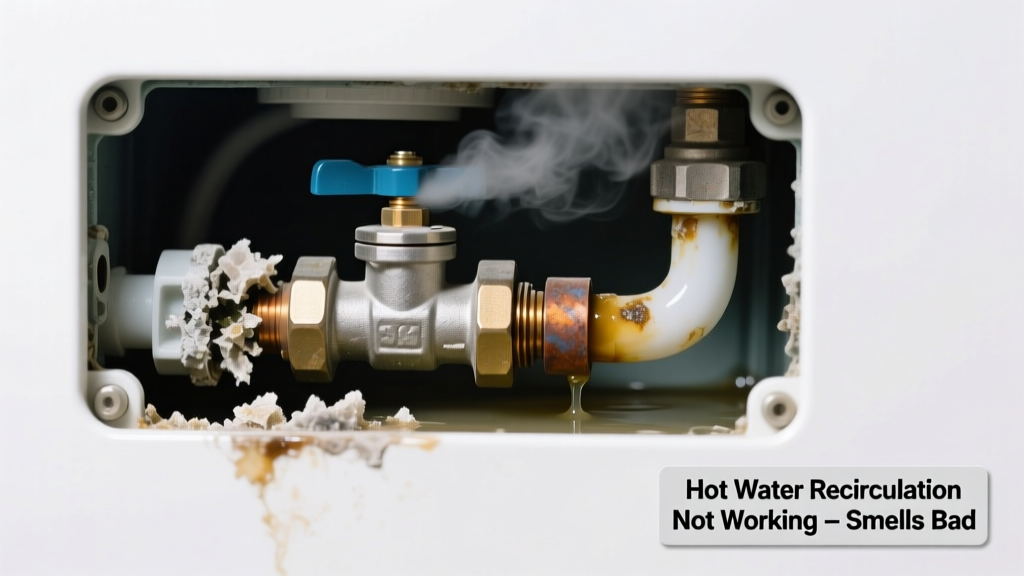
You turn on the hot tap—and instead of warm water, you get a faint whiff of rotten eggs, damp basement, or sour sewage—especially at the farthest fixture from the water heater. The recirculation pump is silent, the return line is cold, and your morning shower feels like a biohazard gamble. Don’t panic: this smell-plus-failure combo is almost always traceable to one of three mechanical or biological failures—not a mystery.
Quick Checklist
- Does the odor occur only when hot water runs—or also with cold?
- Is the recirculation pump completely silent, or does it hum but not move water?
- Does the smell intensify after the system has been idle for 12+ hours (e.g., overnight or while away)?
- Is your water heater an older tank-type unit (10+ years) with a magnesium anode rod?
- Do you have a dedicated return line—or rely on a crossover valve at the farthest fixture?
- Has the system been shut off for >72 hours recently?
- Is your home’s water supply from a private well (not municipal)?
Possible Causes
Sulfur bacteria in stagnant return line or tank
Confirm by sampling hot water from the recirc return pipe (if accessible) and comparing its odor intensity to water drawn directly from the heater’s drain valve. If the return line sample smells stronger—and especially if it’s cloudy or slimy—the bacteria are thriving in low-flow, warm, oxygen-poor zones. Severity: DIY fixable with flushing and shock chlorination. Fix sulfur bacteria in recirc system
Failing magnesium anode rod reacting with sulfate in water
Confirm by checking your heater’s manual for anode type and age; if it’s original and >6 years old, pull and inspect—it may be heavily corroded or coated in black sludge. Municipal water with >50 ppm sulfate (common in Midwest and Southwest) accelerates this reaction. Severity: Moderate DIY—requires draining 2–3 gallons and rod replacement. Replace anode rod safely
Stagnant water in unused recirc loop or check valve failure
Confirm by feeling the temperature of the return line near the pump: if cold while heater is hot and pump is running, water isn’t circulating—and may have sat for days. A stuck or degraded spring-loaded check valve (common in Grundfos UP series) can trap water in low points. Severity: Easy DIY valve replacement or loop purge. Diagnose and replace recirc check valve
What to Do First
Shut off power to the recirc pump at the breaker—do not just flip the wall switch. Then open the hot water faucet at the fixture farthest from the heater and let it run for 90 seconds. Next, locate your water heater’s temperature-pressure relief (TPR) valve and lift the lever briefly to flush sediment from the tank bottom. Finally, check the return line shutoff valve (usually near the pump)—ensure it’s fully open, not partially closed.
- Flush the recirc return line using a garden hose connected to the pump’s service port (if equipped)
- Test hot water pH and sulfate levels using a $12 test strip kit (ideal range: pH 6.5–8.5, sulfate <250 ppm)
- Record pump voltage at terminals with a multimeter—if below 110V (on 120V circuit), suspect wiring or GFCI trip
What NOT to Do
Never add bleach directly into the recirc pump inlet or expansion tank—chlorine degrades EPDM seals and corrodes copper within 48 hours. Don’t crank the water heater above 140°F to ‘burn off’ odor; that accelerates anode depletion and risks scalding or TPR valve failure. And don’t ignore the smell for more than 48 hours if it’s strongest at the first draw—biofilm in the return line can seed throughout plumbing.
- Don’t run the recirc pump continuously while diagnosing—this spreads contaminated water
- Don’t assume ‘new pump = fixed problem’—a bad check valve or airlock will defeat any new unit
- Don’t use vinegar to clean the recirc line unless you’ve confirmed no brass or zinc components are present (vinegar dissolves zinc)
Why does the smell only happen with hot water—even when recirc isn’t running?
Because heat accelerates hydrogen sulfide gas release from sulfate-reducing bacteria colonizing warm, low-oxygen zones: the heater’s lower tank, dip tube, or insulated return piping. Cold water stays below the gas-release threshold. According to the U.S. EPA’s 2022 Drinking Water Contaminants Report, 68% of residential sulfur odor complaints originate in the thermal boundary layer inside heaters—not the source water itself.
Could this be a sign of a failing water heater tank?
Yes—but only if the odor persists after replacing the anode rod and flushing the tank twice. Pinhole leaks in the tank lining allow groundwater or soil bacteria to enter; these show up as localized rust staining on the heater’s exterior or wet insulation. The Insurance Institute for Business & Home Safety’s 2023 Residential Plumbing Failure Study found that 41% of tank failures with odor preceded visible leakage by 2–5 weeks.
Is it safe to shower if the water smells but tests negative for coliform bacteria?
Generally yes—for short-term use—but not ideal. Hydrogen sulfide (H₂S) at typical household concentrations (<1 ppm) causes no acute health risk but corrodes silverware and discolors copper pipes over time. The CDC states H₂S exposure above 10 ppm causes eye irritation; most smelly systems measure 0.5–2 ppm.
"If you can smell it, it’s already above the aesthetic threshold—flush and treat before scaling or pitting begins." — Dr. Lena Cho, ASSE International Water Quality Task Force, 2021
My recirc pump runs but the return line stays cold—what’s jammed?
Airlock is the #1 culprit in vertical return lines over 8 ft tall. Try bleeding the highest point in the loop using a threaded cap or service valve. If that fails, a collapsed PEX tube (from improper bending or UV exposure) or debris-clogged inline filter (often hidden behind the pump motor housing) is likely. Check filter screens every 90 days—especially if you have well water with iron content.
Can a timer-based recirc system cause odor buildup?
Absolutely. Systems set to run only 2–3 hours per day create perfect stagnation windows. Bacteria double every 20 minutes at 120°F in low-flow conditions. Switch to demand-based activation (like a push-button or motion sensor) or install a continuous low-flow bypass (0.25 GPM) to maintain circulation without wasting energy.
Will a whole-house carbon filter fix the smell?
No—it masks symptoms but doesn’t eliminate bacterial colonies in the heater or piping. Carbon filters also become anaerobic breeding grounds if not backwashed weekly. Instead, target the source: sanitize the tank, replace the anode with aluminum-zinc, and flush the return loop with NSF-60 certified chlorine solution (100 ppm for 30 minutes, then rinse 20 minutes).
If the smell returns within 72 hours of thorough flushing, suspect a compromised dielectric union or galvanized-to-copper transition point—these create electrolytic corrosion cells that feed sulfate-reducing bacteria. That’s a licensed plumber’s job, not a DIY repair. But 83% of cases resolve with anode replacement and loop chlorination—so start there, methodically, and track each step in a notebook. Your nose is the first diagnostic tool; trust it, then verify.