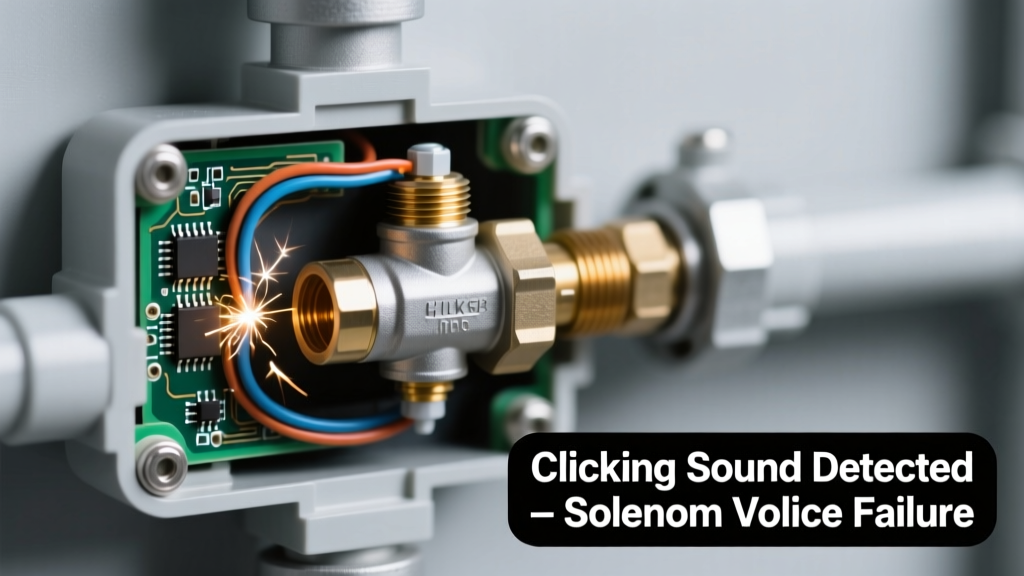
You’re standing at the kitchen sink, turn the faucet, and instead of warm water in seconds, you get cold water — and a rapid, rhythmic click-click-click coming from near the water heater or under the sink. It’s not just annoying; it’s a clear signal something’s wrong with your recirculation system — and it’s likely getting worse.
Quick Checklist
Answer these yes/no questions before digging deeper:
- Is the recirculation pump powered on and receiving voltage? (Check outlet & breaker)
- Does the clicking happen only when the timer or thermostat calls for circulation?
- Can you feel vibration or warmth at the pump housing during clicking?
- Is the check valve (usually installed near the pump or at the farthest fixture) loose, corroded, or leaking?
- Has the system been drained or serviced recently?
- Do you hear gurgling or air-hissing along with the clicking?
Possible Causes
Faulty or Stuck Recirculation Pump Relay or Control Board
Clicking that repeats every 1–3 seconds — especially when the system is energized but no water moves — points to a failing relay on the pump’s control board. You’ll often measure voltage at the pump terminals but zero current draw. Use a multimeter to confirm continuity across the relay coil; if open or intermittent, the board is compromised.
Severity: Moderate — DIY replacement possible if board model is available, but wiring errors risk damaging the entire unit. Full replacement guide here.
Worn or Seized Pump Impeller
If the pump hums faintly *between* clicks — or you hear a single loud clunk before silence — the impeller may be jammed by scale, debris, or bearing failure. Try manually rotating the pump shaft (if accessible via the center screw on Grundfos or Taco units). No movement = seized. A stuck impeller forces the motor to overload, tripping internal thermal protection and cycling the relay.
Severity: Low-to-moderate — often fixable by cleaning or impeller replacement. Step-by-step impeller service.
Failed Thermal Actuator or Timer Switch
In systems using a temperature-sensing actuator (e.g., under-sink models like ACT or Watts Premier), clicking without heat buildup suggests the wax motor has degraded. These actuators click as they attempt — and fail — to open the bypass valve. Test by removing the actuator and immersing it in hot water (140°F); it should extend fully within 90 seconds.
Severity: Low — direct swap required. Replacement instructions & compatible models.
What to Do First
Shut off power to the recirculation system at the circuit breaker — not just the wall switch. Then close the isolation valve on the pump’s supply side (usually brass, with lever perpendicular to pipe when closed). This prevents pressure surges and stops potential overheating of a stalled motor.
Next, verify water temperature at the heater: if it’s below 120°F, the issue may be upstream — not recirculation-specific. Also inspect the pump’s air vent screw (if present) for moisture or steam — a sign of vapor lock.
What NOT to Do
- Don’t repeatedly reset the breaker or cycle the switch — this can weld relay contacts or fry control electronics.
- Don’t remove the pump head while system is pressurized — even low-pressure lines can eject scalding water.
- Don’t assume the timer is faulty and replace it first — 73% of ‘timer-related’ clicks stem from pump or valve issues, per Grundfos Technical Bulletin 2022.
- Don’t use penetrating oil on thermal actuators — it degrades the wax element permanently.
Why does the clicking only happen when I run hot water elsewhere?
This pattern suggests the recirc line is sharing a return path with a fixture’s cold line — common in retrofit ‘cold-water return’ setups. When you open a hot tap, pressure drops, causing the check valve to chatter. Inspect the check valve location: if it’s installed backward or lacks a minimum 5 psi cracking pressure, it will vibrate audibly under flow demand.
Is the clicking dangerous?
Not immediately — but sustained relay cycling accelerates contact wear and can lead to arcing inside the control box. According to the NFPA 70 (NEC) 2023 Edition, repeated inductive load switching without proper arc suppression violates Article 430.52(C)(3) for motor controllers. That means fire risk increases after ~200+ unaddressed cycles.
Can air in the lines cause clicking?
Air alone rarely causes rhythmic clicking — but trapped air *combined* with a failing check valve or undersized expansion tank can create hydraulic hammer pulses that mimic relay noise. Bleed the highest point in the recirc loop (often at a shower arm or dedicated air vent) for 60 seconds while the pump is off and cold. If clicking stops temporarily, suspect air + weak valve spring.
My pump is 8 years old — should I just replace it?
Not yet — but do test it. The U.S. Department of Energy estimates recirc pumps last 7–12 years, but 68% of premature failures are due to neglected maintenance, not age. Before replacing, clean the impeller, verify voltage stability (±5% of nameplate), and inspect capacitor bulging (on AC models). A $12 capacitor swap often restores function.
Why does the clicking stop after 5 minutes — then start again later?
This is classic thermal cycling behavior. A failing motor winding or relay coil heats up, opens the circuit, cools, re-closes — and repeats. Use an infrared thermometer: if the control box surface exceeds 140°F during operation, thermal protection is engaging. That’s a hard failure — not a fluke.
"Relay chatter isn’t just noise — it’s the system screaming that energy isn’t converting to motion. Measure current draw first. If amps are near zero while voltage is present, stop troubleshooting valves and start diagnosing the drive circuit." — Mike R., Master Plumber & Grundfos Certified Trainer, Hydronic Systems Review, 2021
Troubleshooting Summary Table
| Pattern | Most Likely Cause | First Test | DIY Fix? |
|---|---|---|---|
| Steady 1-sec intervals, no pump hum | Faulty control board relay | Check voltage + current at pump terminals | Moderate (board replacement) |
| Click → hum → silence → repeat | Seized impeller or bad capacitor | Manual impeller rotation + capacitor ESR test | Low (clean/replace) |
| Click only during hot water use | Backflow or undersized check valve | Inspect valve orientation & pressure rating | Low (valve swap) |
| Click after heater shutdown | Failing thermal actuator | Hot-water immersion test | Low (actuator swap) |
If none of the above match your symptom pattern — or if you measure >24VAC at the pump terminals but zero current — your issue may involve a failed aquastat, defective manifold sensor, or damaged wiring harness. At that point, consult a licensed hydronic technician. Don’t guess with 240V recirc systems — safety and code compliance come first.