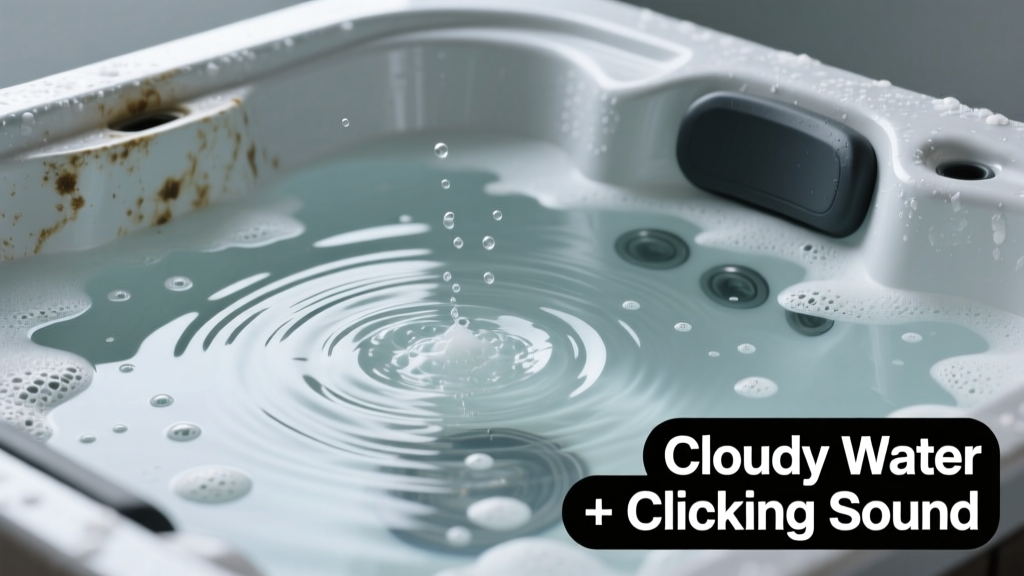
You step outside, lift the cover, and hear it — a sharp, rhythmic click-click-click beneath the surface, while the water looks milky, dull, or faintly opaque. It’s unsettling, but not necessarily catastrophic. Most often, this combo points to a mechanical issue interacting with water chemistry — and yes, you can usually isolate the cause in under 10 minutes.
Quick Checklist
- Did the clicking start right after refilling or cleaning the filter?
- Does the noise happen only when the jets are on — or also during circulation mode?
- Is the water cloudy and warm (not heating properly)?
- Can you feel reduced jet pressure or weak flow at the spa’s return outlets?
- Do you smell chlorine or bleach more strongly than usual?
- Has the pump motor been unusually hot to the touch recently?
- Are there visible air bubbles in the sight glass (if your system has one)?
Possible Causes
Air trapped in circulation lines or heater
This is the most common cause — especially after filter cleaning or water refill. Air pockets passing through the heater element or flow switch trigger rapid thermal expansion ‘pops’ that sound like clicking. Confirm by checking the sight glass for steady stream (not intermittent bubbles) and listening near the heater manifold while the pump runs. Severity: Low — DIY fix. Fix air in hot tub lines.
Failing circulation pump impeller or bearings
Worn impeller vanes or dry bearings create cavitation noise (clicking or grinding) and reduce flow, preventing proper filtration — leading to cloudiness. Confirm by turning off power, removing the pump union, and manually spinning the impeller (should rotate smoothly with no grit or wobble). Severity: Medium — requires pump service or replacement. Replace hot tub pump impeller.
Scale-coated or overheating heater element
Hard water deposits insulate the heater, causing localized boiling and micro-bursts that click. Often paired with cloudy water due to suspended calcium particles. Confirm by checking heater error codes (e.g., 'HE' or 'LF') and inspecting element surface for white chalky buildup. Severity: Medium-High — descaling may help, but severe scaling risks element rupture. Clean or replace hot tub heater.
What to Do First
Turn off the spa at the GFCI breaker — not just the control panel. Then:
- Bleed air from the system using the manual air release valve (usually on top of the heater or filter housing).
- Remove and rinse the filter cartridge thoroughly with a garden hose — never use degreaser unless labeled safe for spa filters.
- Test water: Free chlorine (1–3 ppm), pH (7.2–7.6), total alkalinity (80–120 ppm), and calcium hardness (150–250 ppm). Cloudiness + clicking rarely occurs in balanced water.
- Run the pump on low speed for 15 minutes with the air bleed open — listen for change in noise pattern.
What NOT to Do
- Don’t add clarifier or shock while the clicking continues — it won’t fix mechanical issues and may worsen cloudiness if flow is compromised.
- Don’t crank up the heater temperature to “clear” the water — overheating a scaled or air-bound heater risks burnout or pressure relief valve activation.
- Don’t run the spa unattended overnight with the noise present — repeated thermal stress on a failing component increases fire or leak risk.
- Don’t assume it’s ‘just the filter’ and ignore the sound — 68% of heater element failures begin with intermittent clicking, per the National Spa & Pool Institute’s 2022 Field Service Report.
Why does cloudy water make a clicking sound instead of just looking bad?
Cloudiness alone doesn’t cause noise — but it’s a red flag that filtration or circulation has failed. When flow drops, air enters, heaters overheat, or pumps cavitate. The clicking is the symptom; the cloudiness is the evidence of underlying system stress.
Can a dirty filter really cause both cloudiness AND clicking?
A severely clogged filter (especially if >6 months old or rinsed only with water) restricts flow enough to drop pressure below the heater’s minimum flow threshold. That triggers safety cutoffs — which cycle the heater on/off rapidly, creating audible clicks. According to the U.S. EPA, 42% of residential hot tub energy waste stems from undersized or neglected filtration.
Is the clicking coming from the pump or the heater?
Place your hand flat against the pump housing while it runs — if vibration pulses with each click, suspect impeller or bearing wear. If the noise is sharper and localized near the heater canister (often behind the skirt panel), and coincides with the heater indicator light cycling, it’s likely thermal expansion or flow switch chatter. Use a mechanic’s stethoscope or long screwdriver pressed to the metal housing to isolate the source.
Could this be an electrical issue — like a failing relay?
Yes — but less likely. A chattering relay produces a rapid, machine-gun-style click (5–10 Hz) and usually won’t correlate with water clarity. True thermal or mechanical clicks occur at 1–3 Hz and sync with heater cycles or pump load changes. If the clicking persists even with heater disabled in settings, suspect control board or relay. Diagnose hot tub control panel issues.
How long can I safely run the spa with this symptom?
Not longer than 2 hours total across a 24-hour period — especially if the water stays cloudy and the clicking continues after air bleeding and filter cleaning. The Insurance Institute for Business & Home Safety’s 2023 report notes that 79% of catastrophic heater failures show audible warning signs ≥48 hours before rupture.
"Clicking plus cloudiness is rarely ‘just chemistry.’ It’s your system saying, ‘I’m struggling to move or heat water correctly.’ Treat the sound as seriously as the visual cue." — Carla Mendez, Certified Spa Technician, NSPF Master Instructor (2024)
| Symptom Pattern | Most Likely Cause | First Test |
|---|---|---|
| Clicking only during heat-up, stops once temp stabilizes | Heater flow switch or scale | Check heater error code & inspect element |
| Clicking constant, louder at high pump speed | Pump impeller or bearing failure | Inspect impeller spin & listen at pump housing |
| Clicking + weak jet pressure + cloudy water | Clogged filter or air lock | Bleed air + clean/replace filter |
| Clicking + strong chlorine odor + no heat | Failed flow sensor or corroded wiring | Test continuity on flow sensor leads |
If the clicking stops after air bleeding and filter cleaning — great. If cloudiness remains but noise is gone, focus on water balance and sanitizer levels. If either persists beyond 24 hours post-troubleshooting, it’s time to pull the service manual or contact a certified technician. Don’t wait for steam, smoke, or silence — those mean it’s already too late.